The #1 Mistake Beginners Make: One Model for Everything
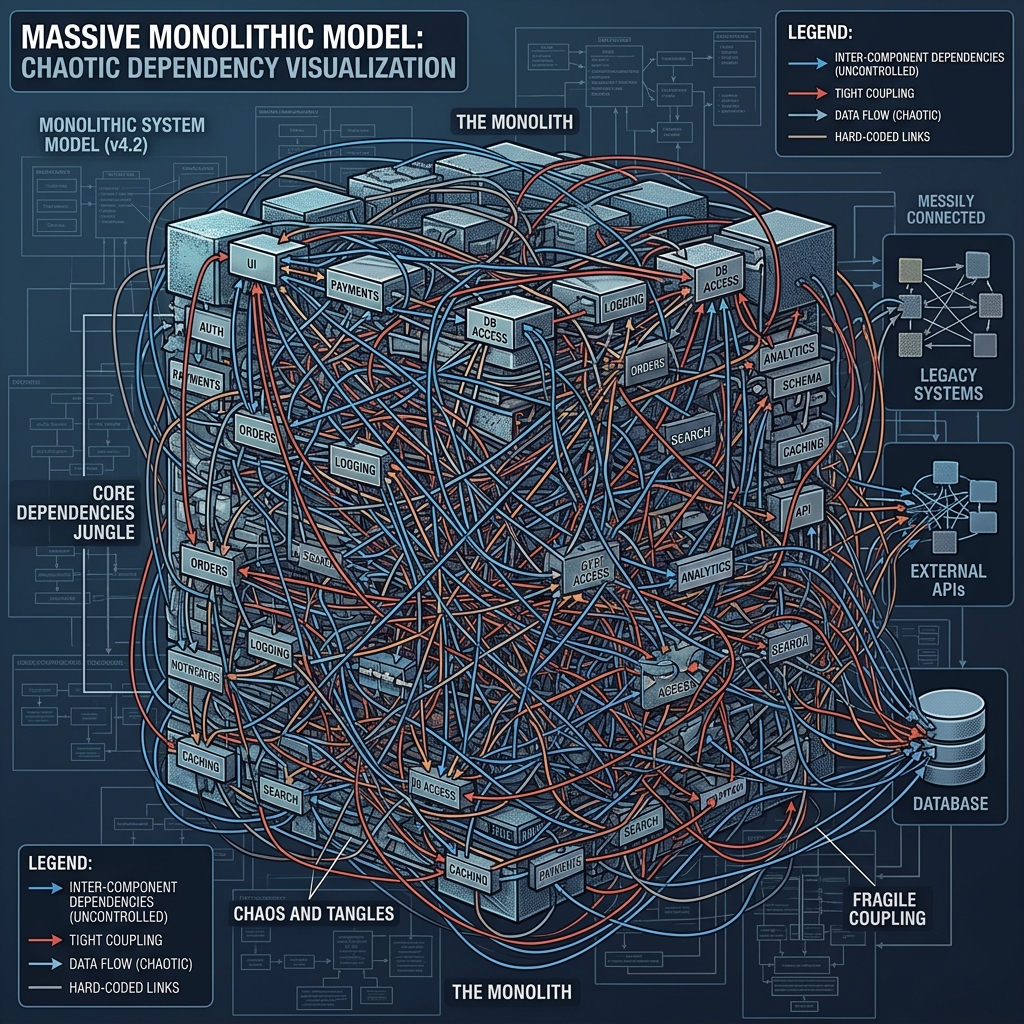
When software engineers first learn Domain-Driven Design (DDD), they make one frequent mistake. They try to design one single, unified domain model for their entire enterprise. They create massive Java classes with dozens of properties. For example, they build a single User or Customer entity. That single class holds fields for user authentication, password hashes, shipping street addresses, credit card tokens, tax exemption numbers, marketing email preferences, and order tracking histories.
This approach leads directly to what software architects call a Big Ball of Mud. A Big Ball of Mud is an application where all parts depend on all other parts. There are no clear boundaries. Everything is coupled. Every time the finance team asks for a small change to tax calculation, the developers accidentally break shipping label generation. Why does this happen? Because both departments share the exact same entity class, the same Hibernate mapping, and the same database table.
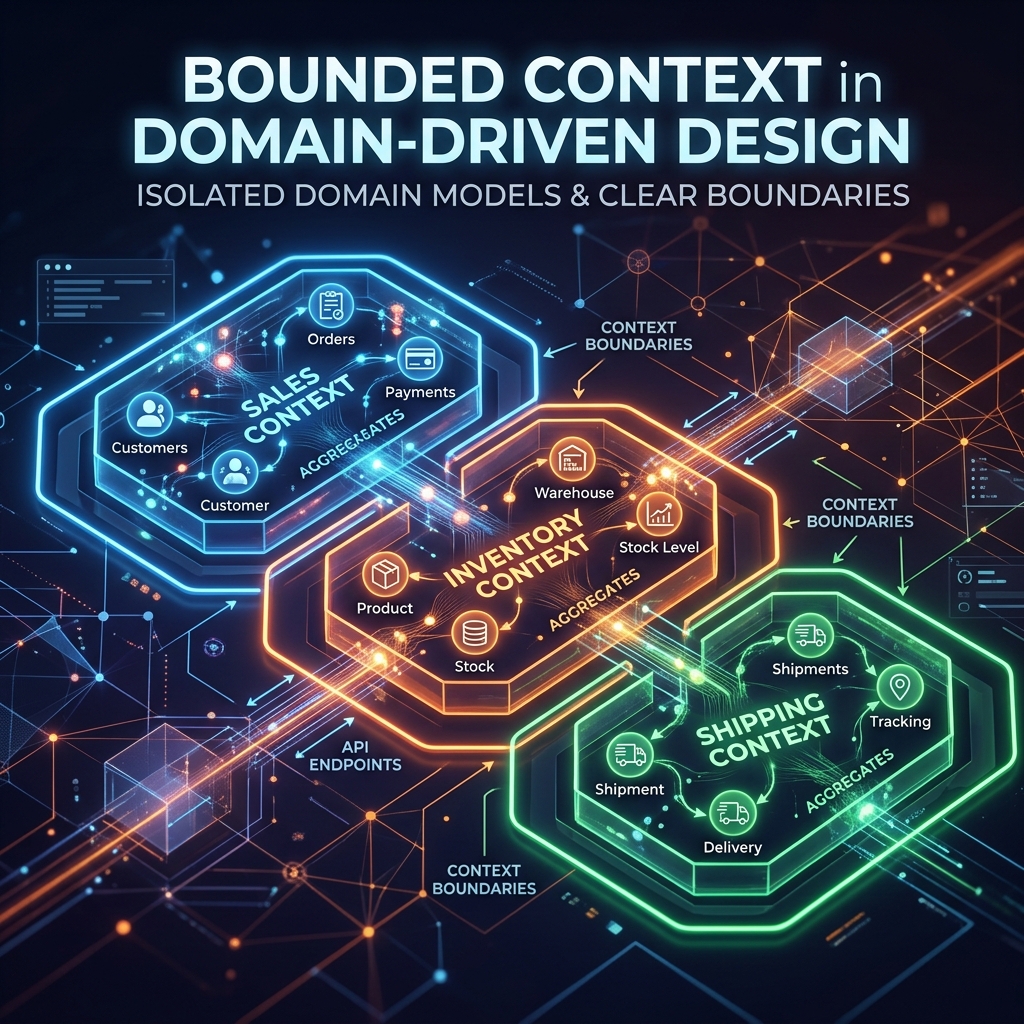
In high-growth companies, this tight coupling creates severe problems. Development velocity grinds to a halt. Teams block each other during pull request reviews. Database migrations become terrifying events because altering one column requires coordinated testing across ten different business teams. This is why Bounded Contexts are the most important strategic concept in Domain-Driven Design. A Bounded Context splits a large, unwieldy system into clear, autonomous pieces. Each piece has its own model, its own language, and its own database tables.
Analogy: Departments in a Company
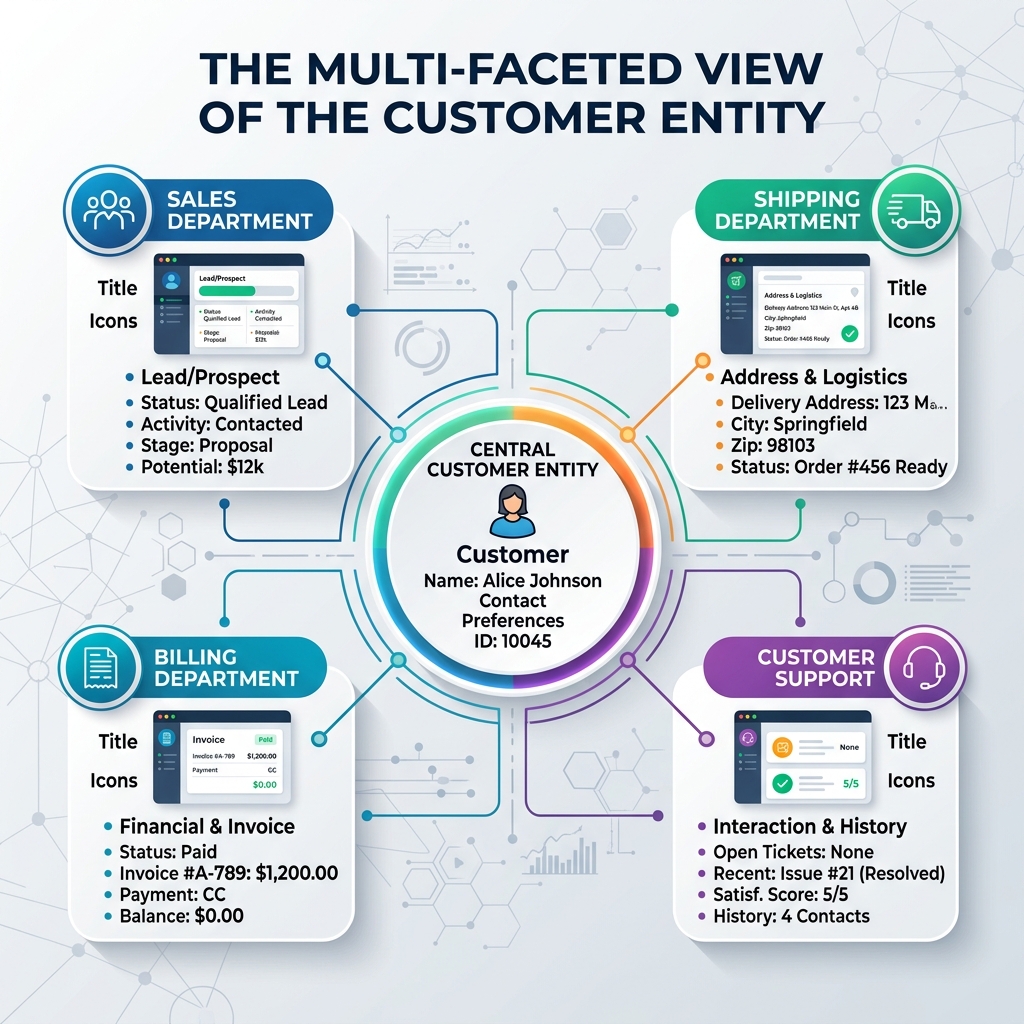
To understand Bounded Contexts intuitively, consider how a real-world enterprise operates. Think about the word Customer. In everyday conversation, we assume everyone knows what a customer is. But inside a medium or large enterprise, that single word has completely different meanings depending on which department you interview.
The Sales Department Perspective
In the Sales Department, a Customer is a sales lead or a business prospect. The sales team wants to know the customer’s full name, company name, corporate email address, annual software budget, and deal pipeline stage. They track when the last phone call took place and the likelihood of closing a sale this quarter. The sales representative does not care about warehouse shipping boxes, postal carrier tracking barcodes, or database primary keys.
The Support Department Perspective
In the Customer Support Department, a Customer is a user who needs technical assistance. The support agent cares about open trouble tickets, service level agreement (SLA) timers, warranty contracts, and customer satisfaction ratings. They need to know which software version the customer runs and their recent chat transcripts. The support agent does not care about the customer’s annual procurement budget or how the sales team qualified the lead.
The Shipping Department Perspective
In the Logistics and Shipping Department, a Customer is merely a physical delivery destination. The warehouse staff cares about the recipient name, street address, postal code, apartment buzzer number, parcel weight, and delivery carrier preferences. The forklift driver does not care about sales commission rates, warranty agreements, or billing invoice numbers.
The Billing Department Perspective
In the Accounting and Billing Department, a Customer is a legal payment party. The accountants care about company tax identification numbers (VAT/EIN), credit card payment gateway tokens, bank account IBAN numbers, currency exchange rates, payment terms (such as Net 30), and billing addresses. The billing specialist does not care about what color shirt the customer ordered or what delivery route the truck took.
Notice what happened here: each department uses the exact same word—Customer—yet the underlying data, behavior, rules, and lifecycle are completely different. If you force all four departments to share a single, massive Customer.java file and a single customers database table, you create confusion, bugs, and endless merge conflicts. Bounded Contexts solve this problem by giving each department its own dedicated, clean domain model.
What is a Bounded Context? (Visual Definition)
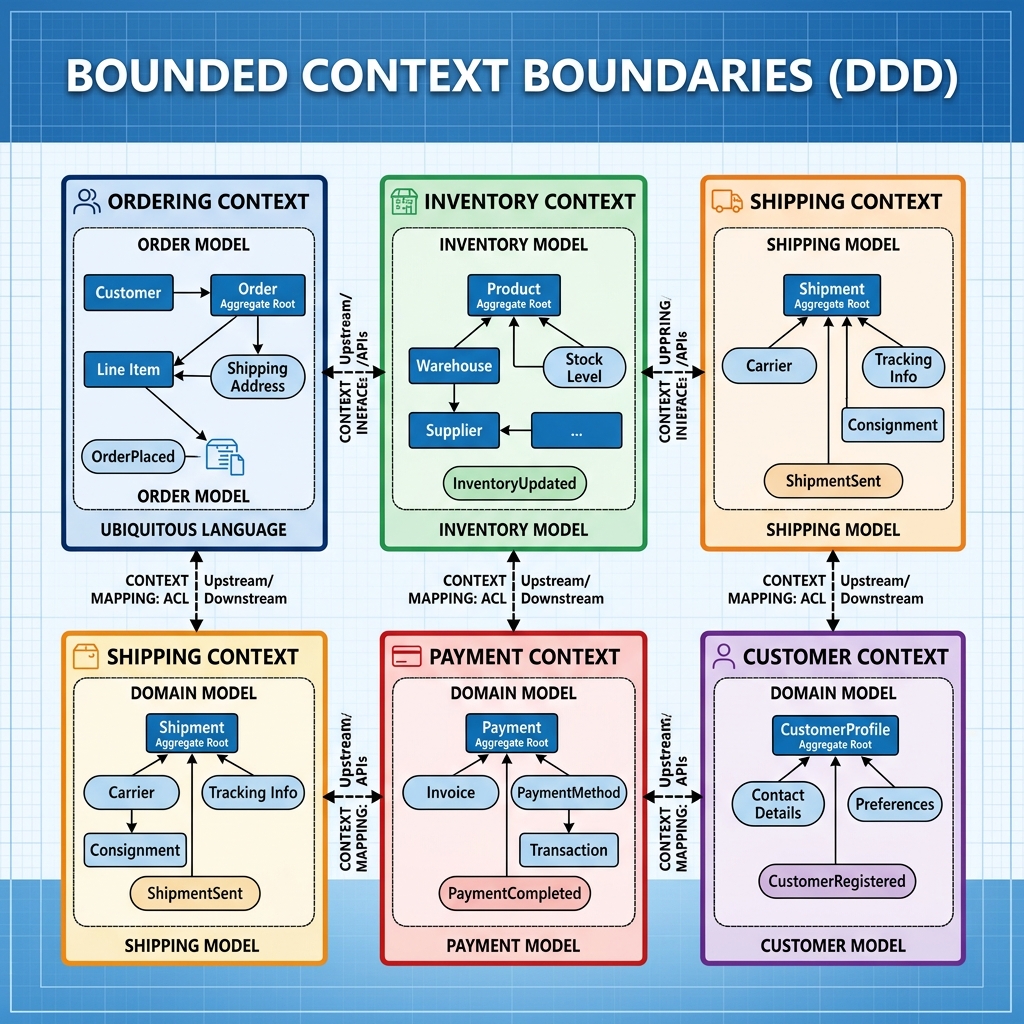
In Domain-Driven Design, a Bounded Context is an explicit boundary within which a specific domain model applies. Inside that boundary, every word, entity, and business rule has one single, unambiguous meaning. Outside that boundary, those exact words may mean something else, or they may not exist at all.
A Bounded Context acts as a protective shield. It isolates the domain logic of one business capability from the domain logic of another. When you work inside the Order context, the word Product means an item snapshot with an immutable price and quantity. When you work inside the Catalog context, Product means a rich marketing listing with high-resolution photos, category hierarchies, and SEO descriptions. Neither context is allowed to pollute the other.
This separation is not just a nice way to organize folders. It is a fundamental strategy for managing software complexity. By giving each business capability its own Bounded Context, teams can develop, test, and refactor their models independently. When the Catalog team adds a new photo gallery feature, they do not touch the Order team’s database or code.
Ubiquitous Language and Linguistic Boundaries
At the heart of every Bounded Context lies the Ubiquitous Language. The Ubiquitous Language is a shared, rigorous vocabulary created collaboratively by software developers and business domain experts. It is not technical jargon like DTO, DAO, or ORM Entity. Nor is it vague business buzzwords. It is a precise language spoken in daily conversations, written in design documents, and reflected directly in class names, method names, and database column names.
However, Eric Evans—the creator of Domain-Driven Design—made a critical discovery: a Ubiquitous Language cannot remain pure across an entire large organization. As soon as you try to make a language universal across sales, billing, shipping, and inventory, words become ambiguous. Compromises are made. Class names become vague, like CustomerGeneralData or OrderCompositeManager.
This is why Bounded Contexts are linguistic boundaries first and foremost. The boundary sets the perimeter within which the Ubiquitous Language remains 100% consistent and strictly defined. When you cross the boundary into another context, the language changes. Understanding this prevents the trap of trying to build an impossible universal data dictionary for your enterprise.
Comparative Boundary Matrix: Bounded Context vs Other Architecture Units
Developers often ask how a Bounded Context relates to other common architectural concepts like subdomains, microservices, Java packages, or database schemas. The following comparative matrix clarifies the differences across six key technical dimensions:
| Architectural Concept | Primary Dimension | Scope & Granularity | Data Boundary | Linguistic Boundary | Typical Implementation in Java |
|---|---|---|---|---|---|
| Subdomain | Problem Space (Business) | A distinct area of business capability (Core, Supporting, or Generic). | Conceptual business data. | General business dialect. | High-level enterprise architecture diagram or business specification. |
| Bounded Context | Solution Space (Software Design) | A boundary enclosing one cohesive domain model and its Ubiquitous Language. | Strictly isolated database tables or dedicated schema. | Strict, unambiguous Ubiquitous Language. | Top-level Java package in a modular monolith or independent Git repository. |
| Microservice | Deployment & Operations | An independently deployable artifact running in its own OS process or container. | Dedicated physical database instance or private schema. | Network API contract (REST JSON, Protobuf, gRPC). | Standalone Spring Boot application running in a Docker container. |
| Java Module / Package | Code Organization | A namespace grouping related Java classes and controlling visibility. | None (can access any database table if unchecked). | None (merely a technical naming convention). | Standard package such as com.webcodein.boundedcontext.catalog. |
| Database Schema | Data Persistence | A physical or logical grouping of database tables, views, and indexes. | Foreign key constraints and SQL table definitions. | SQL table and column naming conventions. | PostgreSQL schema (e.g., catalog.* vs orders.*) or distinct DB. |
| Hexagonal Layer | Internal Component Structure | Separation of pure domain logic from technical infrastructure (ports & adapters). | Domain models never contain database annotations. | Enforces domain rules independent of framework types. | Subpackages within a context: domain, application, infrastructure. |
As the table demonstrates, a Bounded Context is a logical software design boundary. You do not need microservices to have Bounded Contexts. In fact, hosting multiple Bounded Contexts inside a well-structured Spring Boot Modular Monolith is often the best architectural choice for most development teams.
Strategic Context Mapping: How Bounded Contexts Communicate
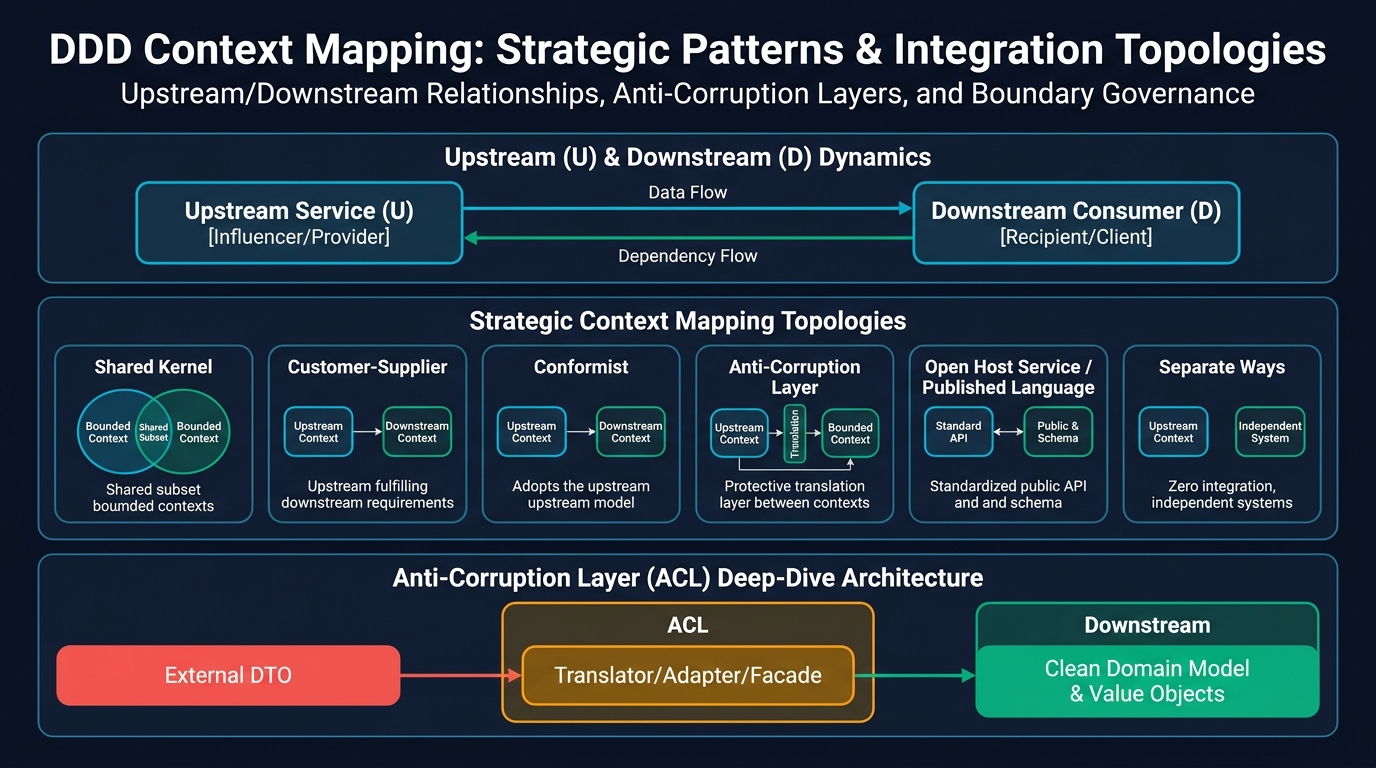
Because each Bounded Context maintains its own distinct domain model, they cannot share database tables or entity references directly. When two contexts need to collaborate to complete a business process, they must communicate across their boundaries. In Strategic DDD, this practice is called Context Mapping.
Upstream (U) and Downstream (D) Dynamics
Whenever two Bounded Contexts communicate, there is an Upstream (U) service and a Downstream (D) consumer. The upstream context delivers data or triggers events. The downstream context receives data or reacts to events. Upstream actions influence the downstream system, but downstream actions rarely dictate upstream behavior directly. Understanding who has organizational and technical leverage determines which integration pattern to apply.
Anti-Corruption Layer (ACL)
An Anti-Corruption Layer (ACL) is the most important defensive pattern in Context Mapping. When a downstream context must consume data from an upstream system with a messy, legacy, or foreign domain model, the downstream context builds an ACL translator. The ACL converts foreign data structures into the downstream context’s clean, native domain concepts. If the upstream API changes its schema tomorrow, only the ACL adapter is updated. The downstream core domain remains completely untouched.
Shared Kernel
In a Shared Kernel pattern, two or more contexts agree to share a small, strictly defined subset of their domain model and database. Both teams must consult each other whenever the shared code or database tables change. While this introduces tight coupling, it can be a pragmatic temporary bridge during monolith refactoring. However, teams should minimize the size of the Shared Kernel to avoid recreating a monolithic bottleneck.
Customer-Supplier
In a Customer-Supplier relationship, the upstream team (Supplier) agrees to prioritize the feature requests and requirements of the downstream team (Customer). The downstream team’s delivery timeline depends directly on the supplier’s commitments. This pattern requires strong cross-team collaboration and supportive executive management.
Conformist
In a Conformist relationship, the downstream team has no leverage over the upstream team. The upstream system might be a giant legacy mainframe or a rigid third-party vendor API (such as Stripe or Salesforce). The downstream team chooses not to build an expensive translation layer; instead, they conform directly to the upstream model, adopting its naming and structures directly in their own domain.
Open Host Service (OHS) and Published Language (PL)
An Open Host Service (OHS) is a pattern where an upstream context provides a stable, well-documented public interface (such as a REST API or gRPC service) designed to serve multiple downstream consumers. To prevent consumer churn, the upstream system publishes a formal Published Language (PL)—such as an OpenAPI JSON schema or Protobuf specification. Downstream clients integrate with the Published Language rather than reaching into private domain entities.
Separate Ways
Sometimes, the cost of integrating two systems exceeds the business benefit. In the Separate Ways pattern, teams intentionally choose zero integration. Each context builds its own self-contained solution, accepting duplicate work in exchange for total independence, zero network latency, and zero cross-team coordination overhead.
Three Enterprise Real-World Case Studies
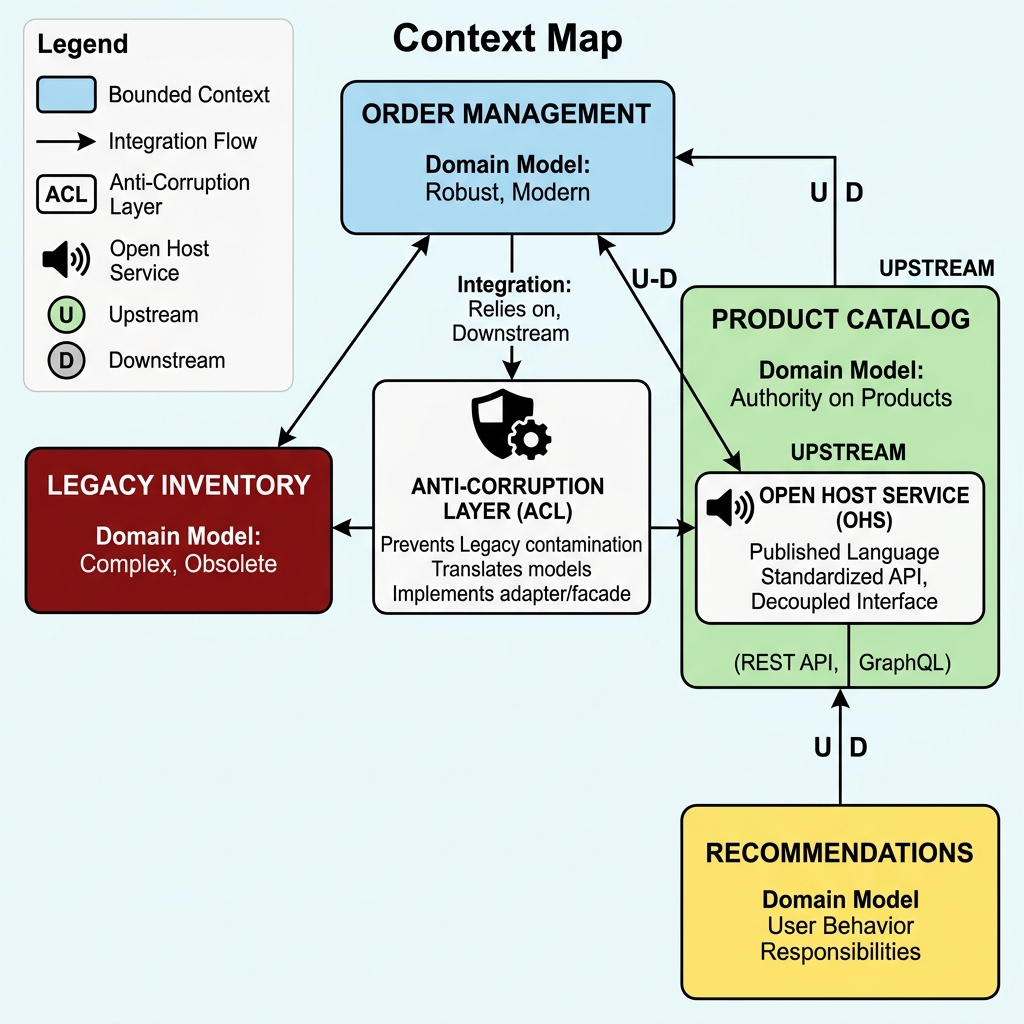
To see how Bounded Contexts and Context Mapping operate in production, examine these three real-world enterprise architectures:
Case Study 1: Global E-Commerce Platform
A global online retail system receives 50,000 requests per second during peak shopping seasons. The architecture is decomposed into four autonomous Bounded Contexts:
- Catalog Context (Upstream): Manages 5 million product SKUs, brand taxonomies, search tags, and localized marketing descriptions. It exposes an Open Host Service via read-only Redis caches and REST endpoints.
- Order Context (Downstream): Manages customer shopping carts and checkout workflows. It consumes product details via an Anti-Corruption Layer, capturing a point-in-time snapshot of the product name and price.
- Inventory Context (Partner): Tracks physical stock across 12 regional fulfillment warehouses. It listens asynchronously to
OrderPlacedEventmessages from Kafka to decrement warehouse inventory counts. - Billing Context (Downstream): Interfaces with external payment gateways (PayPal, Stripe, Apple Pay). It stores currency transaction receipts and issues PDF invoices without ever storing warehouse aisle numbers or marketing copy.
Case Study 2: Healthcare Clinical and Billing System
In a large hospital network, patient safety and regulatory compliance require strict model isolation:
- Electronic Health Records (EHR) Context: Doctors and nurses record vital signs, diagnosis codes (ICD-10), prescription dosages, and allergy alerts. The Ubiquitous Language defines a Patient as an active biological human being under medical observation.
- Insurance Claims Context: Hospital billing administrators compile diagnostic codes and procedure codes into standardized insurance claim submissions. The Ubiquitous Language defines a Policyholder or Beneficiary with deductible balances and coverage co-pays.
- Patient Scheduling Context: Receptionists schedule operating rooms, magnetic resonance imaging (MRI) machines, and physician consultation calendars. A Patient here is simply a calendar appointment slot.
- Integration Governance: Because medical record privacy is regulated under strict federal law (HIPAA/GDPR), the EHR context acts as a secured Upstream provider. The Billing Context interacts via an Anti-Corruption Layer that strips out sensitive medical notes and only extracts approved procedure codes.
Case Study 3: Fintech Multi-Currency Banking Engine
A modern financial institution processes cross-border remittances across 35 countries:
- Core Ledger Context: Implements an append-only, double-entry bookkeeping ledger. An Account is an immutable balance identifier with strict currency code and debit/credit ledger entries. High consistency is required.
- Know Your Customer (KYC) Context: Verifies passport scans, residential utility bills, and anti-money laundering (AML) government watchlists. An Account here represents an identity verification dossier with compliance risk scoring.
- Payment Gateway Context: Handles real-time ISO 20022 wire transfers, SWIFT messaging, and instant retail card payments. It uses an Anti-Corruption Layer to translate external bank XML messages into internal transfer commands.
- Architectural Decoupling: The Core Ledger context operates in complete isolation. If the KYC service experiences downtime due to a third-party biometric verification outage, the Core Ledger continues to process pre-approved batch settlement transactions without interruption.
How to Identify Bounded Contexts in Your Project
Finding the right boundaries is the hardest part of Domain-Driven Design. It requires deep collaboration with business experts rather than looking at database schemas. Here are three proven techniques to discover boundaries:
1. Look for Linguistic Shifts
Listen closely to how business domain experts speak during meetings. If the marketing team and the accounting team use the same word but argue over its definition, you have discovered a linguistic boundary. For example, if you find yourself writing class names with prefixes like MarketingCustomer, ShippingCustomer, and BillingCustomer, stop immediately. Those prefixes are a cry for help. Remove the prefixes, create three distinct Bounded Contexts, and name the entity Customer cleanly inside each one.
2. Follow Business Capabilities
Analyze how your organization is structured and what business capabilities it delivers. Business capabilities represent what a business does, not how it does it. Capabilities like Product Catalog Management, Order Processing, Warehouse Logistics, and Customer Billing naturally map to candidate Bounded Contexts. Aligning software boundaries with organizational departments minimizes cross-team friction and aligns code ownership with business accountability.
3. Use Event Storming Workshops
Event Storming is a rapid, highly collaborative workshop method invented by Alberto Brandolini. Software developers, domain experts, product managers, and business analysts gather in a room with a large roll of paper on the wall. Participants write domain events (past-tense occurrences like OrderPlaced, PaymentCaptured, ItemDispatched) on orange sticky notes and arrange them chronologically.
As the timeline grows, participants identify clusters of related events, commands, and business policies. Natural gaps and boundary lines emerge where events transition from one department to another. These clusters reveal your true Bounded Contexts and show where domain events must flow across context boundaries.
Implementing Bounded Contexts in Spring Boot 4
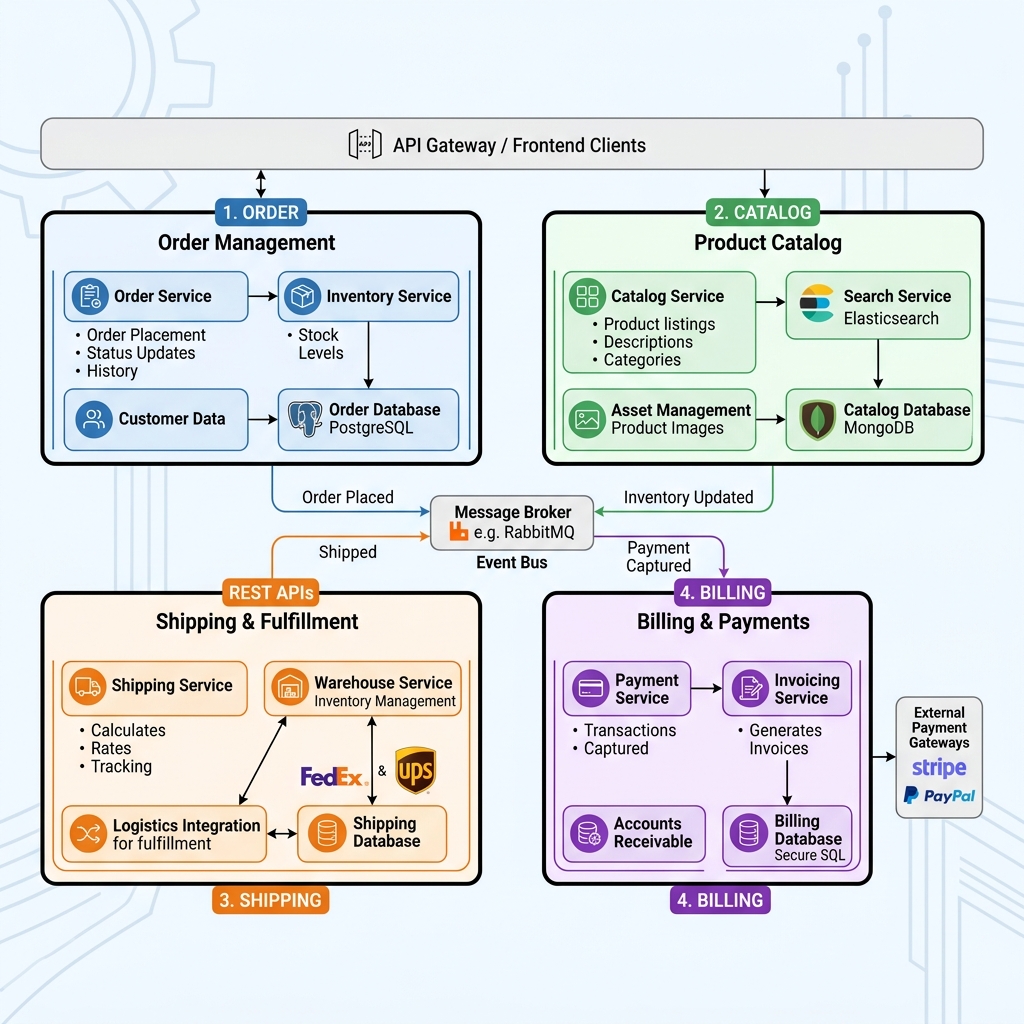
Let’s examine how to implement clean Bounded Contexts inside a Spring Boot 4 application. In our companion project on GitHub, we build a Modular Monolith. This pattern packages distinct contexts within a single deployable JAR while enforcing strict isolation between their models.
Package Structure and Modular Monolith Layout
We organize our codebase by business capability rather than technical layers. Each Bounded Context resides in its own dedicated package branch:
src/main/java/com/webcodein/boundedcontext/
├── EcommerceApplication.java
├── catalog/                          # Catalog Bounded Context
│   ├── Product.java                  # Catalog Aggregate Entity
│   ├── ProductRepository.java        # Spring Data JPA Repository
│   ├── CatalogService.java           # Application Service
│   ├── CatalogController.java        # REST Controller (/api/catalog/products)
│   └── dto/
│       ├── CreateProductRequest.java
│       └── ProductResponseDto.java   # Published Language DTO
└── order/                            # Order Bounded Context
    ├── Order.java                    # Order Aggregate Root
    ├── OrderItem.java                # Order Line Item Snapshot
    ├── OrderRepository.java          # Spring Data JPA Repository
    ├── OrderService.java             # Order Orchestration Service
    ├── OrderController.java          # REST Controller (/api/orders)
    ├── acl/
    │   ├── CatalogClient.java        # Downstream Port Interface
    │   ├── ProductSnapshot.java      # Order Value Object
    │   └── CatalogAclAdapter.java    # Anti-Corruption Layer Translator
    └── dto/
        ├── CreateOrderRequest.java
        ├── OrderItemRequest.java
        ├── OrderItemResponseDto.java
        └── OrderResponseDto.java
Catalog Context Implementation
Inside the Catalog context, a Product entity represents a marketable merchandise item. Notice that it maps to its own dedicated table (catalog_products):
package com.webcodein.boundedcontext.catalog;

import jakarta.persistence.Entity;
import jakarta.persistence.Id;
import jakarta.persistence.Table;
import java.util.Objects;
import java.util.UUID;

@Entity
@Table(name = "catalog_products")
public class Product {

    @Id
    private UUID id;
    private String sku;
    private String name;
    private String description;
    private double price;

    protected Product() {} // JPA requirement

    public Product(String sku, String name, String description, double price) {
        if (sku == null || sku.isBlank()) {
            throw new IllegalArgumentException("Product SKU cannot be null or blank");
        }
        if (price < 0.0) {
            throw new IllegalArgumentException("Product price cannot be negative");
        }
        this.id = UUID.randomUUID();
        this.sku = sku;
        this.name = Objects.requireNonNull(name, "Product name cannot be null");
        this.description = description;
        this.price = price;
    }

    public UUID getId() { return id; }
    public String getSku() { return sku; }
    public String getName() { return name; }
    public String getDescription() { return description; }
    public double getPrice() { return price; }

    public void updatePrice(double newPrice) {
        if (newPrice < 0.0) {
            throw new IllegalArgumentException("Product price cannot be negative");
        }
        this.price = newPrice;
    }
}
Order Context Implementation
Inside the Order context, an Order aggregate manages the purchase lifecycle. It does not contain a collection of Catalog Product objects. Instead, it contains OrderItem snapshots that record the purchased product’s SKU, name, and unit price at the exact moment of order placement:
package com.webcodein.boundedcontext.order;

import jakarta.persistence.*;
import java.time.Instant;
import java.util.ArrayList;
import java.util.Collections;
import java.util.List;
import java.util.Objects;
import java.util.UUID;

@Entity
@Table(name = "orders")
public class Order {

    @Id
    private UUID id;
    private UUID customerId;
    private String status;
    private Instant createdAt;

    @OneToMany(cascade = CascadeType.ALL, orphanRemoval = true, fetch = FetchType.EAGER)
    @JoinColumn(name = "order_id")
    private List<OrderItem> items = new ArrayList<>();

    protected Order() {} // JPA requirement

    public Order(UUID customerId) {
        this.id = UUID.randomUUID();
        this.customerId = Objects.requireNonNull(customerId, "CustomerId cannot be null");
        this.status = "CREATED";
        this.createdAt = Instant.now();
    }

    public UUID getId() { return id; }
    public UUID getCustomerId() { return customerId; }
    public String getStatus() { return status; }
    public List<OrderItem> getItems() { return Collections.unmodifiableList(items); }

    public void addItem(OrderItem item) {
        if (!"CREATED".equals(this.status)) {
            throw new IllegalStateException("Cannot add items to order in status: " + this.status);
        }
        Objects.requireNonNull(item, "OrderItem cannot be null");
        this.items.add(item);
    }

    public double calculateTotal() {
        return items.stream()
            .mapToDouble(OrderItem::getSubtotal)
            .sum();
    }

    public void confirmOrder() {
        if (!"CREATED".equals(this.status)) {
            throw new IllegalStateException("Only CREATED orders can be confirmed");
        }
        if (items.isEmpty()) {
            throw new IllegalStateException("Cannot confirm an order with zero items");
        }
        this.status = "CONFIRMED";
    }
}
The OrderItem class stores a frozen snapshot of the price. If the marketing team discounts the product in the Catalog tomorrow, historical confirmed orders do not change their totals:
package com.webcodein.boundedcontext.order;

import jakarta.persistence.Entity;
import jakarta.persistence.Id;
import jakarta.persistence.Table;
import java.util.UUID;

@Entity
@Table(name = "order_items")
public class OrderItem {

    @Id
    private UUID id;
    private String sku;
    private String productName;
    private double unitPrice;
    private int quantity;

    protected OrderItem() {}

    public OrderItem(String sku, String productName, double unitPrice, int quantity) {
        this.id = UUID.randomUUID();
        this.sku = sku;
        this.productName = productName;
        this.unitPrice = unitPrice;
        this.quantity = quantity;
    }

    public double getSubtotal() {
        return unitPrice * quantity;
    }

    public String getSku() { return sku; }
    public String getProductName() { return productName; }
    public double getUnitPrice() { return unitPrice; }
    public int getQuantity() { return quantity; }
}
Anti-Corruption Layer (ACL) Implementation
To obtain product details without coupling to the Catalog context’s JPA entities, the Order context defines a port interface (CatalogClient) and implements it with an Anti-Corruption Layer adapter (CatalogAclAdapter):
package com.webcodein.boundedcontext.order.acl;

import com.webcodein.boundedcontext.catalog.CatalogService;
import org.springframework.stereotype.Component;
import java.util.Optional;

/**
 * Anti-Corruption Layer (ACL) Adapter.
 * Translates external Catalog DTOs into the Order context's internal ProductSnapshot value object.
 */
@Component
public class CatalogAclAdapter implements CatalogClient {

    private final CatalogService catalogService;

    public CatalogAclAdapter(CatalogService catalogService) {
        this.catalogService = catalogService;
    }

    @Override
    public Optional<ProductSnapshot> fetchProductBySku(String sku) {
        return catalogService.getProductBySku(sku)
            .map(dto -> new ProductSnapshot(
                dto.sku(),
                dto.name(),
                dto.price()
            ));
    }
}
This adapter provides defensive isolation. If the Catalog context renames its database table or introduces internal polymorphic product subtypes, the Order context remains completely unaffected.
ArchUnit Boundary Governance and Fitness Functions
When multiple Bounded Contexts live inside a single modular monolith repository, a developer in a hurry might be tempted to directly import an entity from another context. To prevent architectural erosion, we write automated compile-time fitness tests using ArchUnit.
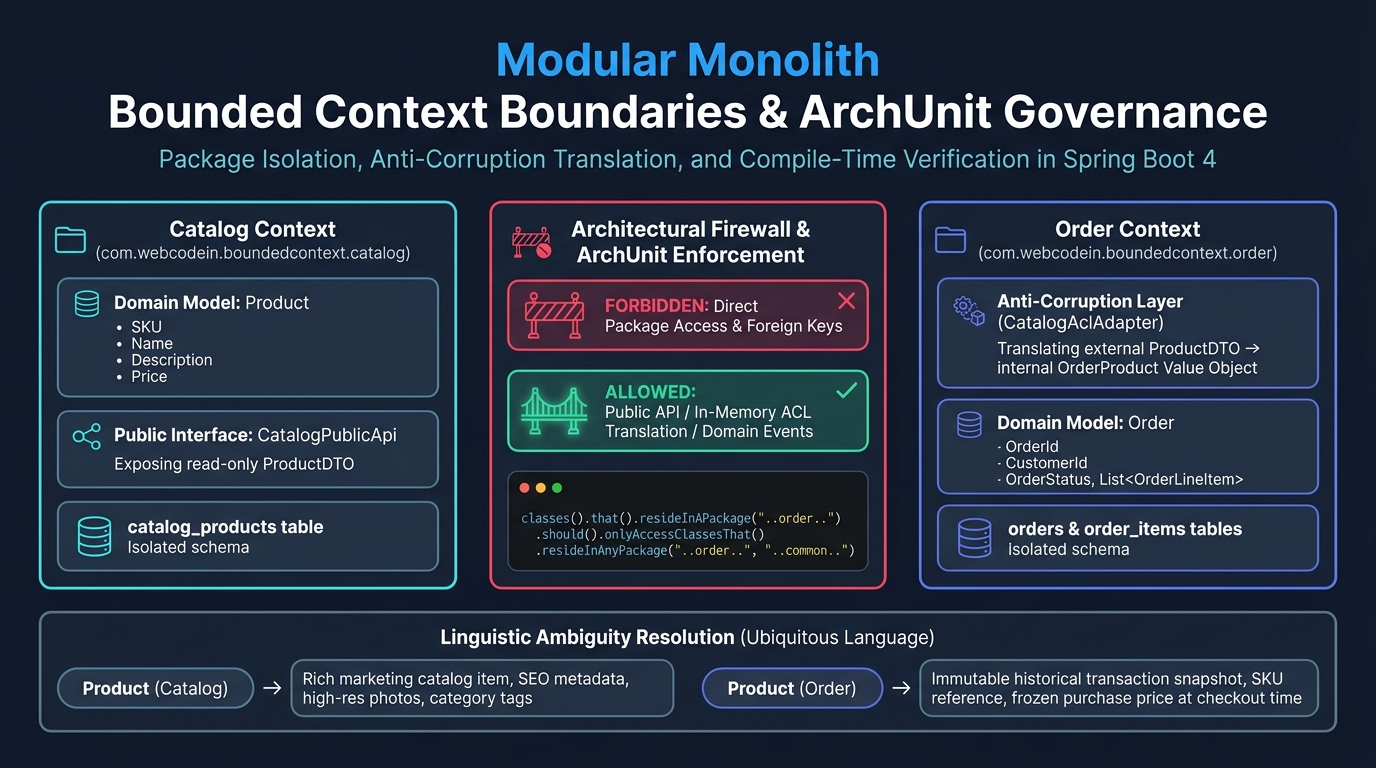
The following ArchUnit test suite runs during mvn test and fails the build immediately if any developer violates context boundaries:
package com.webcodein.boundedcontext.architecture;

import com.tngtech.archunit.core.importer.ImportOption;
import com.tngtech.archunit.junit.AnalyzeClasses;
import com.tngtech.archunit.junit.ArchTest;
import com.tngtech.archunit.lang.ArchRule;

import static com.tngtech.archunit.lang.syntax.ArchRuleDefinition.noClasses;
import static com.tngtech.archunit.library.dependencies.SlicesRuleDefinition.slices;

@AnalyzeClasses(
    packages = "com.webcodein.boundedcontext",
    importOptions = ImportOption.DoNotIncludeTests.class
)
public class BoundedContextArchitectureTest {

    @ArchTest
    static final ArchRule catalog_must_not_depend_on_order_context =
        noClasses()
            .that().resideInAPackage("..catalog..")
            .should().dependOnClassesThat().resideInAPackage("..order..")
            .as("Catalog context (Upstream) must never depend on the Order context (Downstream)");

    @ArchTest
    static final ArchRule order_domain_must_not_access_catalog_entity_directly =
        noClasses()
            .that().resideInAPackage("..order..")
            .and().resideOutsideOfPackage("..order.acl..")
            .should().dependOnClassesThat().haveFullyQualifiedName("com.webcodein.boundedcontext.catalog.Product")
            .as("Order context domain must never directly access the internal Catalog Product entity; all interaction must flow through the Anti-Corruption Layer (ACL)");

    @ArchTest
    static final ArchRule bounded_contexts_must_be_free_of_cycles =
        slices()
            .matching("com.webcodein.boundedcontext.(*)..")
            .should().beFreeOfCycles()
            .as("Bounded context packages must not have cyclical dependencies");
}
Common Mistakes and Anti-Patterns
Designing Bounded Contexts requires vigilance. Watch out for these three common production anti-patterns:
Anti-Pattern 1: The Shared Database Trap
The Mistake: You separate your Java classes into clean packages, but both packages read and write to the exact same database tables using SQL joins.
The Consequence: The boundary is an illusion. Any database schema migration in one context can break queries in another context without triggering Java compiler errors. Performance degrades due to row locking conflicts.
The Fix: Give each Bounded Context its own dedicated database tables (e.g., catalog_products vs orders and order_items). If using PostgreSQL, consider using distinct schemas (CREATE SCHEMA catalog; CREATE SCHEMA orders;). Forbid cross-schema SQL joins entirely.
Anti-Pattern 2: The Anemic Distributed Monolith
The Mistake: Slicing contexts too finely into microscopic boundaries (e.g., creating a separate service for every database table: ProductService, PriceService, CategoryService).
The Consequence: To execute a simple business transaction, the system must make 10 synchronous HTTP network calls. If any single service experiences latency, the entire user experience freezes. You inherit all the operational complexity of distributed systems without any of the domain benefits.
The Fix: Ensure your Bounded Context represents a cohesive, self-contained business capability that can fulfill write commands autonomously. Consolidate tightly coupled entity groups into a single context.
Anti-Pattern 3: The God Context and Canonical Model
The Mistake: Corporate enterprise architects attempt to design a single, company-wide Canonical Data Model (CDM) that represents every entity across all departments.
The Consequence: A massive committee must approve every single field addition. Innovation stops. Teams create backdoor workarounds to bypass the central committee’s slow governance.
The Fix: Accept that models are contextual. Embrace duplicate concepts when they represent different business realities. Let Catalog define its product and let Order define its line item independently.
Best Practices for Designing Bounded Contexts
- Start with a Modular Monolith: Do not jump straight to microservices on day one. Organize your Bounded Contexts as distinct packages inside a single Spring Boot application. Refactoring package boundaries is thousands of times faster than moving network microservices.
- Reference Cross-Context Entities by ID Only: Never establish a JPA
@ManyToOneor@OneToManyrelationship across Bounded Context boundaries. Store the foreign context’s ID as a plainUUIDorString. - Enforce Compile-Time Rules with ArchUnit: Add ArchUnit architecture tests to your continuous integration (CI) pipeline. Automatically fail any pull request that attempts an unauthorized cross-package import.
- Publish Explicit Public DTOs: Never return JPA entities directly from REST controllers or service boundaries. Always map internal domain models to explicit Published Language DTOs.
- Embrace Asynchronous Domain Events: For cross-context state synchronization, publish domain events via Apache Kafka or Spring Application Events. This keeps upstream contexts fully decoupled from downstream reactions.
Your Next Step: Hexagonal Architecture and Tactical DDD
Bounded Contexts provide the strategic foundation of your software architecture. Once your high-level boundaries and context maps are clearly established, you need proven patterns to organize the code inside each context.
Explore our companion architectural guides to master the tactical side of Domain-Driven Design:
- DDD Layers Explained: Where Does Each Piece of Code Go? — Complete guide to organizing Domain, Application, Presentation, and Infrastructure layers.
- Clean Architecture & Hexagonal Ports and Adapters in Spring Boot 4 — How to isolate your pure domain model from databases, HTTP frameworks, and message brokers.
- Hexagonal vs Clean vs Onion Architecture: Visual Comparison — Deep architectural comparison of modern structural patterns.
- Spring Modulith: Building Modular Monoliths with Spring Boot 4 — Advanced framework support for module verification and event publication registries.
- Event-Driven Architecture with Kafka and Spring Boot 4 — Production patterns for reliable asynchronous cross-context messaging.
- Multi-Tenant SaaS with Hibernate 7 and Spring Boot — Managing tenant data boundaries and database isolation.
- Modern Local Development with Testcontainers and Spring Boot 4 — Testing multi-container architectures reliably in local environments.
- DDD Masterclass: Tactical Patterns for Java Developers — Deep dive into Aggregates, Value Objects, Domain Events, and Repositories.
Conclusion
Bounded Contexts are the most transformative concept in Domain-Driven Design. They teach us that trying to build one giant, universal model for an entire enterprise is an anti-pattern that leads directly to fragile, tangled systems. By creating clear boundaries that align with business capabilities and Ubiquitous Languages, you empower software engineering teams to build cohesive, resilient, and maintainable software.
Start small. Identify where linguistic shifts occur in your business discussions. Group cohesive business capabilities into distinct packages within a Spring Boot modular monolith. Defend your boundaries with Anti-Corruption Layers and ArchUnit fitness tests. As your organization scales, your clean boundaries will provide the structural integrity needed to evolve into independent microservices with minimal friction.
Frequently Asked Questions (FAQ)
- 1. Is a Bounded Context always a microservice?
- No. A Bounded Context is a logical design boundary for a domain model. A microservice is a physical operational deployment unit. While a microservice often hosts one Bounded Context, multiple Bounded Contexts can live peacefully inside a single Spring Boot modular monolith.
- 2. Can two entities share the exact same name across different Bounded Contexts?
- Yes, absolutely. In fact, Domain-Driven Design encourages this. Having a
Productentity in the Catalog context and a separateProductentity orOrderItemsnapshot in the Order context allows each model to stay concise, relevant, and free from cross-department bloat. - 3. How should Bounded Contexts reference entities from other contexts without foreign keys?
- Bounded Contexts should reference foreign entities strictly by identifier (such as a
UUIDor businessSKU). Never establish JPA@ManyToOneor@JoinColumnrelationships across context boundaries. If you need historical data (like product prices), capture an immutable snapshot inside the consuming context. - 4. What is the difference between an Anti-Corruption Layer (ACL) and a Conformist pattern?
- In a Conformist pattern, the downstream context directly uses the upstream system’s data structures and models without modification. In an Anti-Corruption Layer (ACL), the downstream context writes an explicit adapter and translator to convert foreign models into its own clean domain entities, shielding itself from upstream schema changes.
- 5. When should a Bounded Context be split into smaller contexts?
- Split a context when you observe clear linguistic contradictions inside the same team, when two sub-teams constantly experience merge conflicts on the same entities, or when part of the model has vastly different scalability, security, or deployment lifecycles compared to the rest of the context.
References and Further Reading
- GitHub Companion Repository: Bounded Context Spring Boot 4 Workshop
- Evans, Eric. Domain-Driven Design: Tackling Complexity in the Heart of Software. Addison-Wesley, 2003.
- Vernon, Vaughn. Implementing Domain-Driven Design. Addison-Wesley, 2013.
- Fowler, Martin. Bounded Context. MartinFowler.com.
- Brandolini, Alberto. Introducing EventStorming: An agile methodology for domain-driven design. Leanpub, 2021.
- Spring Boot Documentation. Spring Boot Reference Guide. VMware Tanzu.