Quick Index: Domain-Driven Design for Beginners
- 1. The Real-World Software Crisis: The “Lost in Translation” Problem
- 2. What Exactly is Domain-Driven Design?
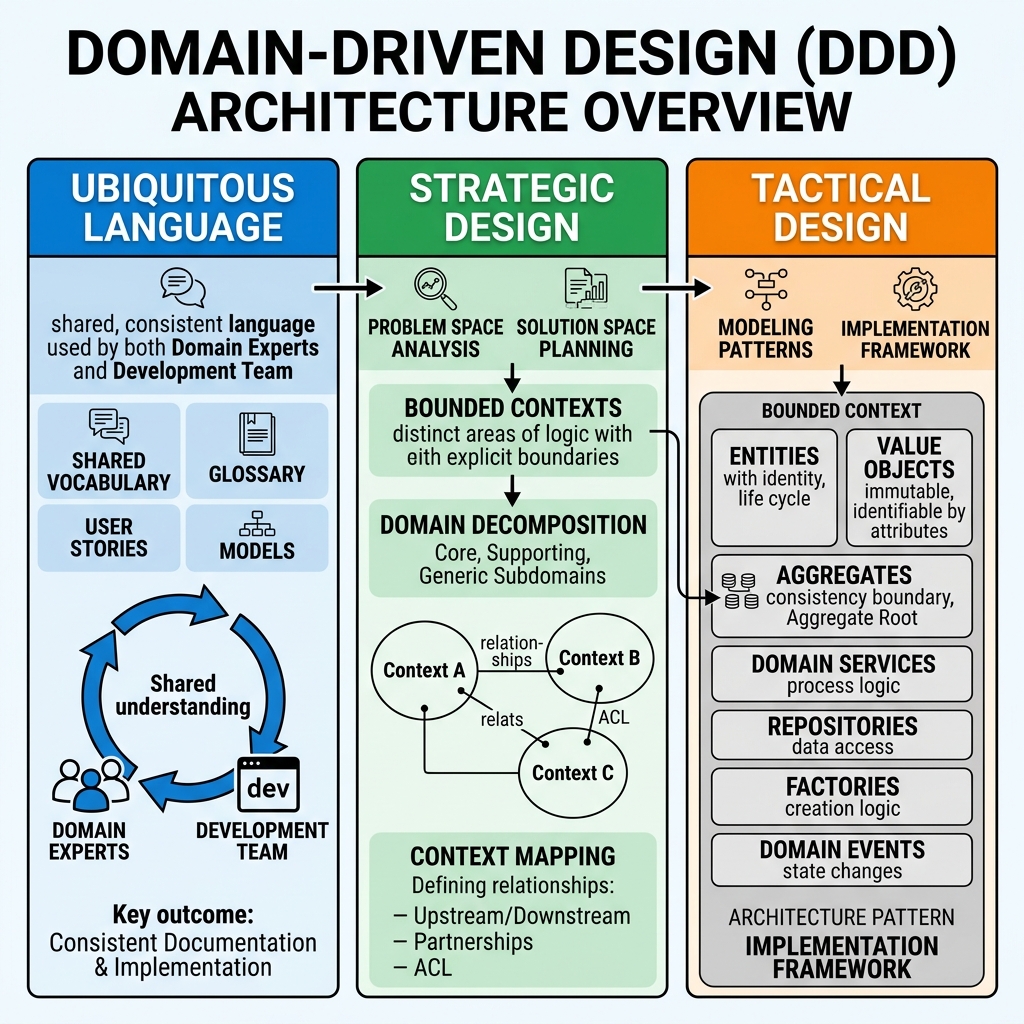
- 3. The Three Pillars of DDD: An Architectural Overview
- 4. Pillar 1: Ubiquitous Language
- 5. Pillar 2: Strategic Design (The Big Picture)
- 6. Domains, Subdomains, and Core Capabilities
- 7. Bounded Contexts and Context Mapping
- 8. Pillar 3: Tactical Design (The Building Blocks)
- 9. Entities: Identity, Mutability, and Lifecycle
- 10. Value Objects: Immutability and Java 25 Records
- 11. Aggregates and Aggregate Roots: Protecting Invariants
- 12. Repositories, Domain Services, and Domain Events
- 13. Practical Implementation with Spring Boot 4 and Java 25
- 14. Enforcing Architecture Boundaries with ArchUnit
- 15. Comparative Architecture & Boundary Matrix
- 16. Real-World Enterprise Use Cases
- 17. When to Use DDD (and When NOT To)
- 18. Common Mistakes and Production Anti-Patterns
- 19. Best Practices for DDD Beginners
- 20. Frequently Asked Questions (FAQ)
- 21. Companion Workshop Code
- 22. References and Further Reading
1. The Real-World Software Crisis: The “Lost in Translation” Problem
You are a Java developer working at a major retail bank. Your product manager walks up to your desk with a new feature. She says: “A customer can open a savings account, deposit money, and freeze the card when fraud is detected.”
You open your code editor. But in the Java codebase, you do not find those words. Instead, you see a class called AccountDataProcessor. You see database operations called insertRecord(), updateBalance(), and setFlag(3). Nobody on your team uses the same vocabulary. The code speaks one language, while the business speaks another.
This communication gap is expensive. It causes subtle bugs. It delays product releases. It makes onboarding new software engineers stressful. Most importantly, it creates an anemic codebase where critical business rules hide in random controllers, database triggers, or SQL scripts.
Domain-Driven Design (DDD) solves this exact problem. DDD is a software development philosophy that places the business domain at the center of all design decisions. DDD makes sure your code speaks the exact same language as your business experts.
In this beginner guide, we explore DDD from the ground up. We do not assume you have read 500-page academic textbooks. We use simple analogies, clean diagrams, and working Spring Boot 4 and Java 25 code examples.
2. What Exactly is Domain-Driven Design?
Most enterprise software projects fail not because of hardware limits, slow frameworks, or bad compilers. They fail because software developers do not truly understand the business problem they are trying to solve.
Consider software for a modern hospital. What does the word “patient” mean? To a triage nurse in the emergency room, a patient is a person with physical symptoms, vital signs, and urgent pain. To the hospital billing office, that same patient is a health insurance policy number and an open invoice. To the research lab, that patient is an anonymous participant in a clinical medication trial.
If you try to build a single giant Java class called Patient with 120 database columns to satisfy all three departments, your application becomes an unmaintainable disaster. Every small change made for the billing team accidentally breaks the nurse dashboard.
The Restaurant Kitchen Analogy
Think about a busy restaurant. The dining room and the kitchen work together, but they are two completely different worlds:
- The Dining Room: Waiters hand out printed menus to guests. An “order” here means food choices with retail prices, table numbers, and payment receipts.
- The Kitchen: Chefs handle raw ingredients, ovens, and preparation steps. An “order” here means cooking temperatures, preparation time, and ticket priority.
A restaurant does not force the head chef to balance customer credit card bills. A restaurant also does not force the dining room waiter to measure oven temperatures. Both departments have clear boundaries. Each department uses its own vocabulary. DDD applies this exact separation to software systems.
Domain-Driven Design was introduced by Eric Evans in his seminal 2003 book Domain-Driven Design: Tackling Complexity in the Heart of Software. DDD is not a library you download from Maven Central. It is not an annotation you add to a Spring class. DDD is a disciplined way of thinking that unites developers and business leaders.
3. The Three Pillars of DDD: An Architectural Overview
To master Domain-Driven Design, you must understand its three central pillars. Each pillar addresses a specific level of system architecture:
| DDD Pillar | Core Responsibility | Real-World Analogy |
|---|---|---|
| 1. Ubiquitous Language | A single shared vocabulary used by developers and domain experts everywhere | A shared team dictionary with zero confusing synonyms |
| 2. Strategic Design | Dividing the enterprise into subdomains and clear model boundaries | Organizational chart of company departments |
| 3. Tactical Design | Object-oriented design patterns to implement domain logic in code | Standardized building blocks like LEGO bricks |
Let us examine how each pillar functions in practice.
4. Pillar 1: Ubiquitous Language
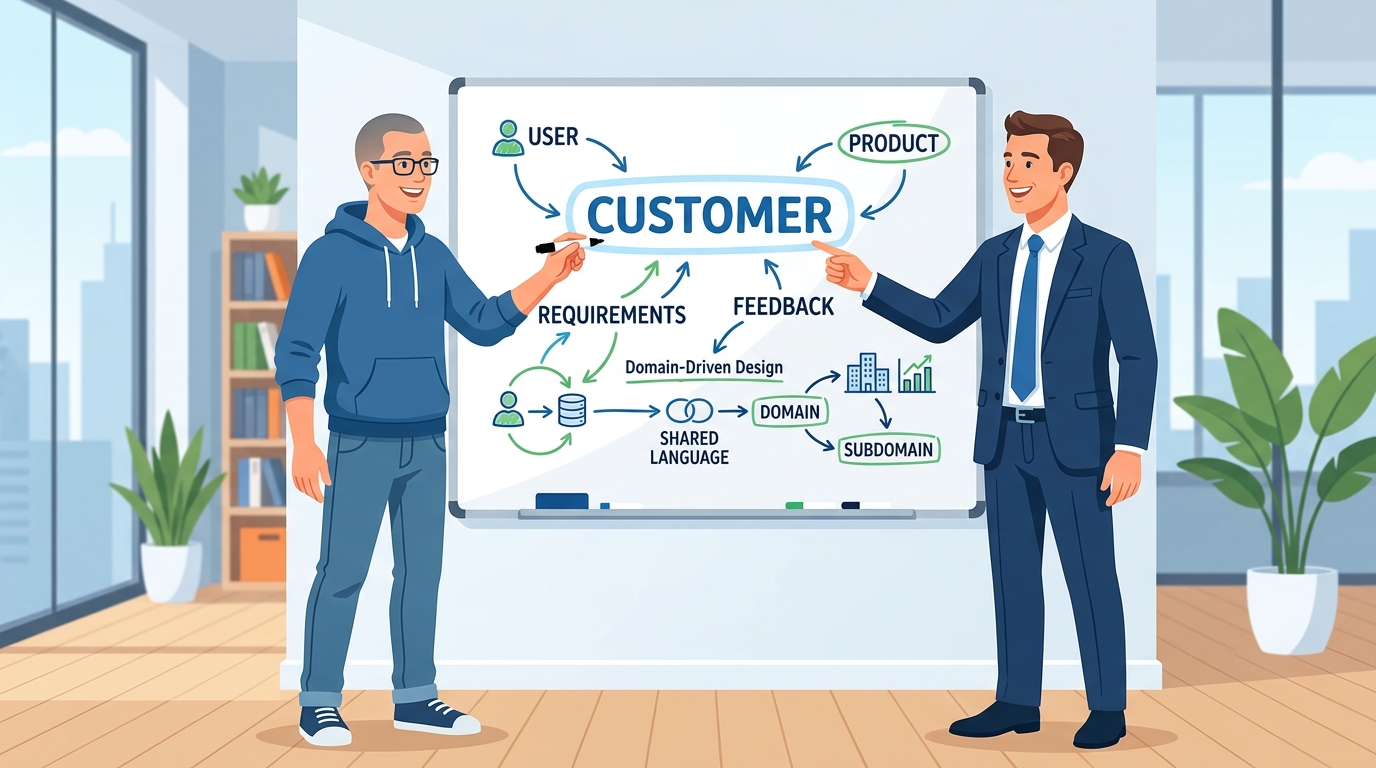
The English word “ubiquitous” means “present everywhere.” In DDD, Ubiquitous Language is a rigorous, shared vocabulary used by everyone on the product team. It appears in spoken conversations, user story tickets, documentation, unit tests, and source code.
When your domain expert says: “A customer submits an order, and the warehouse reserves inventory,” your Java code must literally say:
// Correct: Speaks the Ubiquitous Language directly
public class OrderService {
    public void submitOrder(OrderId id) {
        Order order = orderRepository.findById(id).orElseThrow();
        order.submit();
        warehouseClient.reserveInventory(order.getItems());
    }
}
Your code should never use technical database jargon to describe business operations. Compare the bad and good examples below:
// BAD: Technical, anemic, and disconnected from business reality
public class AccountManager {
    public void executeProcess(Map<String, Object> params) {
        db.update("UPDATE tbl_accounts SET status_code = 2 WHERE id = ?", params.get("id"));
    }
}

// GOOD: Expressive, business-driven, and unambiguous
public class BankAccount {
    public void freeze(FreezeReason reason) {
        if (this.status == AccountStatus.FROZEN) {
            throw new AccountAlreadyFrozenException(this.id);
        }
        this.status = AccountStatus.FROZEN;
        recordEvent(new AccountFrozenEvent(this.id, reason, Instant.now()));
    }
}
When new developers join your team, they do not need to decipher cryptic column codes. They read the class names and understand the business immediately. For an in-depth guide on domain modeling, read our article on DDD Masterclass: The Ultimate Java Developer Guide.
5. Pillar 2: Strategic Design (The Big Picture)
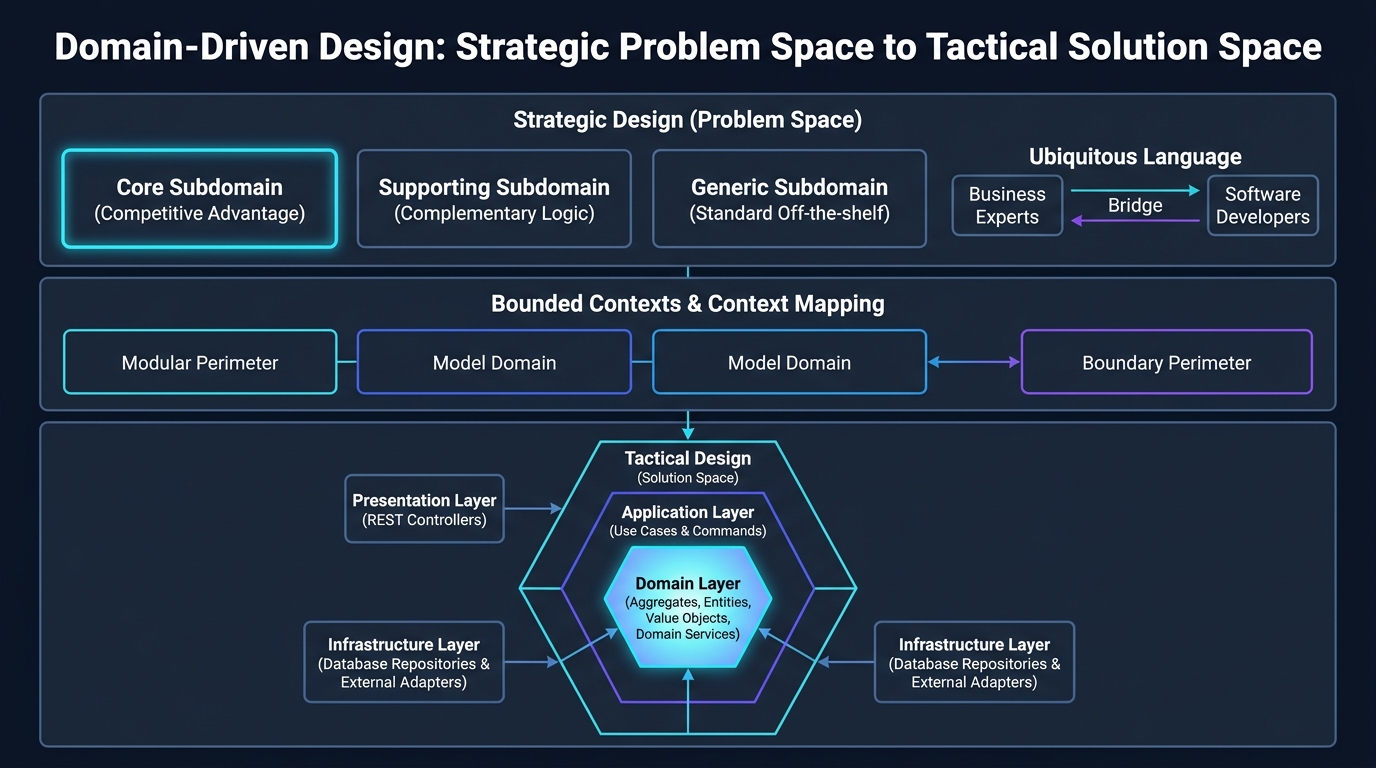
Strategic Design answers the high-level architecture question: “How do we break a large, complicated system into manageable parts?”
Without Strategic Design, teams build monolithic “Big Balls of Mud.” In a Big Ball of Mud, every class touches every other class. Changing a payment feature accidentally breaks user profile photos. Strategic Design prevents this chaos by mapping the Problem Space into the Solution Space.
6. Domains, Subdomains, and Core Capabilities
In DDD terminology, a domain represents the overall sphere of knowledge and business activity your software serves. If you build software for an online bookstore, your broad domain is e-commerce book distribution.
Because full business domains are too large to build in one piece, you decompose them into three types of subdomains:
- Core Subdomain: This is your company’s secret sauce. It provides your distinct competitive advantage. It is what makes customers pick you over competitors. For Amazon, this is the dynamic pricing algorithm and recommendation engine. You write this code in-house with your best engineers.
- Supporting Subdomain: This represents software that complements your business. It is essential for daily operations, but it does not make your company unique. An inventory warehouse tracking module is a supporting subdomain. It requires custom development, but standard rules apply.
- Generic Subdomain: This is common functionality that almost every modern business needs. User identity management, invoice PDF rendering, credit card processing, and transactional email dispatch are generic subdomains. You should never write this from scratch; integrate third-party SaaS tools or open-source libraries like Spring Security and Keycloak.
7. Bounded Contexts and Context Mapping
A Bounded Context is an explicit boundary within which a specific domain model applies. Inside this boundary, every word in the Ubiquitous Language has exactly one unambiguous meaning. Outside this boundary, different models and rules apply.
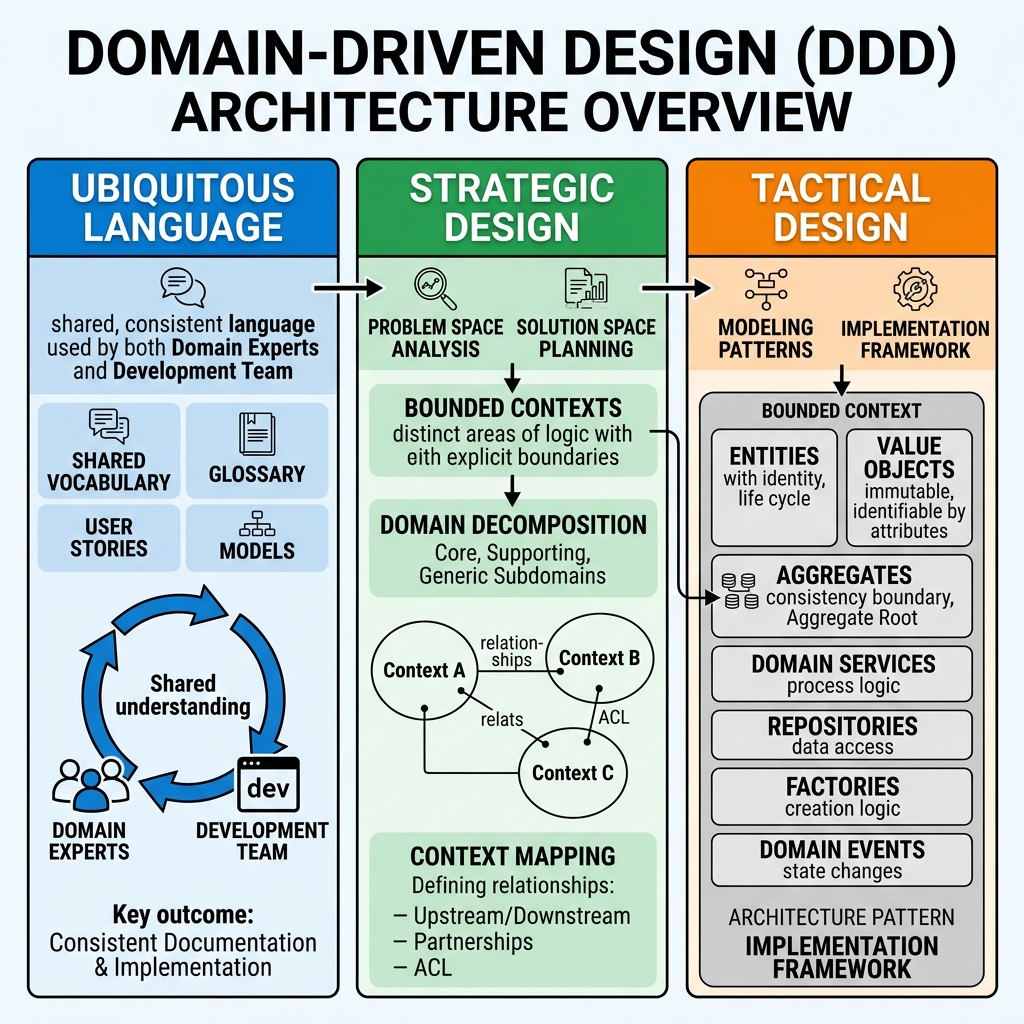
In our online bookstore system, notice how the concept of a Customer differs across three distinct Bounded Contexts:
- Order Placement Context: A Customer is an active buyer. They have a shopping cart, discount codes, shipping addresses, and items awaiting purchase.
- Billing & Payment Context: A Customer is a financial debtor. They have credit cards, tax identification numbers, currency preferences, and payment invoices.
- Warehouse Fulfillment Context: A Customer is simply a delivery destination. They have a physical street address, postal code, and package delivery instructions.
By establishing distinct Bounded Contexts, each software team works on their own model independently. The Billing team can add tax compliance fields without asking permission from the Order team. For deep architectural guidance on boundaries, explore our dedicated guide on Bounded Context in DDD Explained.
8. Pillar 3: Tactical Design (The Building Blocks)
Once Strategic Design defines your boundaries, Tactical Design gives you concrete coding patterns to write inside each Bounded Context. These patterns ensure your domain logic remains expressive, self-validating, and completely decoupled from infrastructure concerns.
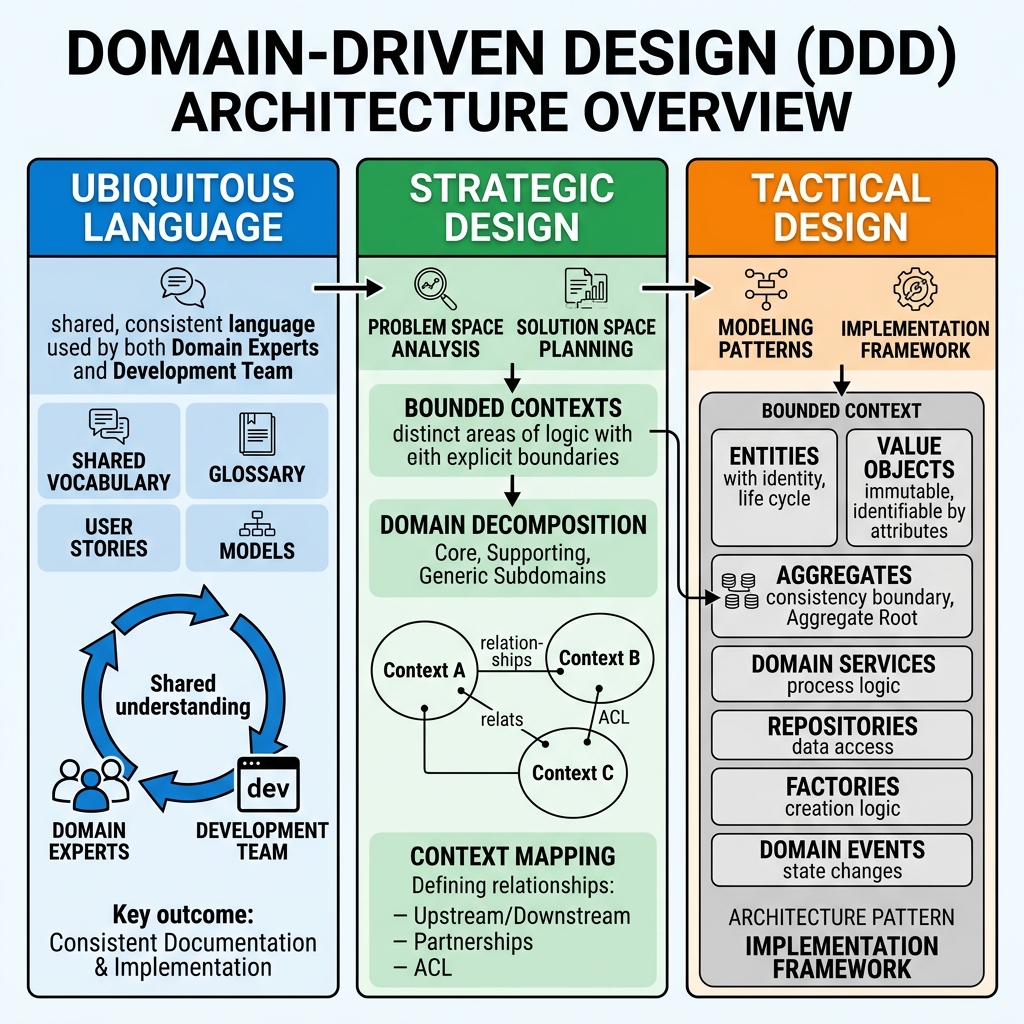
Let us look closely at each tactical building block.
9. Entities: Identity, Mutability, and Lifecycle
An Entity is an object that has an enduring, unique identity that runs continuously through time. Two entities with identical attributes are still distinct objects if their unique identifiers differ.
Real-World Analogy: Think about two identical twins. They look alike, have the same birthday, and share the same parents. Yet they are two distinct human beings because each holds a unique passport number and legal identity.
In Java 25, an Entity encapsulates mutable state and guards its own invariants:
package com.webcodein.workshop.architecture.ddd.domain.model.order;

import java.util.Objects;
import java.util.UUID;

public class OrderLine {
    private final UUID id;
    private final BookId bookId;
    private Quantity quantity;
    private final Money unitPrice;

    public OrderLine(UUID id, BookId bookId, Quantity quantity, Money unitPrice) {
        this.id = Objects.requireNonNull(id, "OrderLine id cannot be null");
        this.bookId = Objects.requireNonNull(bookId, "BookId cannot be null");
        this.quantity = Objects.requireNonNull(quantity, "Quantity cannot be null");
        this.unitPrice = Objects.requireNonNull(unitPrice, "UnitPrice cannot be null");
    }

    public static OrderLine create(BookId bookId, Quantity quantity, Money unitPrice) {
        return new OrderLine(UUID.randomUUID(), bookId, quantity, unitPrice);
    }

    public Money subtotal() {
        return unitPrice.multiply(quantity.value());
    }

    void increaseQuantity(Quantity additional) {
        this.quantity = this.quantity.add(additional);
    }

    // Equality is strictly based on identity, never mutable attributes
    @Override
    public boolean equals(Object o) {
        if (this == o) return true;
        if (o == null || getClass() != o.getClass()) return false;
        OrderLine that = (OrderLine) o;
        return Objects.equals(id, that.id);
    }

    @Override
    public int hashCode() {
        return Objects.hash(id);
    }
}
10. Value Objects: Immutability and Java 25 Records
A Value Object is an object that has no conceptual identity. It is defined solely by the combination of its attributes. Value Objects are completely immutable. If you want to modify a Value Object, you create a new instance with the updated values.
Real-World Analogy: A twenty-dollar bill in your wallet. If you lend a twenty-dollar bill to a friend, you do not expect that exact same paper serial number back next week. Any valid twenty-dollar bill is completely interchangeable because its value is what matters.
In modern Java 25, Java Records are the ideal mechanism for implementing Value Objects:
package com.webcodein.workshop.architecture.ddd.domain.model.order;

import java.math.BigDecimal;
import java.math.RoundingMode;
import java.util.Objects;

public record Money(BigDecimal amount, String currency) {
    public static final Money ZERO_USD = new Money(BigDecimal.ZERO, "USD");

    public Money {
        Objects.requireNonNull(amount, "Amount cannot be null");
        Objects.requireNonNull(currency, "Currency cannot be null");
        if (amount.compareTo(BigDecimal.ZERO) < 0) {
            throw new IllegalArgumentException("Money amount cannot be negative: " + amount);
        }
        if (currency.isBlank() || currency.length() != 3) {
            throw new IllegalArgumentException("Currency must be a valid 3-letter ISO code: " + currency);
        }
        amount = amount.setScale(2, RoundingMode.HALF_UP);
    }

    public static Money of(double amount, String currency) {
        return new Money(BigDecimal.valueOf(amount), currency);
    }

    public Money add(Money other) {
        Objects.requireNonNull(other, "Other money cannot be null");
        assertSameCurrency(other);
        return new Money(this.amount.add(other.amount), this.currency);
    }

    public Money multiply(int factor) {
        if (factor < 0) {
            throw new IllegalArgumentException("Multiplication factor cannot be negative");
        }
        return new Money(this.amount.multiply(BigDecimal.valueOf(factor)), this.currency);
    }

    private void assertSameCurrency(Money other) {
        if (!this.currency.equalsIgnoreCase(other.currency)) {
            throw new IllegalArgumentException(
                "Cannot perform operation on different currencies: " + this.currency + " vs " + other.currency
            );
        }
    }
}
Notice the huge architectural benefit: once created, an instance of Money can never be placed into an invalid state. It prevents negative balances, currency mismatches, and precision bugs at compile time.
11. Aggregates and Aggregate Roots: Protecting Invariants
An Aggregate is a cluster of associated Entities and Value Objects treated as a single transactional unit for data changes. Every Aggregate has an Aggregate Root, which is the primary Entity that controls all access to the cluster.
The Core Aggregate Invariant Rule: External code must NEVER reach inside an Aggregate to directly mutate internal entities. External classes can only call methods exposed on the Aggregate Root.
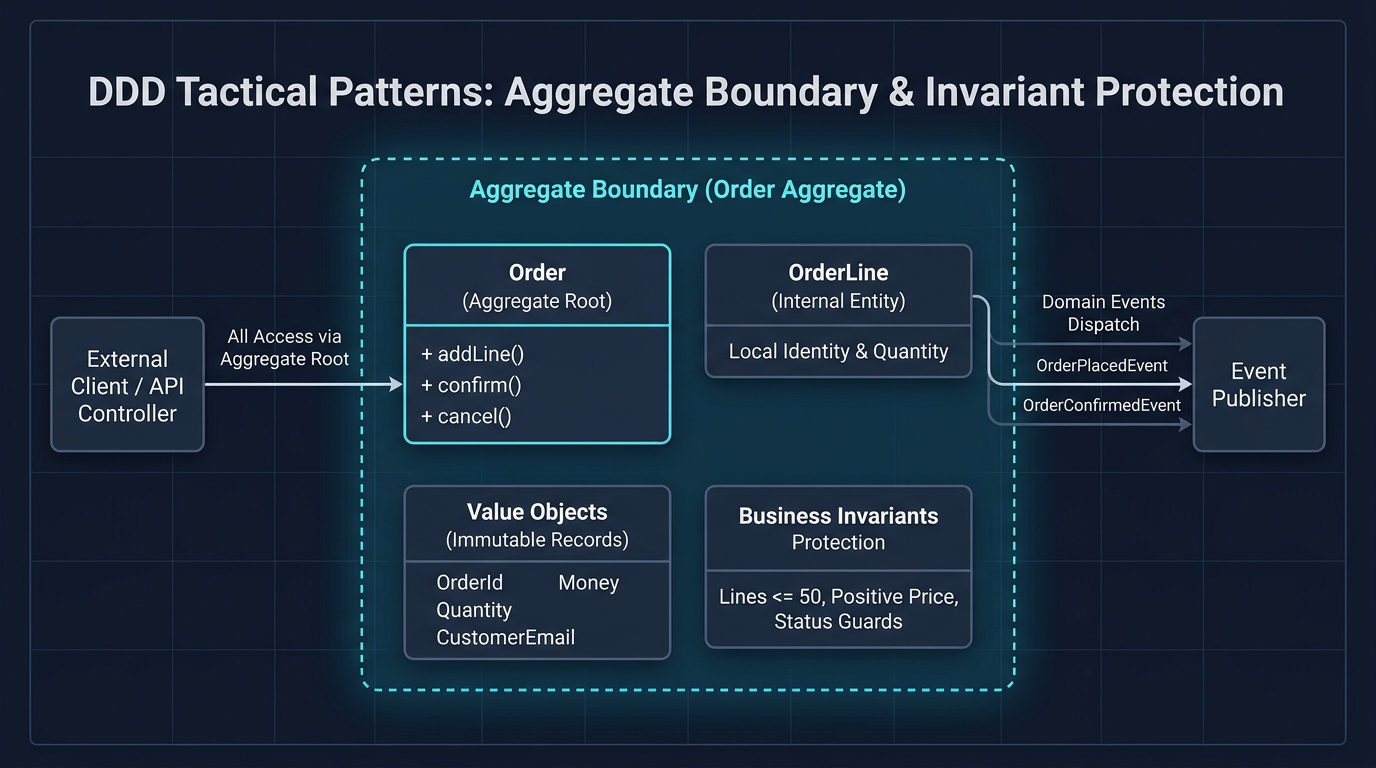
Here is our working Order Aggregate Root:
package com.webcodein.workshop.architecture.ddd.domain.model.order;

import com.webcodein.workshop.architecture.ddd.domain.event.OrderConfirmedEvent;
import com.webcodein.workshop.architecture.ddd.domain.event.OrderPlacedEvent;

import java.time.Instant;
import java.util.*;

public class Order {
    public static final int MAX_ORDER_LINES = 50;

    private final OrderId id;
    private final CustomerEmail customerEmail;
    private final List<OrderLine> lines = new ArrayList<>();
    private OrderStatus status;
    private final Instant createdAt;
    private final List<Object> domainEvents = new ArrayList<>();

    public Order(OrderId id, CustomerEmail customerEmail) {
        this.id = Objects.requireNonNull(id, "OrderId cannot be null");
        this.customerEmail = Objects.requireNonNull(customerEmail, "CustomerEmail cannot be null");
        this.status = OrderStatus.DRAFT;
        this.createdAt = Instant.now();
        recordEvent(new OrderPlacedEvent(this.id, this.customerEmail, this.createdAt));
    }

    // Invariant: Only draft orders can accept new lines, max 50 items
    public void addLine(BookId bookId, Quantity quantity, Money unitPrice) {
        if (this.status != OrderStatus.DRAFT) {
            throw new IllegalStateException("Cannot add items to an order with status: " + status);
        }

        Optional<OrderLine> existing = lines.stream()
                .filter(l -> l.getBookId().equals(bookId))
                .findFirst();

        if (existing.isPresent()) {
            existing.get().increaseQuantity(quantity);
            return;
        }

        if (lines.size() >= MAX_ORDER_LINES) {
            throw new IllegalStateException("Order cannot contain more than " + MAX_ORDER_LINES + " distinct line items");
        }

        lines.add(OrderLine.create(bookId, quantity, unitPrice));
    }

    // Invariant: Cannot confirm an empty order or already confirmed order
    public void confirm() {
        if (this.status != OrderStatus.DRAFT) {
            throw new IllegalStateException("Only DRAFT orders can be confirmed. Current status: " + status);
        }
        if (this.lines.isEmpty()) {
            throw new IllegalStateException("Cannot confirm an order without items");
        }

        this.status = OrderStatus.CONFIRMED;
        recordEvent(new OrderConfirmedEvent(this.id, totalAmount(), Instant.now()));
    }

    public Money totalAmount() {
        if (lines.isEmpty()) return Money.ZERO_USD;
        Money total = new Money(java.math.BigDecimal.ZERO, lines.getFirst().getUnitPrice().currency());
        for (OrderLine line : lines) {
            total = total.add(line.subtotal());
        }
        return total;
    }

    // Defensive copy: Prevent outside callers from calling lines.clear() or lines.add()
    public List<OrderLine> getLines() {
        return Collections.unmodifiableList(lines);
    }

    public List<Object> getDomainEvents() {
        return Collections.unmodifiableList(domainEvents);
    }

    public void clearDomainEvents() {
        this.domainEvents.clear();
    }

    private void recordEvent(Object event) {
        this.domainEvents.add(event);
    }
}
12. Repositories, Domain Services, and Domain Events
The Repository Pattern
A Repository simulates an in-memory collection of all Aggregates in existence. It provides methods to save, find, and delete Aggregate Roots. Crucially, in clean DDD, you only create Repositories for Aggregate Roots. You never create an OrderLineRepository; child entities are loaded and saved through their parent root.
// Pure domain interface with zero Spring or SQL dependencies
package com.webcodein.workshop.architecture.ddd.domain.repository;

import com.webcodein.workshop.architecture.ddd.domain.model.order.Order;
import com.webcodein.workshop.architecture.ddd.domain.model.order.OrderId;
import java.util.List;
import java.util.Optional;

public interface OrderRepository {
    Order save(Order order);
    Optional<Order> findById(OrderId id);
    List<Order> findAll();
    void deleteById(OrderId id);
}
Domain Services
Some business calculations naturally do not belong inside a single Entity or Value Object. A Domain Service is a pure domain class that encapsulates cross-aggregate logic. For example, calculating a VIP customer discount across an order:
package com.webcodein.workshop.architecture.ddd.domain.service;

import com.webcodein.workshop.architecture.ddd.domain.model.order.Money;
import com.webcodein.workshop.architecture.ddd.domain.model.order.Order;
import java.math.BigDecimal;

public class PricingService {
    private static final BigDecimal VIP_DISCOUNT_PERCENT = new BigDecimal("0.10"); // 10%
    private static final Money VIP_THRESHOLD = Money.of("100.00", "USD");

    public Money calculateDiscount(Order order, boolean isVipCustomer) {
        Money total = order.totalAmount();
        if (isVipCustomer && total.isGreaterThan(VIP_THRESHOLD)) {
            return total.multiply(VIP_DISCOUNT_PERCENT);
        }
        return new Money(BigDecimal.ZERO, total.currency());
    }
}
Domain Events
A Domain Event is a message that records something meaningful that occurred in the past. Domain Events enable decoupled asynchronous workflows. When an order is confirmed, the Order context emits an OrderConfirmedEvent. The Notification and Shipping contexts listen to this event without coupling to the Order codebase.
package com.webcodein.workshop.architecture.ddd.domain.event;

import com.webcodein.workshop.architecture.ddd.domain.model.order.Money;
import com.webcodein.workshop.architecture.ddd.domain.model.order.OrderId;
import java.time.Instant;

public record OrderConfirmedEvent(OrderId orderId, Money totalAmount, Instant occurredAt) {
}
13. Practical Implementation with Spring Boot 4 and Java 25
Let us look at how the layers connect in Spring Boot 4. The Application Layer orchestrates use cases, manages database transactions, and publishes domain events:
package com.webcodein.workshop.architecture.ddd.application;

import com.webcodein.workshop.architecture.ddd.domain.model.order.*;
import com.webcodein.workshop.architecture.ddd.domain.repository.OrderRepository;
import org.springframework.context.ApplicationEventPublisher;
import org.springframework.stereotype.Service;
import org.springframework.transaction.annotation.Transactional;
import java.util.UUID;

@Service
@Transactional
public class OrderApplicationService {

    private final OrderRepository orderRepository;
    private final ApplicationEventPublisher eventPublisher;

    public OrderApplicationService(OrderRepository orderRepository, ApplicationEventPublisher eventPublisher) {
        this.orderRepository = orderRepository;
        this.eventPublisher = eventPublisher;
    }

    public OrderDto createOrder(CreateOrderCommand command) {
        Order order = new Order(OrderId.generate(), new CustomerEmail(command.customerEmail()));
        Order saved = orderRepository.save(order);
        publishEvents(order);
        return OrderDto.fromDomain(saved);
    }

    public OrderDto confirmOrder(UUID orderId) {
        Order order = orderRepository.findById(new OrderId(orderId))
                .orElseThrow(() -> new IllegalArgumentException("Order not found: " + orderId));

        order.confirm();
        Order saved = orderRepository.save(order);
        publishEvents(order);
        return OrderDto.fromDomain(saved);
    }

    private void publishEvents(Order order) {
        order.getDomainEvents().forEach(eventPublisher::publishEvent);
        order.clearDomainEvents();
    }
}
The Presentation Layer exposes clean REST API endpoints:
package com.webcodein.workshop.architecture.ddd.presentation;

import com.webcodein.workshop.architecture.ddd.application.*;
import org.springframework.http.HttpStatus;
import org.springframework.http.ResponseEntity;
import org.springframework.web.bind.annotation.*;
import java.util.UUID;

@RestController
@RequestMapping("/api/orders")
public class OrderController {

    private final OrderApplicationService orderApplicationService;

    public OrderController(OrderApplicationService orderApplicationService) {
        this.orderApplicationService = orderApplicationService;
    }

    @PostMapping
    public ResponseEntity<OrderDto> createOrder(@RequestBody CreateOrderCommand command) {
        return ResponseEntity.status(HttpStatus.CREATED).body(orderApplicationService.createOrder(command));
    }

    @PostMapping("/{id}/confirm")
    public ResponseEntity<OrderDto> confirmOrder(@PathVariable UUID id) {
        return ResponseEntity.ok(orderApplicationService.confirmOrder(id));
    }

    @GetMapping("/{id}")
    public ResponseEntity<OrderDto> getOrder(@PathVariable UUID id) {
        return ResponseEntity.ok(orderApplicationService.getOrder(id));
    }
}
For more details on layer responsibilities, read our guide on DDD Layers Explained: Where Does Each Piece of Code Go?.
14. Enforcing Architecture Boundaries with ArchUnit
A common risk in software teams is architectural drift. A developer accidentally imports jakarta.persistence.Entity into a pure domain class, or accesses a repository directly from a REST controller.
We use ArchUnit to enforce DDD tactical rules automatically during the Maven test phase:
package com.webcodein.workshop.architecture.ddd;

import com.tngtech.archunit.core.importer.ImportOption;
import com.tngtech.archunit.junit.AnalyzeClasses;
import com.tngtech.archunit.junit.ArchTest;
import com.tngtech.archunit.lang.ArchRule;

import static com.tngtech.archunit.lang.syntax.ArchRuleDefinition.classes;
import static com.tngtech.archunit.library.Architectures.layeredArchitecture;

@AnalyzeClasses(packages = "com.webcodein.workshop.architecture.ddd", importOptions = ImportOption.DoNotIncludeTests.class)
public class DddArchitectureTest {

    @ArchTest
    static final ArchRule layered_architecture_should_be_respected = layeredArchitecture()
            .consideringAllDependencies()
            .layer("Presentation").definedBy("..presentation..")
            .layer("Application").definedBy("..application..")
            .layer("Domain").definedBy("..domain..")
            .layer("Infrastructure").definedBy("..infrastructure..")

            .whereLayer("Presentation").mayNotBeAccessedByAnyLayer()
            .whereLayer("Application").mayOnlyBeAccessedByLayers("Presentation")
            .whereLayer("Domain").mayOnlyBeAccessedByLayers("Application", "Infrastructure", "Presentation")
            .whereLayer("Infrastructure").mayNotBeAccessedByAnyLayer();

    @ArchTest
    static final ArchRule domain_should_not_depend_on_framework_infrastructure = classes()
            .that().resideInAPackage("..domain..")
            .should().onlyDependOnClassesThat()
            .resideInAnyPackage("com.webcodein.workshop.architecture.ddd.domain..", "java..", "org.springframework.stereotype..");

    @ArchTest
    static final ArchRule domain_repositories_should_be_interfaces = classes()
            .that().resideInAPackage("..domain.repository..")
            .should().beInterfaces();
}
If any developer violates these rules, the build fails immediately on their machine and in CI.
15. Comparative Architecture & Boundary Matrix
To choose the right pattern for your application, review this 6-way architectural comparison:
| Architecture Pattern | Domain Logic Location | Invariant Protection | Learning Curve | Test Execution Speed | Ideal Production Fit |
|---|---|---|---|---|---|
| Traditional Anemic CRUD | Service classes & SQL queries | Low (Scattered across services) | Low (Very simple) | Fast (Unit mocks) | Simple admin portals, static data entry tools |
| Tactical DDD (Layered) | Entities & Value Objects | High (Guarded by Aggregate Roots) | Medium (Requires design discipline) | Very Fast (Pure Java unit tests) | Complex enterprise systems, financial apps |
| Hexagonal / Ports & Adapters | Pure core domain inside ports | High (Adapter isolation) | Medium-High | Fast (Isolated domain tests) | Multi-adapter systems (REST, gRPC, CLI) |
| Event-Driven CQRS | Command Aggregates & Event Handlers | Maximum (Event Sourcing) | High (Complex infrastructure) | Medium (Async event handling) | High-throughput streaming, audit ledgers |
| Spring Modulith | Domain module packages | High (ArchUnit module verifications) | Low-Medium | Fast (Slice verification tests) | Monoliths preparing for future microservices |
| Microservices Architecture | Independent remote services | Variable (Per service boundary) | High (Distributed operations) | Slow (Network & container spinup) | Large multi-team enterprise organizations |
For more architectural comparisons, see our guide on Building Modular Monoliths with Spring Modulith and Spring Boot 4.
16. Real-World Enterprise Use Cases
Use Case 1: Global E-Commerce Order Fulfillment & Inventory Allocation
In high-scale e-commerce, thousands of customers race to purchase limited-edition products. In a naive CRUD design, multiple threads execute UPDATE inventory SET stock = stock - 1, resulting in deadlocks and overselling.
With DDD, the InventoryItem Aggregate Root manages its own stock allocation invariants. When stock reaches zero, the Aggregate rejects further reservation commands and dispatches an InventoryDepletedEvent. This prevents overselling while keeping payment processing completely decoupled.
Use Case 2: FinTech Multi-Currency Ledger & Fraud Guard
Banking software must guarantee that money is never created or destroyed out of thin air. Double-entry bookkeeping requires that every debit has a matching credit in the same currency.
By enforcing Money as an immutable Value Object and LedgerEntry inside a Transaction Aggregate Root, the system guarantees that total debits match total credits before any database row is saved.
Use Case 3: Healthcare EHR Patient Records & Insurance Claims
Hospitals must maintain patient clinical safety while managing complex medical billing codes under strict HIPAA compliance.
DDD separates the Clinical Care Context (doctors, diagnoses, prescriptions) from the Insurance Billing Context (coverage codes, co-pays, claim approvals). When a physician records an operation, an event triggers asynchronous billing claim generation without polluting the physician's medical chart interface.
17. When to Use DDD (and When NOT To)
Domain-Driven Design is a powerful methodology, but it is not a silver bullet. Applying full tactical DDD to simple applications is a recipe for wasted engineering hours.
| Use Domain-Driven Design When... | Use Simple Spring Data CRUD When... |
|---|---|
| The business logic is intricate, dense, and changes frequently | The app primarily displays, filters, and saves table rows |
| Domain experts and software engineers collaborate closely | No domain experts exist; standard CRUD operations suffice |
| Incorrect business decisions cause direct financial or legal penalties | Data mistakes are minor and trivial to fix manually |
| The software is an enterprise asset that will evolve for 5+ years | The system is an exploratory prototype, MVP, or short-lived script |
| Multiple software teams build features simultaneously | A single solo developer maintains the entire codebase |
For a detailed breakdown of this trade-off, see our article on DDD vs. CRUD: A Visual Guide for Java Developers.
18. Common Mistakes and Production Anti-Patterns
Anti-Pattern 1: The Anemic Domain Model
The Flaw: Entities contain only private fields with public getters and setters. All business rules, validation, and calculations live in huge procedural service classes. The domain model is just an empty data container.
The Fix: Move business logic directly into the Entities and Value Objects. Remove setters. Make methods express business intentions (e.g., order.confirm() instead of order.setStatus("CONFIRMED")).
Anti-Pattern 2: The God Aggregate
The Flaw: Making an Aggregate Root contain every related entity in the database (e.g., placing the entire customer purchase history and all past invoices inside the Customer Aggregate).
The Fix: Keep Aggregates small. Reference other Aggregates strictly by their unique ID, not by direct Java object references. If a customer places an order, the Order stores CustomerId, not the full Customer entity.
Anti-Pattern 3: Leaking Persistence into the Domain Core
The Flaw: Littering pure domain entities with Hibernate annotations like @Entity, @Table, and @OneToMany. Changing a database column forces you to edit pure domain business logic.
The Fix: Keep domain models pure Java. Use separate JPA entities in the infrastructure layer, and map between them using clean Repository adapters as demonstrated in our workshop.
19. Best Practices for DDD Beginners
- Start with the Ubiquitous Language: Before writing any Java code, build a shared glossary of business terms with your product manager and domain experts.
- Leverage Java 25 Records: Make all Value Objects immutable records with compact constructors for automated validation.
- Keep Aggregates Small: One Aggregate Root with 1 to 3 child entities is usually optimal. Avoid massive entity trees.
- Only Create Repositories for Aggregate Roots: Do not create repositories for internal child entities.
- Automate Governance with ArchUnit: Add compile-time fitness tests to prevent junior developers from violating layer boundaries.
20. Frequently Asked Questions (FAQ)
What is Domain-Driven Design in simple words?
Domain-Driven Design (DDD) is a way of building software by focusing deeply on the real-world business problem. Developers and business experts use a shared language, and the structure of the Java code directly mirrors business concepts.
Is Domain-Driven Design only for microservices?
No. DDD works exceptionally well with monoliths, modular monoliths, and microservices. In fact, practicing DDD inside a modular monolith is often the safest path before splitting into microservices.
What is the difference between an Entity and a Value Object?
An Entity has a unique identifier that persists over time (like a passport number). Two entities with different IDs are different, even if their data matches. A Value Object has no identity and is defined entirely by its attributes (like a $20 bill). Value Objects are always immutable.
Why should I use Java Records for Value Objects?
Java Records automatically provide immutability, compact constructor validation, and built-in implementations of equals(), hashCode(), and toString() based on state, making them the perfect tool for DDD Value Objects.
Can I use Spring Data JPA with Domain-Driven Design?
Yes. You declare a clean domain repository interface in your domain package, and implement it in your infrastructure package using a Spring Data JPA adapter. This shields your domain rules from database coupling.
21. Companion Workshop Code
The complete, compilable source code for this guide is available on GitHub. It includes working examples of Value Objects, Aggregate Roots, Domain Services, Repositories, REST Controllers, and ArchUnit tests built with Java 25 and Spring Boot 4:
Explore the Companion Workshop on GitHub