Modern enterprise backend development demands both productivity and safety. Java has evolved rapidly with records, pattern matching, and virtual threads. However, many engineering teams seek a language that eliminates legacy pain points completely. They want concise syntax, compile-time null safety, and first-class functional programming support. This is where Kotlin 2.0 and Spring Boot 4 deliver an outstanding developer experience.
Kotlin is not just an alternative to Java. It is a first-class language within the Spring ecosystem. Spring Boot 4 provides dedicated Kotlin extensions, reflection-free functional configuration DSLs, and deep coroutine integrations. In this comprehensive guide, you will learn how to build robust, production-ready backend services using Kotlin 2.0, Spring Boot 4, and Java 25. You will explore compiler plugins, null-safe domain models, asynchronous coroutines, and automated testing strategies.
Table of Contents
- Architecture and Compiler Plugins: The Kotlin-Spring Bridge
- Compile-Time Null Safety in Spring Boot 4
- Data Classes, Value Classes, and DTO Validation
- Reactive Concurrency: Coroutines and Flow in Spring WebFlux
- Functional Configuration: Co-Router DSL and Bean Registration
- Step-by-Step Code Implementation
- Comparative Analysis: Kotlin 2.0 vs Alternatives
- Real-World Enterprise Use Cases
- Production Guidelines and Performance Hardening
- Common Mistakes and How to Fix Them
- Frequently Asked Questions (FAQ)
- Companion Code Repository
- Official References and Resources
Architecture and Compiler Plugins: The Kotlin-Spring Bridge
To understand Kotlin development in Spring Boot, we must examine how the Kotlin compiler interacts with the Spring runtime. In Kotlin, all classes and member functions are final (closed) by default. In contrast, the Spring framework relies heavily on CGLIB runtime dynamic proxies. Annotations like @Configuration, @Transactional, and @Async require classes and methods to be open so Spring can subclass them.
Manually typing the open keyword on every service and configuration class is tedious and error-prone. To solve this, JetBrains created dedicated compiler plugins: the kotlin-spring (all-open) plugin and the kotlin-jpa (no-arg) plugin.
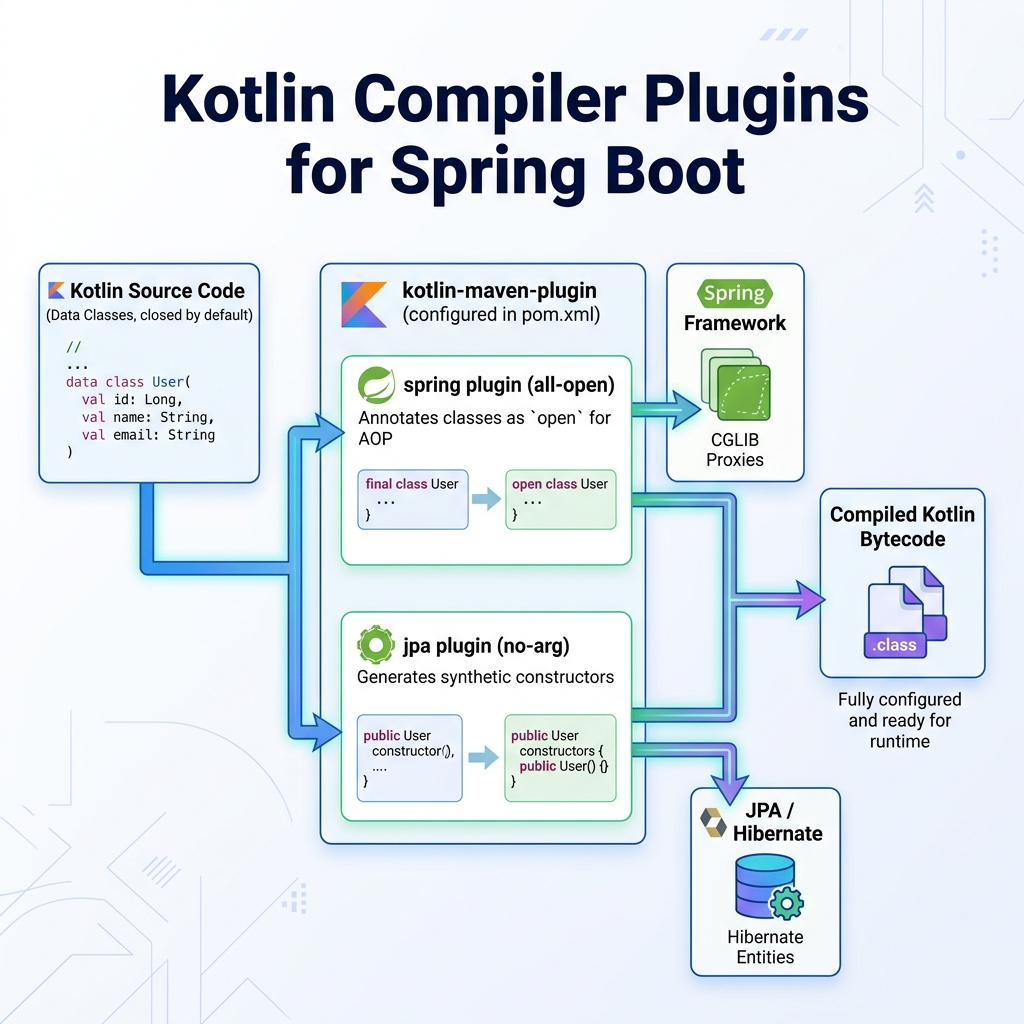
As illustrated in Figure 1, the compiler plugins execute during the build phase:
- All-Open (kotlin-spring): Automatically marks classes annotated with
@Component,@Service,@Repository,@Controller,@RestController, and@Configurationas open for subclassing. - No-Arg (kotlin-jpa): Generates zero-argument constructors for classes annotated with
@Entity,@MappedSuperclass, and@Embeddable. This satisfies Hibernate 7.1 reflection requirements without cluttering domain constructors.
Here is the clean Maven configuration in pom.xml to enable these plugins for Spring Boot 4:
<plugin>
    <groupId>org.jetbrains.kotlin</groupId>
    <artifactId>kotlin-maven-plugin</artifactId>
    <configuration>
        <jvmTarget>25</jvmTarget>
        <args>
            <arg>-Xjsr305=strict</arg>
        </args>
        <compilerPlugins>
            <plugin>spring</plugin>
        </compilerPlugins>
    </configuration>
    <dependencies>
        <dependency>
            <groupId>org.jetbrains.kotlin</groupId>
            <artifactId>kotlin-maven-allopen</artifactId>
            <version>${kotlin.version}</version>
        </dependency>
    </dependencies>
</plugin>
Compile-Time Null Safety in Spring Boot 4
Null pointer errors are historically among the most frequent causes of production outages in enterprise Java backends. Kotlin treats nullability as part of its core type system. A variable of type String cannot hold null. If you need a value that can be absent, you must declare it explicitly with a question mark: String?.
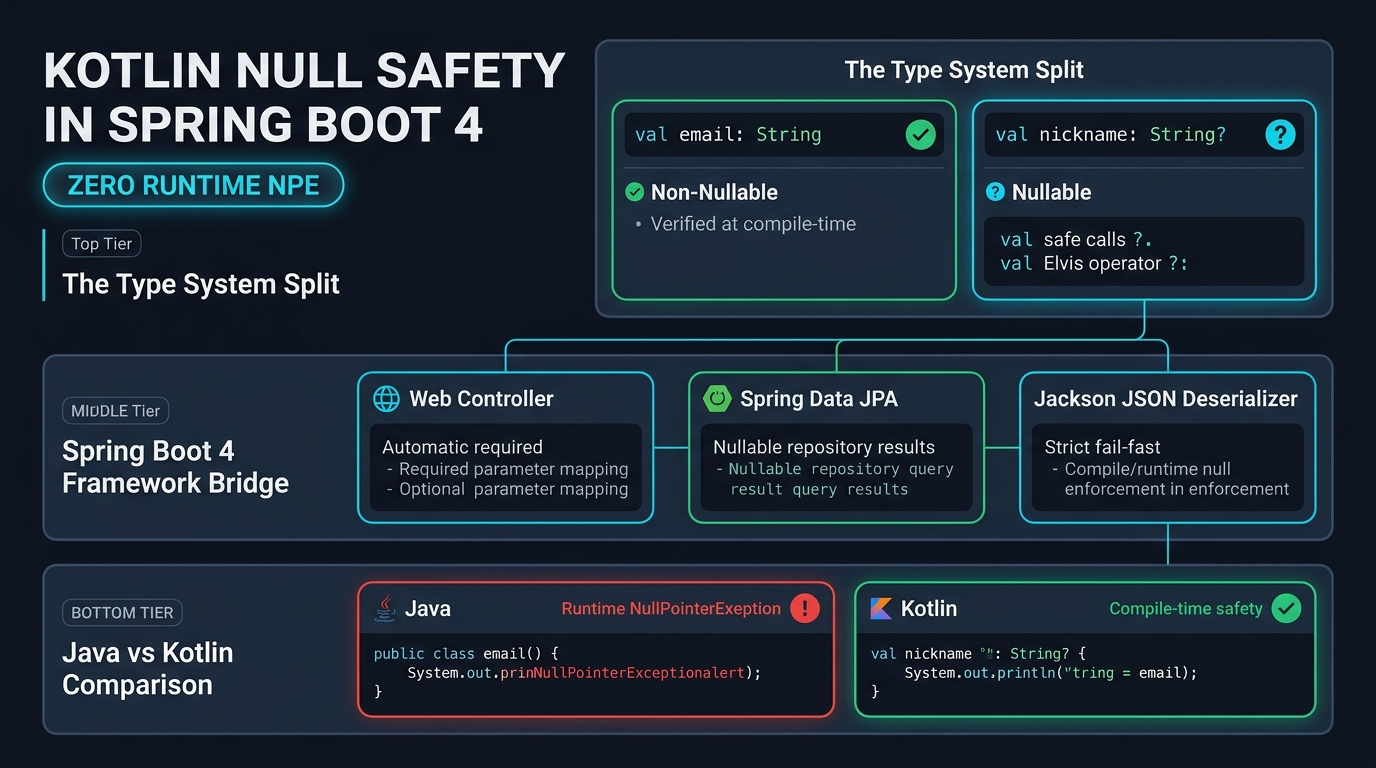
As demonstrated in Figure 2, Spring Boot 4 integrates deeply with Kotlin nullability:
- REST Query Parameters: A controller parameter typed as
val filter: Stringis treated as mandatory. Spring automatically rejects requests without this query parameter with HTTP 400 Bad Request. In contrast,val filter: String?is optional. - Jackson Deserialization: When using
jackson-module-kotlin, missing required fields in incoming JSON payloads trigger an immediate deserialization error. The framework prevents partially initialized, invalid objects from entering your business services. - Spring Framework API Nullability: Spring Boot 4 uses JSR-305 annotations (
@NonNullApi,@Nullable). When compiled with-Xjsr305=strict, the Kotlin compiler enforces these annotations at compile time.
Here is an example demonstrating clean null handling in a domain entity and service:
package com.webcodein.kotlin.user

data class User(
    val id: Long,
    val username: String,       // Non-nullable: guaranteed never null
    val email: String,          // Non-nullable: guaranteed never null
    val bio: String? = null     // Nullable: optional field with default null
)

// Extension function demonstrating safe string template formatting
fun User.toSummary(): String =
    if (bio != null) "$username ($email): $bio" else "$username ($email)"
Data Classes, Value Classes, and DTO Validation
Writing boilerplate data structures in Java often requires getters, setters, equals(), hashCode(), and toString() methods. While Java records solve this for immutable tuples, Kotlin provides even greater flexibility through data classes and inline value classes.
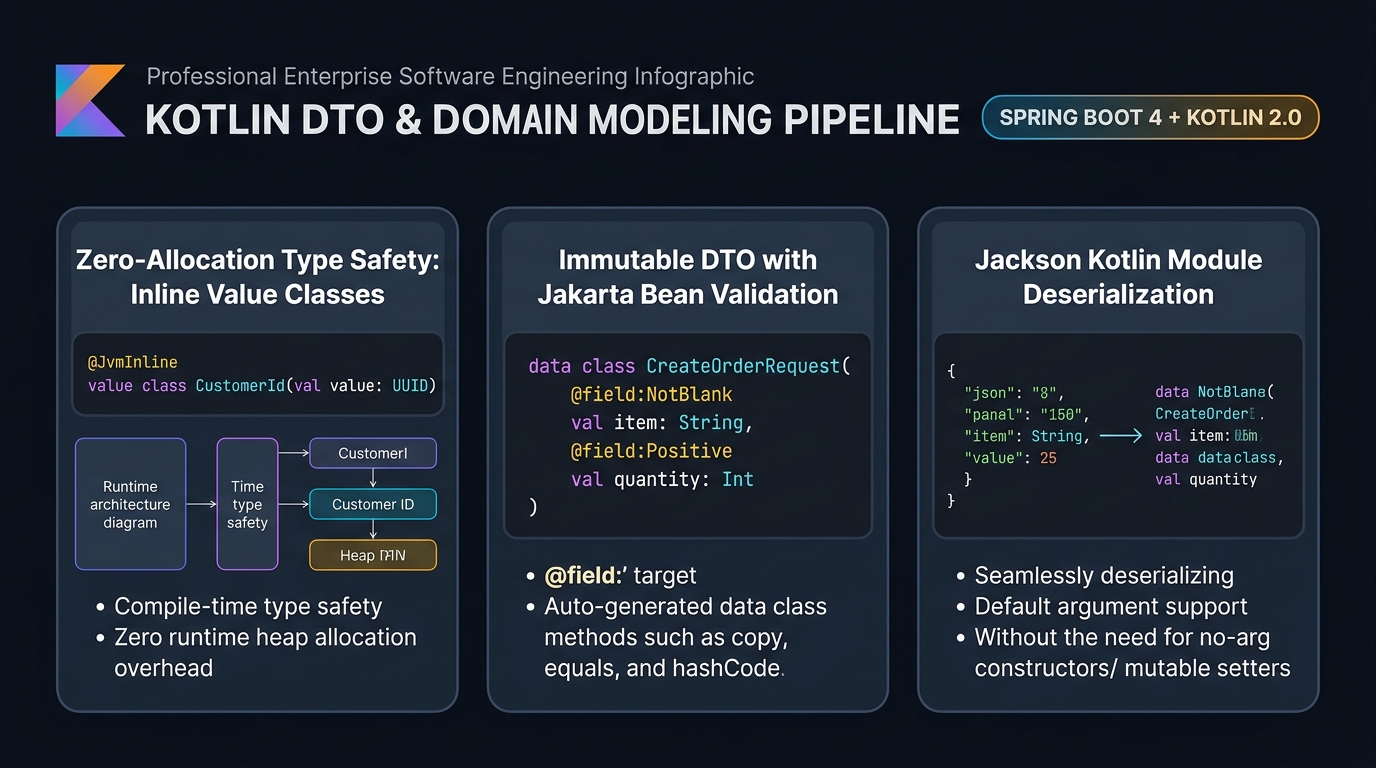
Figure 3 highlights three key architectural capabilities:
- Inline Value Classes (@JvmInline): Wraps primitive values (such as an order ID or email address) in a strongly typed class. At compile time, you cannot pass a
UserIdinto a parameter expecting anOrderId. At runtime, the compiler inlines the wrapped value directly, eliminating heap object allocation overhead. - Data Class Destructuring and Copy: Kotlin generates
component1(),component2(), andcopy()functions automatically. You can clone an immutable object while modifying only one attribute in a single line of code. - Use-Site Targets for Bean Validation: In Kotlin, declaring a property in a primary constructor creates a private field, a getter, and a constructor parameter. When applying Jakarta Bean Validation annotations like
@NotBlank, prefix the annotation with@field:so the validation framework inspects the generated field.
Here is an enterprise request DTO with validation and default parameters:
package com.webcodein.kotlin.user

import jakarta.validation.constraints.Email
import jakarta.validation.constraints.NotBlank
import jakarta.validation.constraints.Size

data class CreateUserRequest(
    @field:NotBlank(message = "Username must not be blank")
    @field:Size(min = 3, max = 50, message = "Username must be between 3 and 50 characters")
    val username: String,

    @field:NotBlank(message = "Email must not be blank")
    @field:Email(message = "Must be a valid email address")
    val email: String,

    @field:Size(max = 250, message = "Bio cannot exceed 250 characters")
    val bio: String? = null
)
Reactive Concurrency: Coroutines and Flow in Spring WebFlux
Asynchronous and reactive programming is essential for building high-throughput cloud services. However, traditional reactive libraries like Project Reactor require chaining operators such as .flatMap(), .map(), and .onErrorResume(). This functional chaining leads to callback complexity and difficult stack traces.
Kotlin Coroutines revolutionize reactive development. They allow you to write non-blocking asynchronous code using sequential, imperative syntax. When a function pauses to wait for a database query or external REST call, it suspends execution without blocking the underlying thread.
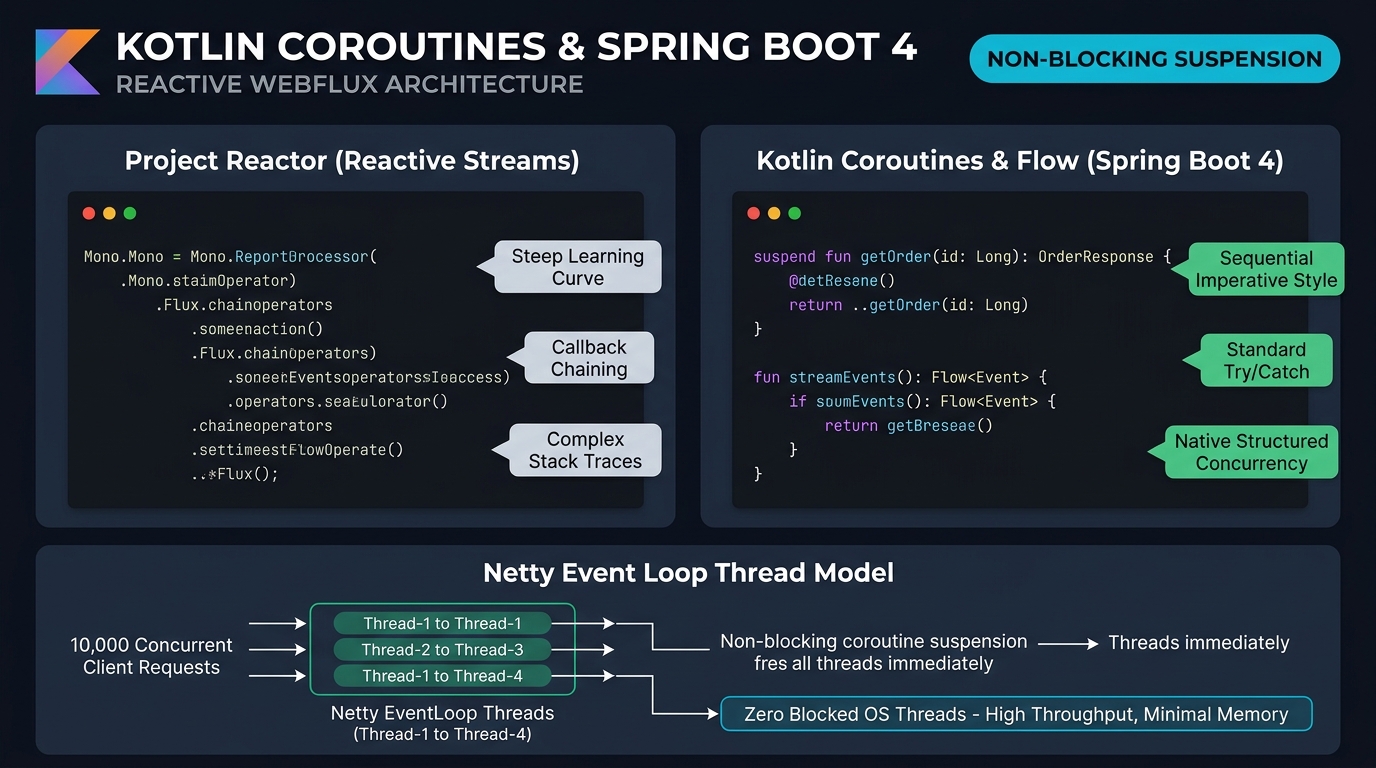
As shown in Figure 4, Kotlin Coroutines integrate natively with Spring WebFlux:
- Suspending Controller Functions: Prefix your controller methods with the
suspendkeyword:suspend fun getProfile(): ProfileResponse. Spring WebFlux detects the suspension point and runs the coroutine on non-blocking threads. - Streaming with Flow: For multi-item reactive streams or Server-Sent Events (SSE), return Kotlin’s
Flow<T>instead of Project Reactor’sFlux<T>. You get full backpressure support with simple collection-like transformation operators. - Structured Concurrency: Coroutines provide structured parent-child scopes. If a child operation fails, all sibling operations cancel automatically, preventing memory leaks and orphaned background tasks.
Notice how clean a reactive coroutine service appears compared to Reactor chains:
package com.webcodein.kotlin.order

import kotlinx.coroutines.flow.Flow
import org.springframework.web.bind.annotation.*

@RestController
@RequestMapping("/api/orders")
class OrderController(private val orderService: OrderService) {

    // Runs asynchronously without blocking the web thread
    @GetMapping("/{id}")
    suspend fun getOrderById(@PathVariable id: Long): Order =
        orderService.fetchOrder(id)

    // Streams live order events using Kotlin Flow
    @GetMapping(produces = ["text/event-stream"])
    fun streamLiveOrders(): Flow<OrderEvent> =
        orderService.streamEvents()
}
Functional Configuration: Co-Router DSL and Bean Registration
Spring Boot applications traditionally use annotations like @Configuration and @Bean. While annotations are convenient, they require runtime classpath scanning and CGLIB reflection. In modern serverless and cloud environments, fast startup and minimal memory footprint are paramount.
Spring Boot 4 provides functional Kotlin DSLs that allow you to register beans and define HTTP routes without annotations. This functional approach pairs perfectly with GraalVM Native Images because it eliminates runtime reflection.
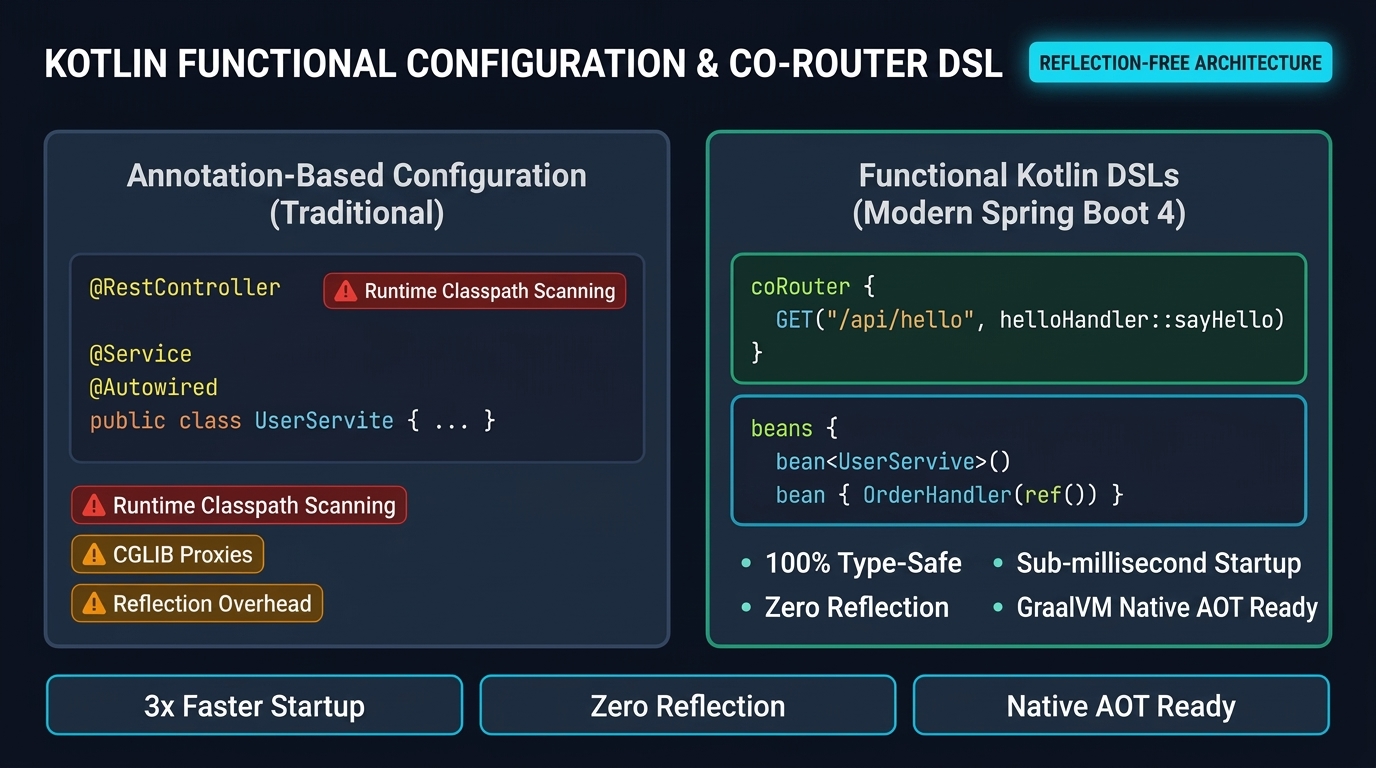
Figure 5 illustrates the two configuration approaches:
- Annotation-Based: Relies on reflection, component scanning, and proxy generation. This approach has slightly higher startup latency.
- Functional Co-Router DSL: Uses
coRouter { }to declare routes directly in code. Handlers are referenced as pure functions. Beans are registered usingbeans { }. The JVM initializes the entire application context in single-digit milliseconds.
Here is an example of functional routing in Spring Boot 4:
package com.webcodein.kotlin.routing

import org.springframework.context.support.beans
import org.springframework.web.reactive.function.server.ServerResponse
import org.springframework.web.reactive.function.server.bodyValueAndAwait
import org.springframework.web.reactive.function.server.coRouter

fun applicationRoutes(handler: GreetingHandler) = coRouter {
    GET("/api/v2/greet") { request ->
        val name = request.queryParam("name").orElse("Developer")
        ServerResponse.ok().bodyValueAndAwait(mapOf("message" to "Hello, $name!"))
    }
}

val applicationBeans = beans {
    bean<GreetingHandler>()
    bean { applicationRoutes(ref()) }
}
Step-by-Step Code Implementation
Let us now walk through the complete implementation of our companion workshop project. The project demonstrates clean REST controllers, service abstractions, null safety, and MockMvc web slice testing.
Step 1: Define Application Entry Point
In src/main/kotlin/com/webcodein/kotlin/KotlinApplication.kt, initialize the Spring Boot application:
package com.webcodein.kotlin

import org.springframework.boot.autoconfigure.SpringBootApplication
import org.springframework.boot.runApplication

@SpringBootApplication
class KotlinApplication

fun main(args: Array<String>) {
    runApplication<KotlinApplication>(*args)
}
Step 2: Create the Service and Controller
In src/main/kotlin/com/webcodein/kotlin/user/UserService.kt, define the domain entities, service layer, and REST endpoints:
package com.webcodein.kotlin.user

import org.springframework.http.HttpStatus
import org.springframework.http.ResponseEntity
import org.springframework.stereotype.Service
import org.springframework.web.bind.annotation.*
import java.util.concurrent.ConcurrentHashMap
import java.util.concurrent.atomic.AtomicLong

data class User(
    val id: Long,
    val username: String,
    val email: String,
    val bio: String? = null
)

data class CreateUserRequest(
    val username: String,
    val email: String,
    val bio: String? = null
)

fun User.toSummary(): String =
    if (bio != null) "$username ($email): $bio" else "$username ($email)"

@Service
class UserService {
    private val users = ConcurrentHashMap<Long, User>()
    private val idCounter = AtomicLong(1L)

    init {
        save(CreateUserRequest(username = "ada", email = "ada@lovelace.dev", bio = "Computing pioneer"))
        save(CreateUserRequest(username = "grace", email = "grace@hopper.dev"))
    }

    fun findById(id: Long): User? = users[id]

    fun findByEmail(email: String): User? =
        users.values.firstOrNull { it.email.equals(email, ignoreCase = true) }

    fun findAll(): List<User> = users.values.toList()

    fun save(request: CreateUserRequest): User {
        val id = idCounter.getAndIncrement()
        val user = User(id = id, username = request.username, email = request.email, bio = request.bio)
        users[id] = user
        return user
    }
}

@RestController
@RequestMapping("/api/users")
class UserController(private val userService: UserService) {

    @GetMapping
    fun getAllUsers(): List<User> = userService.findAll()

    @GetMapping("/{id}")
    fun getUserById(@PathVariable id: Long): ResponseEntity<User> {
        val user = userService.findById(id)
        return if (user != null) {
            ResponseEntity.ok(user)
        } else {
            ResponseEntity.notFound().build()
        }
    }

    @PostMapping
    @ResponseStatus(HttpStatus.CREATED)
    fun createUser(@RequestBody request: CreateUserRequest): User =
        userService.save(request)

    @GetMapping("/{id}/summary")
    fun getUserSummary(@PathVariable id: Long): ResponseEntity<String> {
        val user = userService.findById(id)
        return if (user != null) {
            ResponseEntity.ok(user.toSummary())
        } else {
            ResponseEntity.notFound().build()
        }
    }
}
Step 3: Test with MockMvc Slice Testing
In src/test/kotlin/com/webcodein/kotlin/user/UserControllerTest.kt, write slice tests verifying endpoint contracts:
package com.webcodein.kotlin.user

import org.junit.jupiter.api.DisplayName
import org.junit.jupiter.api.Test
import org.mockito.BDDMockito.given
import org.springframework.beans.factory.annotation.Autowired
import org.springframework.boot.webmvc.test.autoconfigure.WebMvcTest
import org.springframework.http.MediaType
import org.springframework.test.context.bean.override.mockito.MockitoBean
import org.springframework.test.web.servlet.MockMvc
import org.springframework.test.web.servlet.request.MockMvcRequestBuilders.get
import org.springframework.test.web.servlet.request.MockMvcRequestBuilders.post
import org.springframework.test.web.servlet.result.MockMvcResultMatchers.*

@WebMvcTest(UserController::class)
class UserControllerTest {

    @Autowired
    private lateinit var mockMvc: MockMvc

    @MockitoBean
    private lateinit var userService: UserService

    @Test
    @DisplayName("GET /api/users should return all users")
    fun testGetAllUsers() {
        val users = listOf(
            User(1L, "ada", "ada@lovelace.dev", "Pioneer"),
            User(2L, "grace", "grace@hopper.dev", null)
        )
        given(userService.findAll()).willReturn(users)

        mockMvc.perform(get("/api/users"))
            .andExpect(status().isOk)
            .andExpect(jsonPath("$.length()").value(2))
            .andExpect(jsonPath("$[0].username").value("ada"))
            .andExpect(jsonPath("$[1].username").value("grace"))
    }

    @Test
    @DisplayName("GET /api/users/{id} should return 404 when user not found")
    fun testGetUserByIdNotFound() {
        given(userService.findById(999L)).willReturn(null)

        mockMvc.perform(get("/api/users/999"))
            .andExpect(status().isNotFound)
    }

    @Test
    @DisplayName("POST /api/users should create user and return HTTP 201")
    fun testCreateUser() {
        val request = CreateUserRequest("linus", "linus@kernel.org", "Linux")
        val created = User(3L, "linus", "linus@kernel.org", "Linux")
        given(userService.save(request)).willReturn(created)

        mockMvc.perform(
            post("/api/users")
                .contentType(MediaType.APPLICATION_JSON)
                .content("""{"username":"linus","email":"linus@kernel.org","bio":"Linux"}""")
        )
            .andExpect(status().isCreated)
            .andExpect(jsonPath("$.id").value(3))
            .andExpect(jsonPath("$.username").value("linus"))
    }
}
Comparative Analysis: Kotlin 2.0 vs Alternatives
To help you choose the best technology stack for your backend projects, evaluate how Kotlin 2.0 compares with Java 25, Scala, Go, and TypeScript:
| Feature / Dimension | Kotlin 2.0 (Spring Boot 4) | Java 25 (Spring Boot 4) | Scala 3 (Play / Pekko) | Go (Gin / Fiber) | TypeScript (NestJS) |
|---|---|---|---|---|---|
| Null Safety | Strict compile-time type system (T vs T?) |
Optional types and JSR-305 annotations; NPE possible | Option monadic wrapper; compile-time safety | Explicit nil error checks; runtime panics |
Strict null checks in compiler; runtime type erasure |
| Concurrency Model | Lightweight Coroutines + Virtual Threads integration | Java 25 Virtual Threads (Project Loom) | Akka / Pekko Actor model + Futures | Goroutines with communication channels | Single-threaded Event Loop with async/await |
| Boilerplate Syntax | Minimal: data classes, default args, extension functions | Moderate: Records, pattern matching, switch expressions | Very low: case classes, implicit definitions | Moderate: manual struct instantiation and error handling | Low: decorators and TypeScript interfaces |
| Spring Ecosystem Synergy | First-class extensions, Co-Router DSL, Jackson Kotlin module | Native reference language; 100% framework alignment | Community adapters; lacks official Spring tooling | None (Separate standalone ecosystem) | None (Independent framework models) |
| Compilation Speed | Fast (New K2 compiler frontend in Kotlin 2.0) | Ultra-fast standard javac compiler |
Slower due to complex type derivation | Ultra-fast native compilation | Fast Transpilation via SWC or esbuild |
| Target Use Case | Enterprise microservices, reactive streams, modular monoliths | High-performance systems, legacy enterprise codebases | Complex data pipelines, streaming analytics | High-throughput network proxies, CLI tools | Full-stack JavaScript/TypeScript web portals |
Real-World Enterprise Use Cases
Combining Kotlin 2.0 with Spring Boot 4 solves concrete business challenges in production environments:
1. High-Throughput Fintech Payment Gateway
Payment processing gateways must communicate concurrently with third-party banking APIs, fraud detection engines, and ledger databases. Using Kotlin Coroutines with Spring WebFlux, engineers coordinate multiple outbound REST and gRPC calls concurrently with structured concurrency. When a network timeout occurs on one vendor, sibling requests cancel immediately, preserving system resources and preventing thread pool starvation.
2. Mission-Critical Medical Record Ingestion
Healthcare APIs receive complex patient records from laboratory instruments and hospital databases. Ingesting records with null values in required patient identifier fields can lead to corrupt medical histories. Kotlin’s strict null-safety system ensures that missing vital attributes fail fast during JSON deserialization, preventing invalid records from ever reaching downstream microservices.
3. Serverless Edge Microservices with GraalVM Native Image
Cloud functions and Kubernetes pods require sub-second cold starts and minimal RAM footprints. By pairing Kotlin’s functional Co-Router DSL with GraalVM Native Image compilation, teams produce native binaries that start in under 25 milliseconds and consume less than 35 megabytes of memory.
Production Guidelines and Performance Hardening
When deploying Kotlin Spring Boot 4 applications to production, implement these operational best practices:
1. Configure the Jackson Kotlin Module Correctly
Ensure that jackson-module-kotlin is present on the runtime classpath. Spring Boot 4 automatically registers this module. It allows Jackson to read Kotlin reflection metadata, ensuring that default parameter values are applied correctly when JSON attributes are omitted.
2. Enforce Strict JSR-305 Compiler Flags
Always pass -Xjsr305=strict to the Kotlin compiler in your Maven or Gradle build file. This flag forces the compiler to treat Spring framework nullability annotations (such as @Nullable and @NonNullApi) as strict type contracts rather than lenient warnings.
3. Align with Modular Monolith Architecture
When organizing large codebases, use modular package boundaries. Review our architectural guide on Building Modular Monoliths with Spring Modulith to enforce clean module encapsulation between your Kotlin domain modules.
Common Mistakes and How to Fix Them
Avoid these common traps when building Kotlin applications with Spring Boot 4:
Mistake 1: Final Class Proxy Errors with Spring AOP
The Mistake: Omitting the kotlin-spring compiler plugin. Because Kotlin classes are final by default, Spring fails to generate CGLIB proxies for classes annotated with @Transactional or @Async, resulting in subtle runtime bugs where transactions are ignored.
The Fix: Add the kotlin-spring compiler plugin to the kotlin-maven-plugin configuration in your build file. It automatically opens all Spring-managed beans.
Mistake 2: Missing No-Arg Constructors for Hibernate Entities
The Mistake: Declaring a JPA entity as a Kotlin data class without a zero-argument constructor: data class Order(val id: Long, val total: BigDecimal). Hibernate requires a zero-argument constructor to instantiate entities via reflection from JDBC result sets.
The Fix: Add the kotlin-jpa compiler plugin, or provide default parameter values for every property in the entity constructor.
Mistake 3: Omitting the @field: Target on Validation Annotations
The Mistake: Writing data class UserDto(@NotBlank val name: String) without a use-site target. The Kotlin compiler applies the annotation to the constructor parameter rather than the field, causing Jakarta Bean Validation to ignore the rule.
The Fix: Explicitly specify the field target: data class UserDto(@field:NotBlank val name: String).
Frequently Asked Questions (FAQ)
Is Kotlin 2.0 fully compatible with Java 25 and Spring Boot 4?
Yes. Kotlin 2.0 features the new K2 compiler frontend and generates bytecode compatible with JVM bytecode levels through Java 25. Spring Boot 4 officially supports Kotlin 2.0 out of the box.
Why are Kotlin classes final by default, and how does Spring handle it?
Kotlin adopted “closed by default” based on Effective Java principles to prevent accidental inheritance issues. The kotlin-spring compiler plugin bridges this gap by automatically opening classes annotated with Spring stereotypes during compilation.
How do Kotlin Coroutines compare to Java 25 Virtual Threads?
Java 25 Virtual Threads run standard blocking code on lightweight user-mode threads managed by the JVM runtime. Kotlin Coroutines provide structured language-level concurrency with suspension points, explicit cancellation scopes, and reactive stream flow transformations. They complement each other, and Spring Boot 4 supports both concurrency models.
Can I use Kotlin data classes as JPA entities?
Yes, but with caution. Avoid using generated equals() and hashCode() methods that evaluate lazy child collections, as this can trigger unexpected database queries. For complex entity relationships, regular open classes are often preferred over data classes.
Does Kotlin increase Spring Boot application startup time?
No. Kotlin compiles directly to standard Java bytecode. At runtime, Kotlin classes execute at the same speed as Java classes. With Spring Boot 4 functional DSLs, startup times can even be faster than traditional Java annotation-based configurations.
Companion Code Repository
The complete, runnable source code for this guide is available on GitHub. It includes full entity implementations, user services, Spring MVC REST controllers, and MockMvc test suites:
GitHub: Kotlin Spring Boot 4 Backend Guide Companion Project