The Evolution of OAuth Authorization
OAuth 2.0 was originally published by the Internet Engineering Task Force (IETF) in 2012 under RFC 6749. At the time, the software development ecosystem looked radically different than it does today. Smartphones were in their infancy, modern Single Page Application (SPA) frameworks like Angular and React did not exist, and most web traffic still flowed through server-rendered monolithic templates.
To accommodate this wide variety of devices and architectures, RFC 6749 offered tremendous flexibility. It defined four core authorization grant types: Authorization Code Grant, Implicit Grant, Resource Owner Password Credentials Grant, and Client Credentials Grant. It allowed implementers broad discretion in choosing client authentication methods, token delivery channels, and redirect URI validation rules.
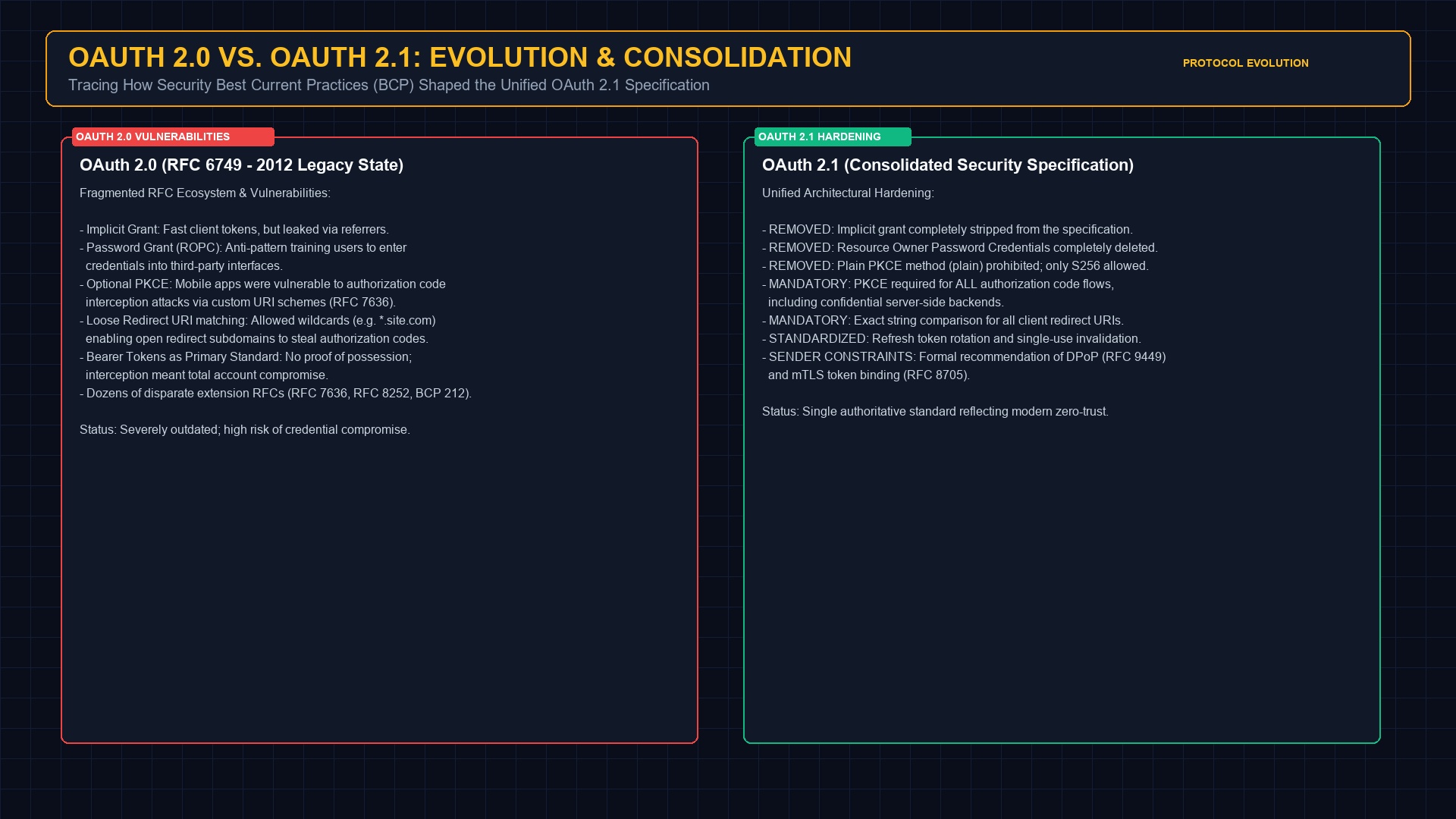
Over the subsequent decade, this vast flexibility proved to be a double-edged sword. As cyberattacks grew more sophisticated, attackers systematically discovered severe security loopholes in OAuth 2.0’s optional features. Millions of user accounts were compromised through token interception, authorization code eavesdropping, and open redirect vulnerabilities. The authorization ecosystem became fragmented across dozens of supplemental Best Current Practice (BCP) documents and extension RFCs.
Why OAuth 2.1 Was Created
To resolve this fragmentation and establish an uncompromising security baseline, the IETF OAuth Working Group authored OAuth 2.1 (draft-ietf-oauth-v2-1). OAuth 2.1 is not a brand new protocol that breaks existing architectures. Instead, it is an authoritative consolidation that incorporates ten years of real-world operational security lessons into a single core specification.
OAuth 2.1 achieves three fundamental objectives:
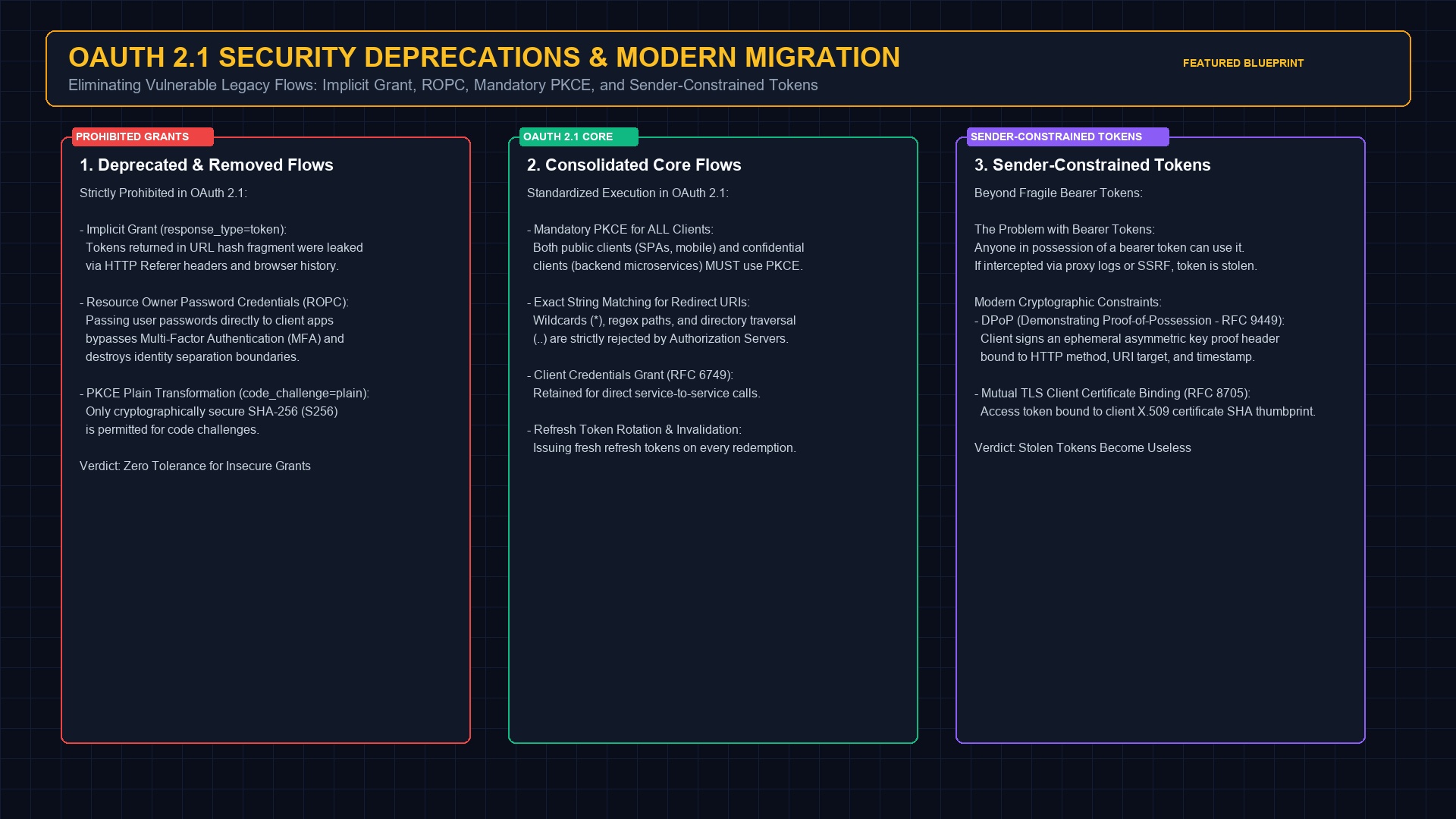
- Elimination of Broken Grants: It formally deprecates and deletes vulnerable legacy grant types, including the Implicit Grant and Resource Owner Password Credentials.
- Mandatory Cryptographic Verification: It mandates Proof Key for Code Exchange (PKCE) for every authorization code exchange, eliminating authorization code interception attacks across both public and confidential clients.
- Strict URI Matching: It forbids wildcards and path traversal in redirect URIs, stopping open-redirect code-stealing attacks completely.
By enforcing these rules, OAuth 2.1 provides modern backend architectures with a zero-trust authorization foundation that resists token theft, credential forwarding, and network eavesdropping.
Removal of the Implicit Grant
In RFC 6749, the Implicit Grant (response_type=token) was designed specifically for client-side JavaScript applications running in web browsers. Because browsers in 2012 could not safely store client secrets, the Authorization Server returned access tokens directly in the URL hash fragment of the redirect URI:
HTTP/1.1 302 Found
Location: https://spa.example.com/callback#access_token=eyJhbGciOi...&token_type=bearer&expires_in=3600
This design contained fatal security flaws:
- Referrer Header Leakage: If the Single Page Application loaded any external resource (such as an image or analytics script), the entire URL—including the raw access token in the hash fragment—was frequently included in outgoing HTTP
Refererheaders. - Browser History Exposure: URLs with access tokens were saved in plain text within browser browsing histories and mobile device diagnostic logs.
- Lack of Sender Authentication: Because no client secret or verification exchange occurred, anyone intercepting the hash fragment could immediately impersonate the user.
In OAuth 2.1, the Implicit Grant is completely removed from the specification. Modern Single Page Applications must now use the Authorization Code Flow with PKCE, which returns ephemeral, single-use authorization codes instead of raw access tokens.
Removal of Resource Owner Password Credentials (ROPC)
The Resource Owner Password Credentials grant (grant_type=password) allowed client applications to collect a user’s raw username and password directly, then exchange them for an access token via a backend POST call:
POST /oauth/token HTTP/1.1
Host: authz.example.com
Content-Type: application/x-www-form-urlencoded

grant_type=password&username=john.doe@example.com&password=SuperSecretPassword123!&client_id=mobile-app
ROPC was originally introduced as a transitional mechanism for legacy corporate applications migrating to OAuth. In practice, it became a dangerous anti-pattern. ROPC violates the core philosophy of OAuth: users must never hand their primary authentication credentials to third-party client applications.
When an application uses ROPC, the client application has visibility into plain-text passwords. Malicious or compromised clients can log credentials, store them insecurely, or attempt credential stuffing across other services. Furthermore, ROPC completely breaks modern identity features: it cannot support Multi-Factor Authentication (MFA), FIDO2/WebAuthn hardware security keys, or federated Single Sign-On (SSO).
OAuth 2.1 completely deletes ROPC. All user authentication must occur on the Authorization Server’s hosted login page via standard web redirects or system browser tabs, preserving credential isolation.
Mandatory PKCE for All Clients (Public and Confidential)
Proof Key for Code Exchange (PKCE), originally standardized in RFC 7636, was initially created to defend native mobile applications against authorization code interception attacks. On mobile operating systems like Android and iOS, multiple applications can register the same custom URI scheme (e.g. myapp://oauth-callback). A rogue malicious app could intercept the authorization code redirect and exchange it for a token before the legitimate app could respond.
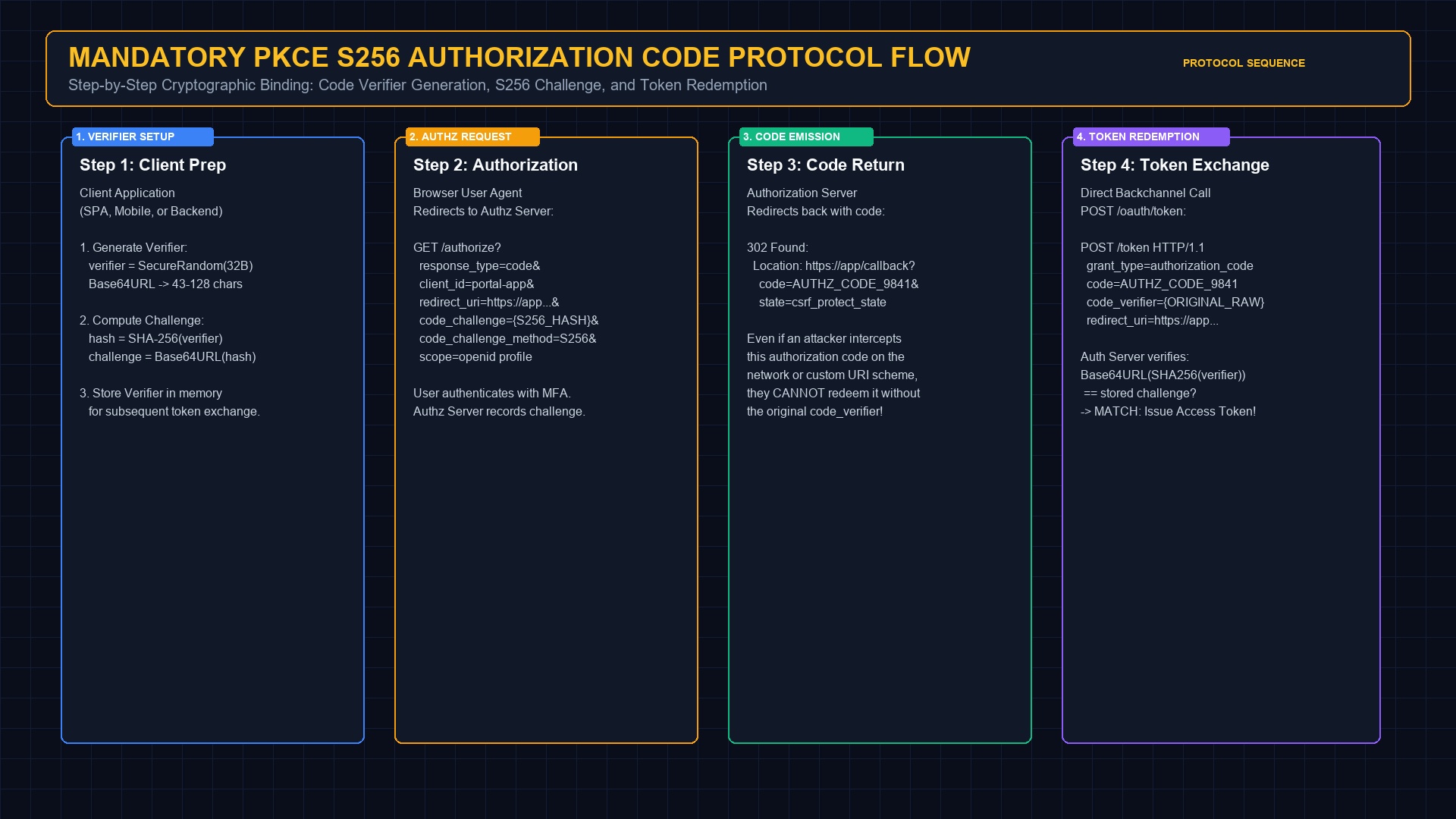
PKCE solves this attack by binding the authorization request cryptographically to the subsequent token redemption:
- Code Verifier Creation: The client generates a high-entropy cryptographically random string between 43 and 128 characters using unreserved URL characters.
- Code Challenge Computation: The client calculates the SHA-256 hash of the verifier and encodes it in Base64URL:
code_challenge = BASE64URL(SHA256(code_verifier)). - Authorization Request: The client sends the
code_challengeandcode_challenge_method=S256to the/authorizeendpoint. The Authorization Server stores the challenge alongside the issued authorization code. - Token Redemption: When the client redeems the code at
/token, it submits the original rawcode_verifier. The Authorization Server hashes the verifier with SHA-256 and compares it against the stored challenge. If they match, the access token is granted.
Even if an attacker intercepts the authorization code on the network or via OS custom schemes, they cannot redeem it because they lack the raw code_verifier, which remained safely in the legitimate client’s memory.
Under OAuth 2.0, PKCE was considered optional, and many developers assumed confidential backend servers did not need it. In OAuth 2.1, PKCE is mandatory for ALL clients—including confidential server-to-server web backends. Furthermore, the legacy plain transformation method is strictly prohibited; clients must use S256.
Exact Redirect URI String Matching
In legacy OAuth 2.0 implementations, authorization servers frequently permitted loose redirect URI matching. Developers configured partial path matches, regular expressions, or wildcard subdomains:
https://*.example.com/oauth/callbackThis loose validation opened the door to devastating account takeover attacks. If an attacker discovered an open redirect vulnerability or a cross-site scripting flaw on any arbitrary subdomain of example.com, they could craft an authorization request redirecting to their compromised subdomain:
GET /authorize?client_id=123&redirect_uri=https://blog.example.com/redirect?to=https://evil.comThe authorization server evaluated blog.example.com against the wildcard pattern, approved the redirect, and transmitted the authorization code straight into the attacker’s hands.
OAuth 2.1 completely eliminates this attack surface by mandating exact character-by-character string matching. The authorization server must compare the requested redirect URI against a pre-registered list of full, absolute URIs using simple string equality. Wildcards, regular expressions, and directory traversal sequences (such as /callback/../evil) are strictly rejected.
Refresh Token Rotation and Single-Use Revocation
When public clients (such as Single Page Applications or mobile apps) execute authorization code flows, they cannot securely protect persistent client secrets. If an application receives a long-lived refresh token, that refresh token is vulnerable to extraction via device theft or local storage compromise.
OAuth 2.1 establishes rigorous security rules for refresh tokens issued to public clients:
- Refresh Token Rotation: Whenever a client presents a refresh token to obtain a new access token, the Authorization Server must invalidate the used refresh token and issue a brand-new refresh token in the response.
- Automatic Breach Detection: If the Authorization Server detects that an already-used refresh token is presented a second time, it assumes a token theft incident has occurred. The server must immediately revoke the entire refresh token family, invalidating all active sessions for that user.
This automated rotation mechanism drastically reduces the window of opportunity for an attacker attempting to exploit stolen refresh credentials.
Sender-Constrained Tokens: DPoP and mTLS
Traditional OAuth access tokens are bearer tokens. As defined in RFC 6750, a bearer token is like cash: whoever holds the token can spend it. If an attacker intercepts a bearer token through proxy logging, Server-Side Request Forgery (SSRF), or intermediate cache exposure, they can immediately invoke backend APIs with full user permissions.
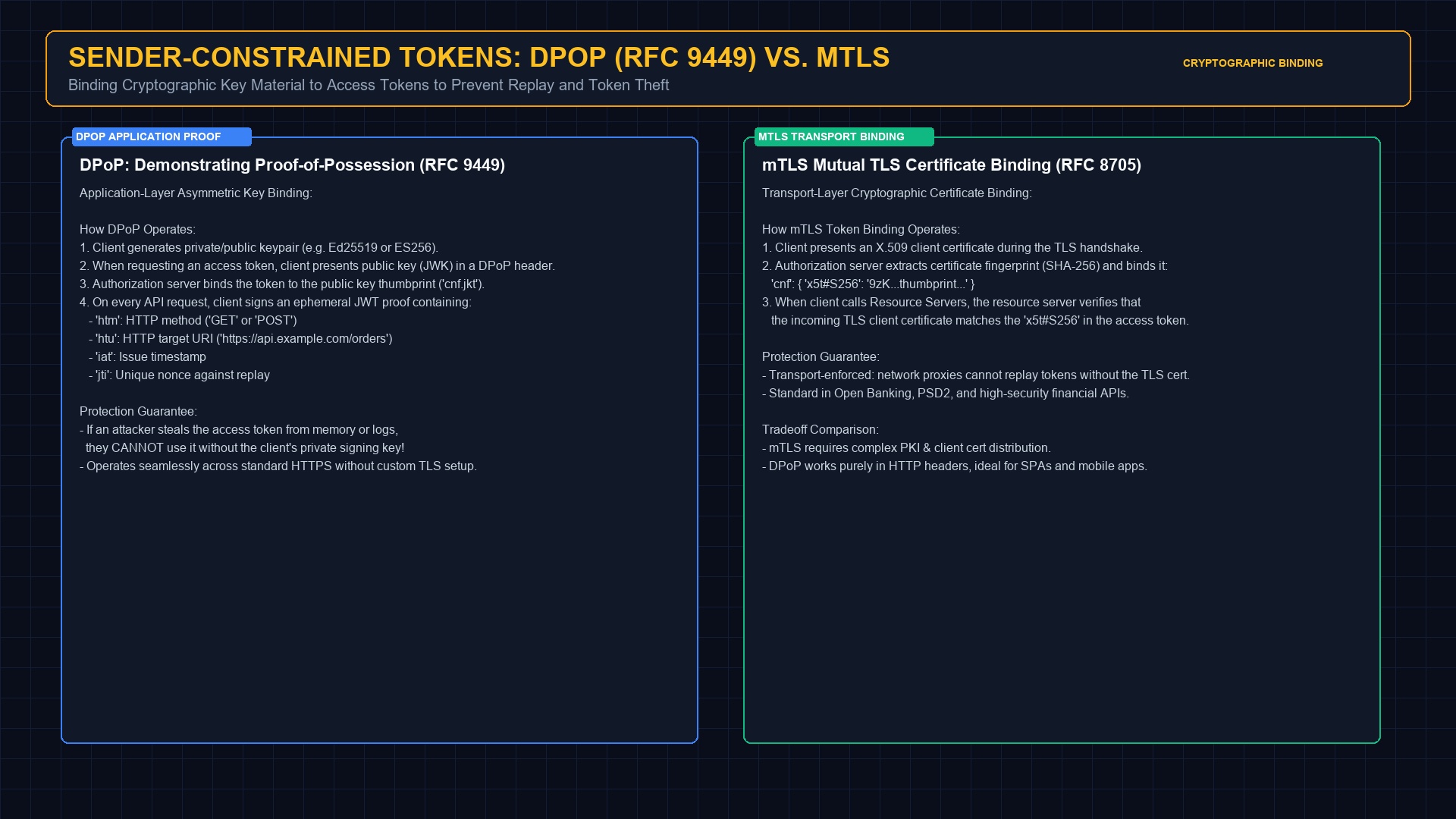
OAuth 2.1 strongly recommends transitioning from bearer tokens to sender-constrained tokens. Sender-constrained tokens bind cryptographic key material to the access token, guaranteeing that only the legitimate sender can present it.
There are two primary industry standards for sender constraint:
- DPoP: Demonstrating Proof-of-Possession (RFC 9449):
DPoP operates entirely at the application layer using asymmetric cryptography (such as Ed25519 or ECDSA). When requesting an access token, the client presents a public key. The authorization server hashes the public key and embeds the thumbprint into the token (the
cnf.jktclaim). When calling protected backend APIs, the client signs an ephemeral JWT proof containing the HTTP method, request URI, and timestamp. If an attacker steals the access token, they cannot make API calls because they lack the client’s private signing key. - Mutual TLS Client Certificate-Bound Access Tokens (RFC 8705):
mTLS token binding operates at the transport layer. The client presents an X.509 client certificate during the TLS handshake. The authorization server binds the SHA-256 fingerprint of the certificate to the token (the
cnf.x5t#S256claim). Backend resource servers verify that incoming client TLS certificates match the token’s bound thumbprint. This approach is widely adopted in Open Banking, healthcare, and high-security government APIs.
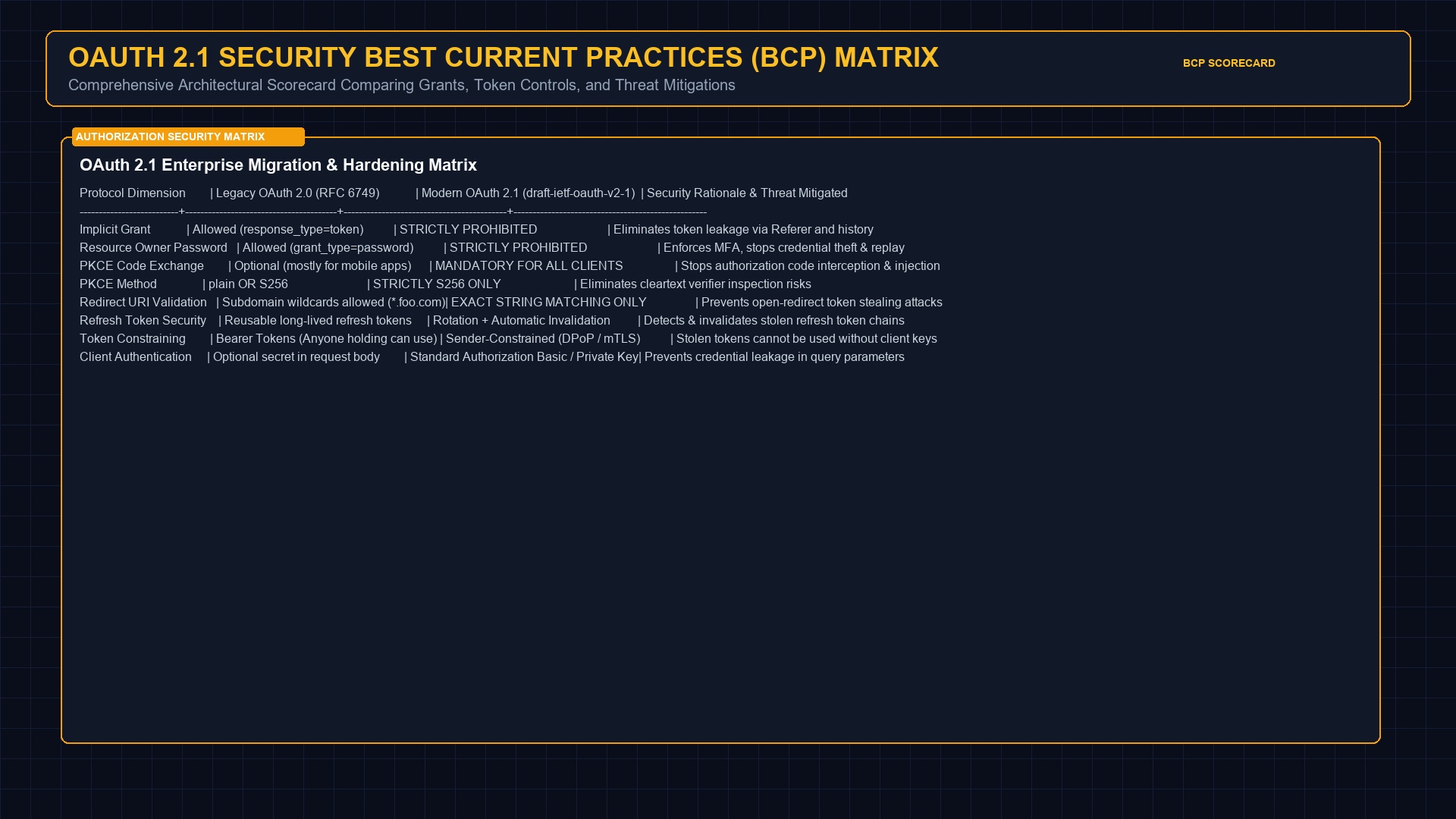
OAuth 2.0 vs. OAuth 2.1 Architectural Comparison Matrix
To help engineering teams plan their authorization modernization, the following table details the key architectural changes between OAuth 2.0 and OAuth 2.1:
| Feature / Constraint | Legacy OAuth 2.0 (RFC 6749) | Modern OAuth 2.1 (draft-ietf-oauth-v2-1) | Security Benefit & Threat Prevented |
|---|---|---|---|
| Implicit Grant | Supported (response_type=token) |
Completely Prohibited | Prevents token exposure in URLs, referrers, and browser logs. |
| Resource Owner Password Grant | Supported (grant_type=password) |
Completely Prohibited | Eliminates plain-text password sharing and enforces MFA/SSO. |
| PKCE Enforcement | Optional (RFC 7636 extension) | Mandatory for ALL Clients | Neutralizes authorization code interception across all client types. |
| PKCE Challenge Method | plain or S256 allowed |
Strictly S256 Only | Prevents eavesdropping of cleartext code verifiers. |
| Redirect URI Validation | Partial paths and wildcards permitted | Exact String Equality Only | Eliminates open-redirect and subdomain code-theft exploits. |
| Public Client Refresh Tokens | Long-lived static tokens allowed | Mandatory Token Rotation | Limits exposure window and enables automated breach detection. |
| Token Constraining | Bearer Tokens (RFC 6750) default | DPoP (RFC 9449) / mTLS (RFC 8705) | Binds tokens to client keys, preventing unauthorized replay. |
| Client Credentials in URLs | Allowed in query string parameters | Strictly Prohibited | Prevents secret leakage in web server access logs and proxies. |
Practical Java 25 OAuth 2.1 Validation Engine Implementation
To demonstrate how backend services enforce OAuth 2.1 rules, we built a standalone authorization validation engine in pure Java 25. The project contains zero Spring Boot dependencies, utilizing modern Java records, MessageDigest constant-time comparisons, and SecureRandom entropy.
First, we implement the PkceGenerator, which generates 43-128 character URL-safe verifiers and computes SHA-256 S256 challenges:
package com.webcodein.workshop.oauth21.engine;

import com.webcodein.workshop.oauth21.model.PkceChallenge;

import java.nio.charset.StandardCharsets;
import java.security.MessageDigest;
import java.security.NoSuchAlgorithmException;
import java.security.SecureRandom;
import java.util.Base64;

public class PkceGenerator {

    private final SecureRandom secureRandom = new SecureRandom();

    public String generateCodeVerifier() {
        byte[] bytes = new byte[32]; // 256 bits of entropy
        secureRandom.nextBytes(bytes);
        return Base64.getUrlEncoder().withoutPadding().encodeToString(bytes);
    }

    public String computeCodeChallenge(String codeVerifier) {
        if (codeVerifier == null || codeVerifier.length() < 43 || codeVerifier.length() > 128) {
            throw new IllegalArgumentException("code_verifier must be between 43 and 128 characters per RFC 7636");
        }
        try {
            MessageDigest digest = MessageDigest.getInstance("SHA-256");
            byte[] hash = digest.digest(codeVerifier.getBytes(StandardCharsets.US_ASCII));
            return Base64.getUrlEncoder().withoutPadding().encodeToString(hash);
        } catch (NoSuchAlgorithmException e) {
            throw new IllegalStateException("SHA-256 algorithm unavailable", e);
        }
    }

    public PkceChallenge createChallenge() {
        String verifier = generateCodeVerifier();
        String challenge = computeCodeChallenge(verifier);
        return new PkceChallenge(verifier, challenge, "S256");
    }
}
Second, we construct the OAuth21Validator, which enforces protocol-level deprecations and verifies incoming requests:
package com.webcodein.workshop.oauth21.engine;

import com.webcodein.workshop.oauth21.model.AuthorizationRequest;
import com.webcodein.workshop.oauth21.model.TokenRequest;

import java.nio.charset.StandardCharsets;
import java.security.MessageDigest;
import java.util.Objects;
import java.util.Set;

public class OAuth21Validator {

    private final PkceGenerator pkceGenerator = new PkceGenerator();

    public void validateAuthorizationRequest(AuthorizationRequest request, Set<String> registeredRedirectUris) {
        Objects.requireNonNull(request, "request must not be null");

        // Rule 1: Implicit Grant is strictly forbidden
        if ("token".equalsIgnoreCase(request.responseType())) {
            throw new IllegalArgumentException("unsupported_response_type: Implicit grant is deprecated and prohibited in OAuth 2.1");
        }

        if (!"code".equalsIgnoreCase(request.responseType())) {
            throw new IllegalArgumentException("unsupported_response_type: Only authorization code flow is permitted");
        }

        // Rule 2: PKCE is MANDATORY for ALL clients in OAuth 2.1
        if (request.pkce() == null || request.pkce().codeChallenge() == null || request.pkce().codeChallenge().isBlank()) {
            throw new IllegalArgumentException("invalid_request: PKCE code_challenge is mandatory for all clients in OAuth 2.1");
        }

        if (!"S256".equals(request.pkce().codeChallengeMethod())) {
            throw new IllegalArgumentException("invalid_request: Only S256 code_challenge_method is permitted in OAuth 2.1");
        }

        // Rule 3: Exact string matching for redirect URIs (No wildcards)
        validateRedirectUri(request.redirectUri(), registeredRedirectUris);
    }

    public void validateTokenRequest(TokenRequest request, String storedChallenge, String expectedRedirectUri) {
        Objects.requireNonNull(request, "request must not be null");

        // Rule 4: Resource Owner Password Credentials is strictly forbidden
        if ("password".equalsIgnoreCase(request.grantType())) {
            throw new IllegalArgumentException("unsupported_grant_type: ROPC is deprecated and prohibited in OAuth 2.1");
        }

        if ("authorization_code".equalsIgnoreCase(request.grantType())) {
            if (request.codeVerifier() == null || request.codeVerifier().isBlank()) {
                throw new IllegalArgumentException("invalid_grant: code_verifier is required to redeem authorization code");
            }

            // Cryptographic constant-time verification
            String computedChallenge = pkceGenerator.computeCodeChallenge(request.codeVerifier());
            byte[] computedBytes = computedChallenge.getBytes(StandardCharsets.US_ASCII);
            byte[] storedBytes = storedChallenge.getBytes(StandardCharsets.US_ASCII);

            if (!MessageDigest.isEqual(computedBytes, storedBytes)) {
                throw new IllegalArgumentException("invalid_grant: PKCE code_verifier does not match registered challenge");
            }

            if (request.redirectUri() != null && !request.redirectUri().equals(expectedRedirectUri)) {
                throw new IllegalArgumentException("invalid_grant: redirect_uri does not match original authorization request");
            }
        }
    }

    public void validateRedirectUri(String redirectUri, Set<String> registeredRedirectUris) {
        if (redirectUri.contains("*") || redirectUri.contains("..")) {
            throw new IllegalArgumentException("invalid_request_uri: Wildcards and path traversal in redirect_uri are prohibited");
        }

        if (registeredRedirectUris != null && !registeredRedirectUris.contains(redirectUri)) {
            throw new IllegalArgumentException("redirect_uri_mismatch: redirect_uri is not an exact match to pre-registered URIs");
        }
    }
}
Real-World Enterprise Case Studies
Case Study 1: Fintech Mobile App Eliminates Authorization Code Hijacking via PKCE S256
A high-growth mobile banking application utilized a custom URI scheme (bankapp://oauth/callback) to complete user authorization on Android and iOS. A security audit discovered that rogue mobile malware could register the identical custom URI scheme and intercept the authorization code when the system browser redirected back to the device.
The engineering team updated the Authorization Server to enforce OAuth 2.1 compliance with mandatory PKCE S256. The mobile app generates a cryptographically secure code_verifier in native memory and submits the SHA-256 code_challenge with the authorization request. When the rogue malware intercepted the authorization code, it attempted to redeem the code at the token endpoint. Because the malware did not possess the client’s internal code_verifier, the Authorization Server rejected the redemption immediately, completely neutralizing the attack.
Case Study 2: Enterprise SaaS Platform Migrates 2 Million SPA Users from Implicit Grant
A cloud customer relationship management (CRM) platform operated a Single Page Application that relied on the legacy OAuth 2.0 Implicit Grant. Users regularly reported security warnings because corporate firewalls were logging access tokens passed in URL hash fragments. Furthermore, third-party analytics scripts embedded in the portal were inadvertently reading tokens from the window.location.hash property.
The architecture team executed a seamless migration to OAuth 2.1 Authorization Code Flow with PKCE and Refresh Token Rotation. Instead of tokens in URLs, the SPA receives a single-use authorization code, performs an immediate backchannel exchange, and stores tokens in memory. Refresh tokens rotate on every invocation, and any token reuse triggers instant session termination. The migration eliminated token exposure in browser logs and improved the company’s enterprise security audit score from C to A+.
Case Study 3: Global Payment Gateway Neutralizes SSRF Replay Attacks with DPoP
A multinational payment processor provides REST APIs for merchants to execute credit card charges. During a red team engagement, ethical hackers discovered a Server-Side Request Forgery (SSRF) flaw in an internal microservice proxy. Using SSRF, the attackers intercepted valid bearer access tokens from internal network requests and used them to issue unauthorized charge refunds from external IP addresses.
The company upgraded all merchant API endpoints to enforce DPoP (RFC 9449) sender-constrained tokens. Merchants now sign every API request using an Ed25519 private key, generating an ephemeral DPoP proof bound to the HTTP method and request URL. When the red team attempted to replay intercepted tokens from their own servers, the payment gateway rejected the calls because the attackers could not forge the merchant’s cryptographic signature. SSRF token exfiltration was rendered entirely useless.
Production Anti-Patterns and Pitfalls
Anti-Pattern 1: Retaining Resource Owner Password Credentials (ROPC) for Mobile Login
Many organizations retain ROPC because native mobile developers prefer building custom in-app username/password login forms rather than redirecting to a system browser tab. This practice trains users to enter corporate credentials into unverified text fields and prevents the organization from rolling out FIDO2/WebAuthn passkeys and hardware tokens.
Solution: Migrate all native mobile apps to use system browsers (Custom Tabs on Android, ASWebAuthenticationSession on iOS) with Authorization Code Flow and PKCE, as recommended in RFC 8252.
Anti-Pattern 2: Permitting Wildcard Redirect URIs in Staging and Production
Developers frequently configure wildcard redirect URIs like https://*.example.com/* to simplify testing across ephemeral branch environments. Attackers exploit these wildcards by setting up open redirects on abandoned subdomains, intercepting authorization codes, and compromising user accounts.
Solution: Enforce strict character-by-character string matching on all redirect URIs. For dynamic developer environments, register unique, fully qualified URIs dynamically via an automated infrastructure pipeline.
Anti-Pattern 3: Reusing Static PKCE Verifiers across Multiple Requests
Some developers attempt to optimize performance by generating a single code_verifier at application startup and reusing it across thousands of user authorization sessions. If the verifier is static, anyone who inspects client network traffic once can reuse that verifier to hijack subsequent authorization codes.
Solution: Always generate a fresh, cryptographically secure code_verifier for every single authorization transaction, and discard it immediately after redemption.
Frequently Asked Questions
Is OAuth 2.1 backward-compatible with OAuth 2.0?
Yes, for secure clients. OAuth 2.1 is a subset of OAuth 2.0 that consolidates Security Best Current Practices. If your client already uses the Authorization Code Grant with PKCE and exact redirect URI matching, it is already fully compliant with OAuth 2.1 without code changes.
Why is PKCE required for confidential backend clients in OAuth 2.1?
Although confidential clients possess a client secret, PKCE provides defense-in-depth against authorization code injection attacks and CSRF vulnerabilities. It cryptographically binds the authorization session to the specific client instance that initiated the request, ensuring intercepted codes cannot be injected into another session.
What should Single Page Applications (SPAs) use instead of the Implicit Grant?
SPAs must use the Authorization Code Flow with PKCE (S256). In addition, organizations should implement refresh token rotation or adopt the Backend-for-Frontend (BFF) pattern, where a lightweight server-side proxy manages tokens securely in HttpOnly, SameSite cookies.
How does DPoP protect against stolen access tokens?
DPoP (RFC 9449) binds the access token to the client’s private cryptographic key. Every API request requires a digitally signed proof header containing the HTTP method and URI. If an attacker steals the access token, they cannot use it because they do not have the client’s private signing key to create valid DPoP proofs.
Can I still use the Client Credentials Grant in OAuth 2.1?
Yes. The Client Credentials Grant (RFC 6749) remains an official, fully supported grant type in OAuth 2.1 for direct machine-to-machine (M2M) and backend service-to-service communication where no end user is involved.
Companion Workshop Code
The companion workshop project for this guide provides a complete Java 25 OAuth 2.1 validation engine and PKCE cryptographic implementation without external web frameworks:
- GitHub Repository: https://github.com/salahtobok/learn.webcodein.workshop/tree/main/security/oauth2-1-security-deprecations-migration-guide
- Core Classes:
PkceGenerator,OAuth21Validator,PkceChallenge,AuthorizationRequest, andTokenRequest. - Architectural Verification: ArchUnit rules verifying model immutability, clean architectural separation, and zero Spring Boot dependencies.
- Build Command:
mvn clean test(14/14 tests passing on Java 25).
For related security and networking architectures, explore our in-depth guides on PASETO vs. JWT Modern Token Security, OWASP API Security Top 10 Architectural Mitigations, Zero-Trust mTLS with Envoy Proxy, Content Security Policy (CSP) Level 3, and OAuth 2.0 Token Exchange with Spring Security 7.
Official Specifications and References
- IETF draft-ietf-oauth-v2-1: The OAuth 2.1 Authorization Framework
- IETF RFC 7636: Proof Key for Code Exchange by OAuth Public Clients (PKCE)
- IETF RFC 9449: Demonstrating Proof-of-Possession at the Application Layer (DPoP)
- IETF RFC 8705: OAuth 2.0 Mutual-TLS Client Authentication and Certificate-Bound Access Tokens
- IETF RFC 8252: OAuth 2.0 for Native Apps (Best Current Practice)