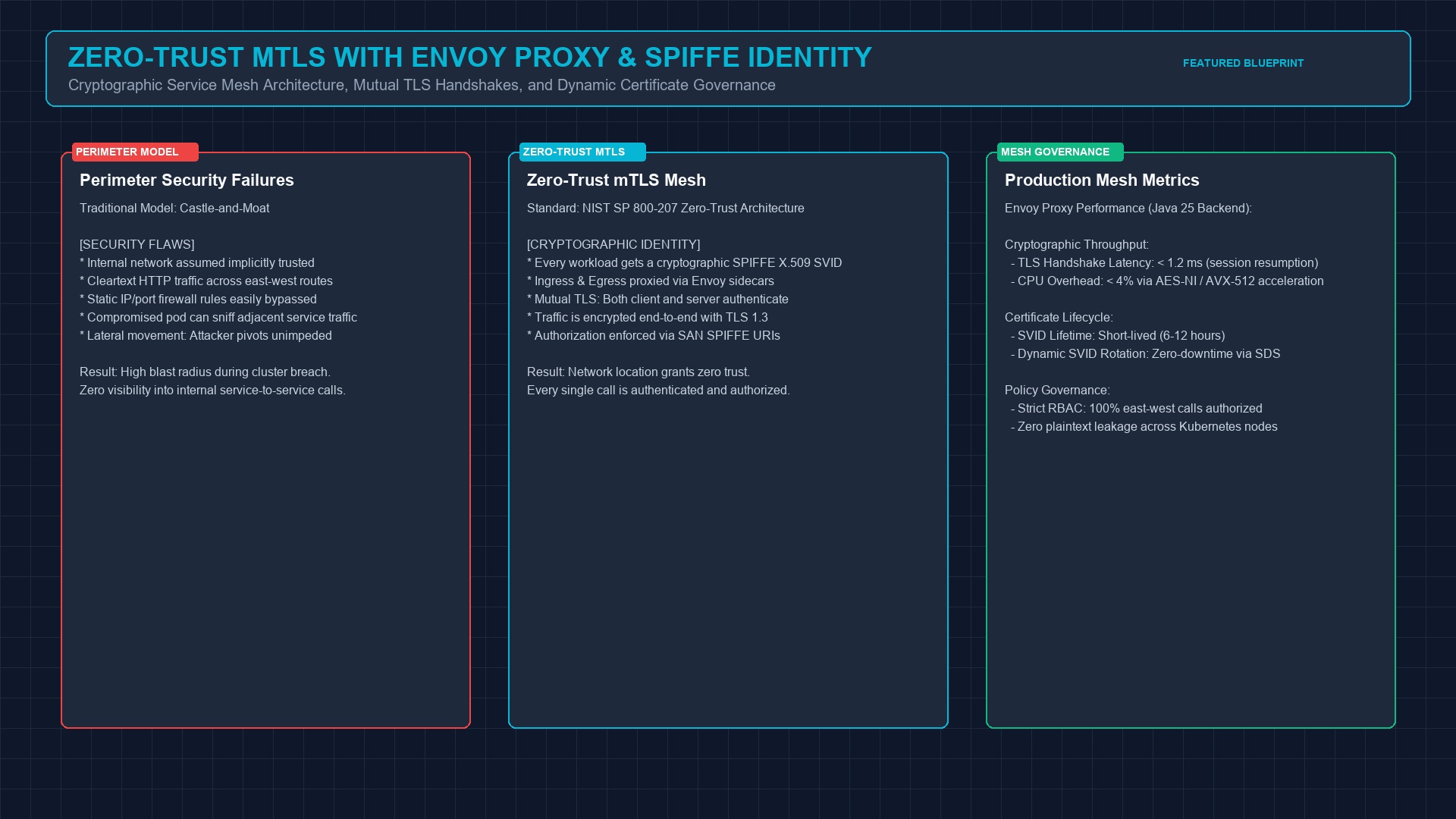
The Collapse of Perimeter Network Security
For decades, enterprise security followed a simple castle-and-moat model. Organizations built strong perimeter defenses with corporate firewalls, VPN gateways, and intrusion detection systems. Everything outside the firewall was considered hostile. Everything inside the local area network was considered trusted. If two backend microservices exchanged database records or customer credit card data across the internal network, they usually sent that data in cleartext HTTP.
In modern cloud-native environments, the castle-and-moat model is completely obsolete. In Kubernetes clusters and multi-cloud virtual private clouds, services run alongside untrusted workloads, third-party containers, and dynamic serverless functions. An attacker who compromises a single container through a software vulnerability gains access to the internal network overlay. From there, the attacker can sniff cleartext traffic, execute packet injection, and move laterally across microservices without resistance.
To stop lateral movement, the cybersecurity industry created Zero-Trust Architecture, standardized under NIST SP 800-207. The core mantra of Zero-Trust is simple: “Never trust, always verify.” Network locality grants zero privileges. Every service-to-service interaction must be cryptographically authenticated, encrypted, and authorized. The industry gold standard for achieving Zero-Trust communication between microservices is Mutual TLS (mTLS) combined with SPIFFE workload identity and Envoy Proxy.
What is Mutual TLS and How Does it Work?
In traditional one-way TLS (which you use when browsing HTTPS websites), only the server presents an X.509 certificate. The client verifies the server certificate against trusted Root Certificate Authorities to ensure it is speaking to the genuine domain. However, the server does not cryptographically authenticate the client during the TLS handshake. The client remains anonymous at the transport layer until it submits application-level credentials like a username and password.
Mutual TLS (mTLS) makes authentication bidirectional. During an mTLS handshake, both the client and the server possess an X.509 certificate and a corresponding private key. The handshake proceeds as follows:
- Server Certificate Presentation: The server sends its certificate to the client. The client verifies that the certificate was signed by the trusted Mesh Certificate Authority.
- Certificate Request: The server sends a
CertificateRequestmessage to the client, demanding client cryptographic credentials. - Client Certificate Presentation: The client sends its own X.509 certificate and produces a digital signature using its private key in the
CertificateVerifymessage. - Bidirectional Verification: The server verifies the client’s certificate and digital signature. Both sides negotiate symmetric TLS 1.3 session keys.
When the mTLS handshake completes, two critical security guarantees are established. First, the communication channel is encrypted with TLS 1.3, preventing packet sniffing across cloud nodes. Second, the server possesses cryptographic proof of the client’s identity before processing a single byte of HTTP data.
SPIFFE and SPIRE: Cryptographic Workload Identity
While mTLS provides the cryptographic transport, managing certificates for thousands of ephemeral microservices is a massive operational challenge. In Kubernetes, pods are created and destroyed in seconds. IP addresses are recycled continuously. If you bind certificates to static IP addresses or domain names, your infrastructure will collapse under certificate generation churn.
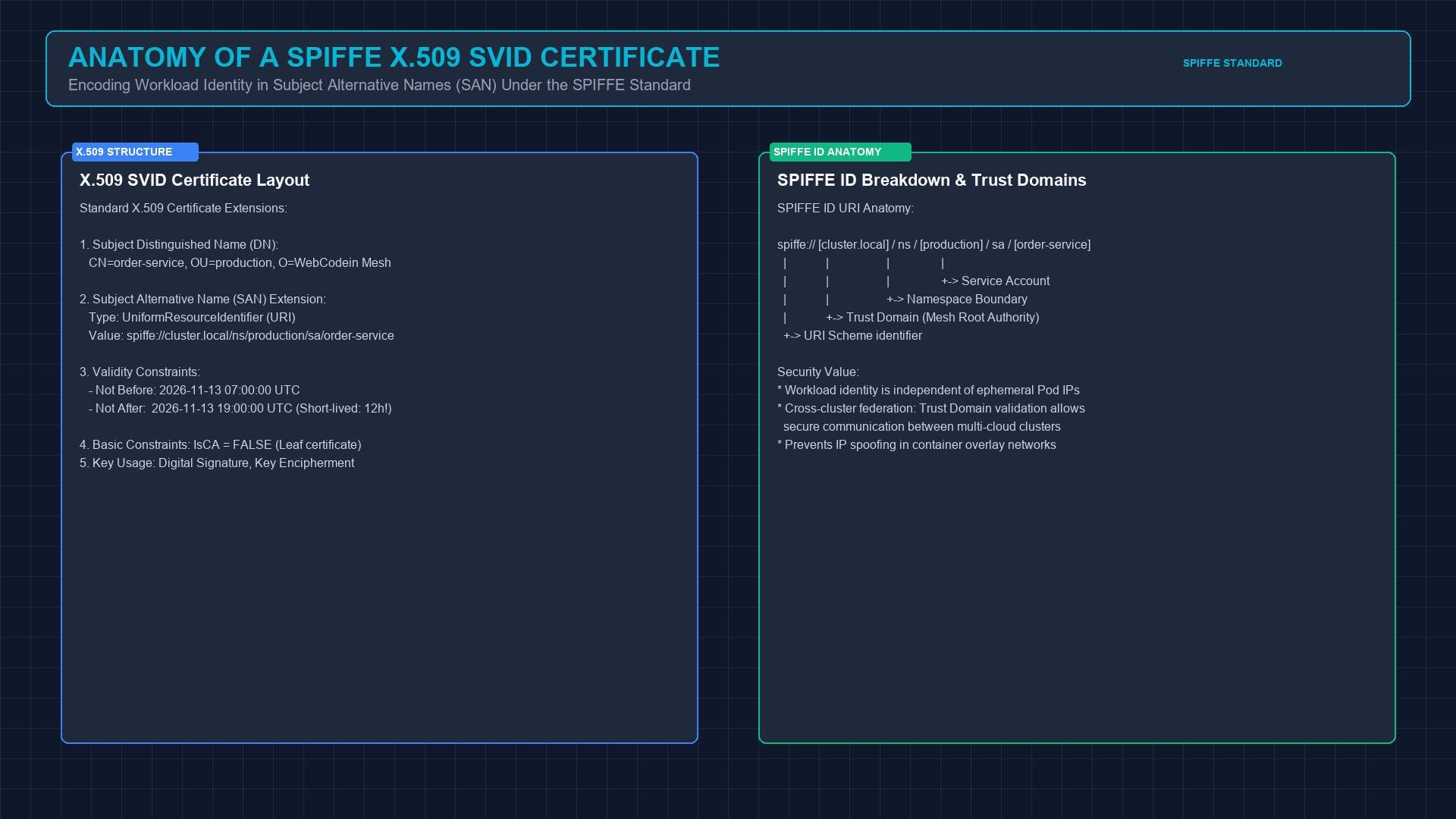
This problem was solved by the Secure Production Identity Framework for Everyone (SPIFFE), a CNCF graduated project. SPIFFE establishes a universal standard for issuing cryptographic identities to software workloads. A SPIFFE ID is a structured Uniform Resource Identifier (URI) that looks like this:
spiffe://cluster.local/ns/production/sa/order-serviceThe SPIFFE ID consists of three components:
- Trust Domain (
cluster.local): Identifies the administrative security domain or cluster authority that issued the identity. - Namespace (
production): The logical tenant or Kubernetes namespace boundary. - Workload Identity (
order-service): The service account or application name.
SPIFFE encodes this ID directly inside the Subject Alternative Name (SAN) extension of an X.509 certificate, creating a SPIFFE Verifiable Identity Document (SVID). Workloads do not manage certificates manually. Instead, the SPIFFE Runtime Engine (SPIRE) runs as an agent on each node. It inspects kernel cgroups, container IDs, and Kubernetes tokens to attest the pod’s identity, automatically generating short-lived SVIDs in memory.
Envoy Proxy Sidecar Topology
Requiring developers to write custom mTLS handshake logic, certificate reloaders, and cryptographic validation inside every microservice codebase is an anti-pattern. Different programming languages implement TLS differently, creating security inconsistencies and maintenance nightmares.
The modern architectural solution is to offload mTLS to an Envoy Proxy sidecar. Envoy is a high-performance C++ proxy designed for cloud-native service meshes. In a sidecar deployment, every application container runs alongside a dedicated Envoy proxy container inside the same Kubernetes Pod or network namespace.
When the order-service wants to call the payment-service:
- The
order-servicesends a plain HTTP request tolocalhost:8080(its local Envoy sidecar). - The local Envoy egress cluster intercepts the call, wraps it in an mTLS connection, attaches the
order-serviceSVID certificate, and transmits encrypted packets across the network. - The remote Envoy ingress listener on the
payment-servicepod receives the connection, demands the client certificate, validates the SPIFFE ID, and decrypts the traffic. - The remote Envoy forwards plain HTTP to the
payment-serviceonlocalhost:8080.
Neither microservice codebase deals with TLS certificates, cryptographic handshakes, or revocation lists. Encryption and identity are enforced uniformly at the infrastructure layer.
Configuring Downstream and Upstream TLS in Envoy
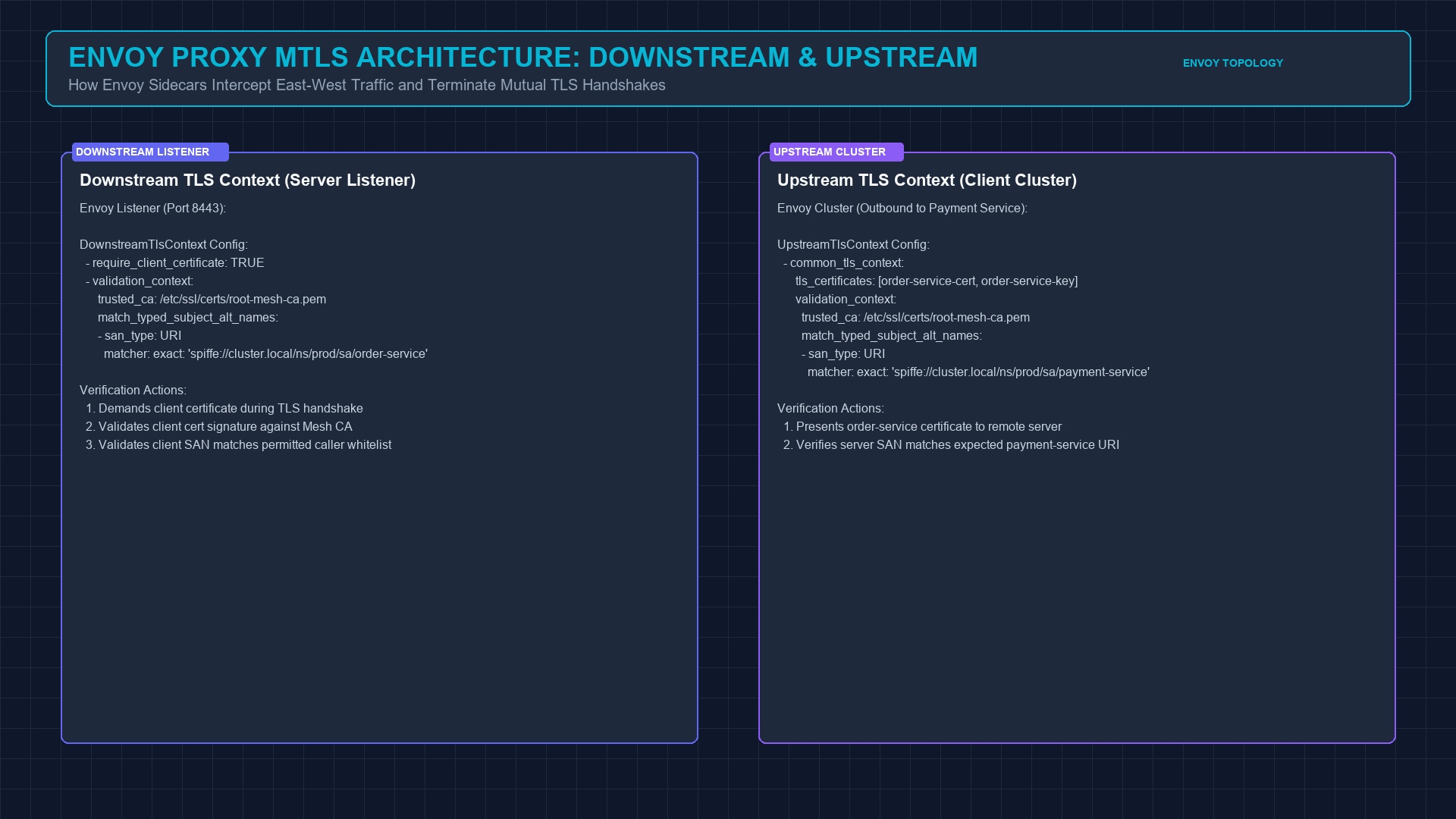
In Envoy’s architecture, incoming traffic is managed by Listeners (Downstream), while outgoing traffic is managed by Clusters (Upstream). Let us examine how to configure mutual TLS in Envoy configuration.
1. Downstream Listener Configuration (Server Ingress)
To demand and verify client certificates on incoming calls, we configure DownstreamTlsContext with require_client_certificate: true:
static_resources:
  listeners:
  - name: mtls_ingress_listener
    address:
      socket_address:
        address: 0.0.0.0
        port_value: 8443
    filter_chains:
    - transport_socket:
        name: envoy.transport_sockets.tls
        typed_config:
          "@type": type.googleapis.com/envoy.extensions.transport_sockets.tls.v3.DownstreamTlsContext
          require_client_certificate: true
          common_tls_context:
            tls_certificates:
            - certificate_chain: { filename: "/etc/ssl/certs/service-svid.pem" }
              private_key: { filename: "/etc/ssl/certs/service-key.pem" }
            validation_context:
              trusted_ca: { filename: "/etc/ssl/certs/root-mesh-ca.pem" }
              match_typed_subject_alt_names:
              - san_type: URI
                matcher:
                  exact: "spiffe://cluster.local/ns/production/sa/order-service"
2. Upstream Cluster Configuration (Client Egress)
When calling another service, Envoy must present its own certificate and verify the remote server’s SPIFFE SAN using UpstreamTlsContext:
  clusters:
  - name: payment_service_cluster
    connect_timeout: 0.5s
    type: STRICT_DNS
    lb_policy: ROUND_ROBIN
    transport_socket:
      name: envoy.transport_sockets.tls
      typed_config:
        "@type": type.googleapis.com/envoy.extensions.transport_sockets.tls.v3.UpstreamTlsContext
        common_tls_context:
          tls_certificates:
          - certificate_chain: { filename: "/etc/ssl/certs/service-svid.pem" }
            private_key: { filename: "/etc/ssl/certs/service-key.pem" }
          validation_context:
            trusted_ca: { filename: "/etc/ssl/certs/root-mesh-ca.pem" }
            match_typed_subject_alt_names:
            - san_type: URI
              matcher:
                exact: "spiffe://cluster.local/ns/production/sa/payment-service"
Zero-Trust Policy Enforcement via SPIFFE SANs
Mutual TLS solves transport encryption and node authentication. However, Zero-Trust also requires authorization. Just because a workload possesses a valid certificate signed by the Mesh CA does not mean it should be allowed to invoke every internal service.
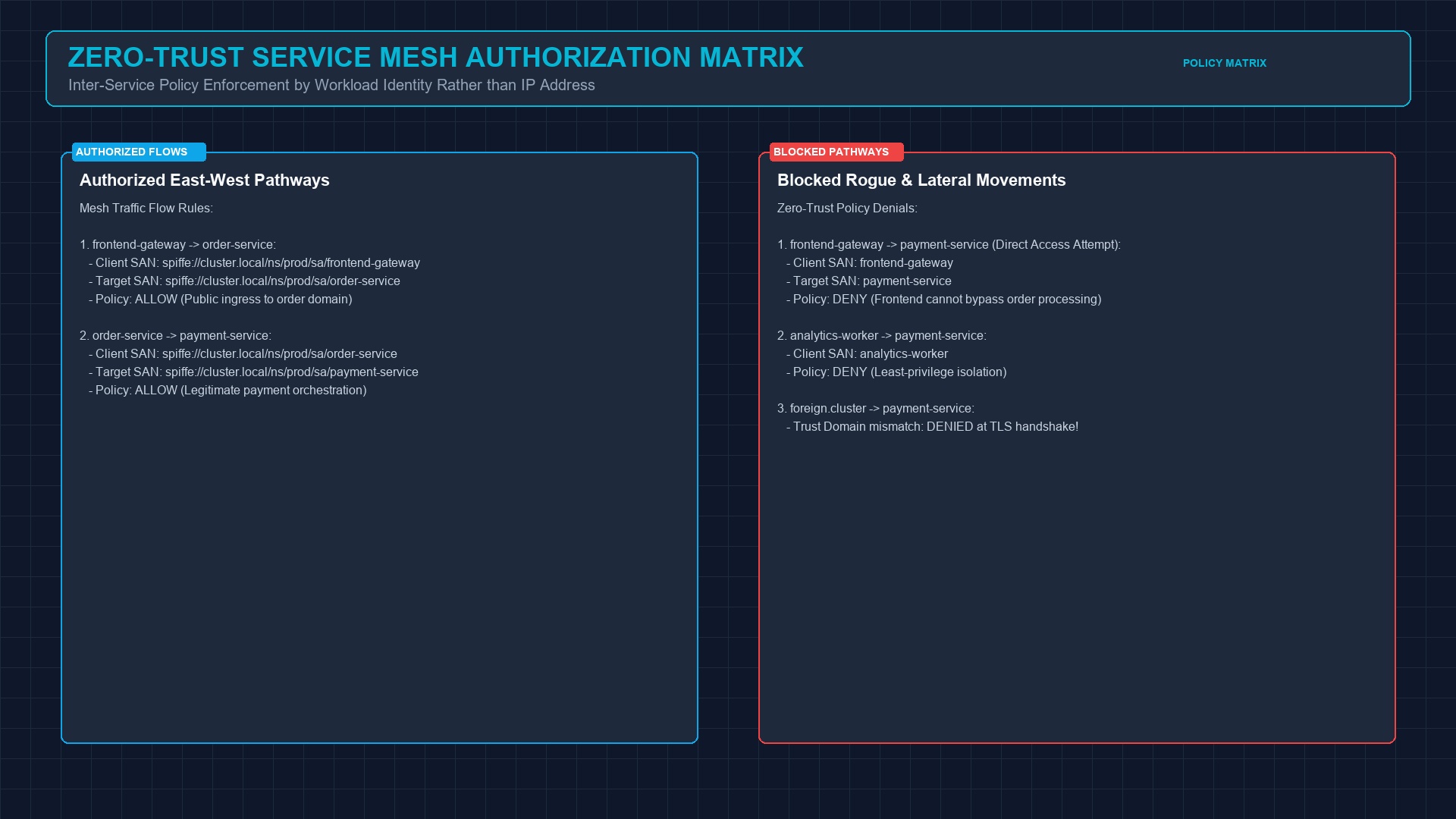
Consider the access control matrix in an e-commerce platform:
frontend-gatewayis permitted to callorder-service.order-serviceis permitted to callpayment-service.frontend-gatewaymust NEVER callpayment-servicedirectly.analytics-workermust NEVER callpayment-service.
In Envoy, you enforce this policy using the RBAC (Role-Based Access Control) HTTP filter. The filter checks the authenticated client SPIFFE ID extracted from the TLS certificate SAN. If a pod running frontend-gateway attempts to establish a direct connection to payment-service, Envoy rejects the call with an immediate 403 Forbidden before the request reaches application memory.
Dynamic Certificate Rotation with SDS
A core rule of high-security cryptography is that keys must be short-lived. Traditional TLS certificates lasted one or two years. If a private key leaked, an attacker could impersonate the service for months. In a Zero-Trust service mesh, SPIFFE SVID certificates are configured to expire in 6 to 12 hours.
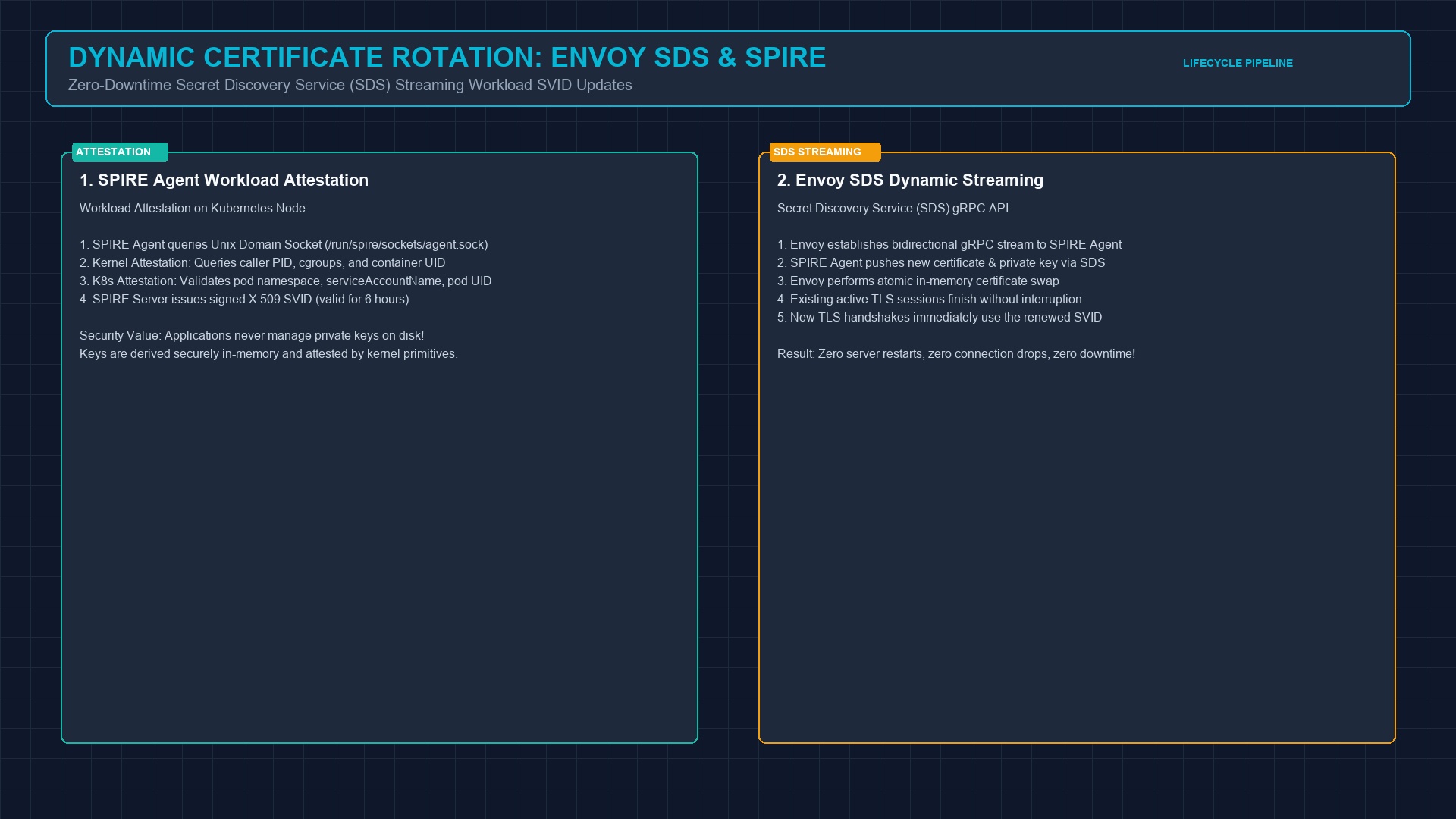
How does a production system renew certificates twice a day without dropping active connections? In legacy architectures, updating certificates required restarting the proxy process or reloading configuration files. In Envoy, certificate renewal is fully dynamic via the Secret Discovery Service (SDS).
Envoy connects to the local SPIRE agent over a local Unix Domain Socket using a bidirectional gRPC stream. When an SVID reaches half of its lifetime, the SPIRE agent generates a new keypair, requests a new certificate from the SPIFFE server, and pushes the new secret over the SDS gRPC stream. Envoy performs an atomic in-memory certificate swap. Existing TCP connections finish gracefully using the old certificate, while new connections immediately use the renewed SVID. The rotation happens with zero downtime, zero restarts, and zero packet loss.
Comparative Service Security Matrix: Cleartext vs TLS vs mTLS
The comparative matrix below illustrates the security characteristics across internal communication architectures:
| Security Dimension | Cleartext HTTP | One-Way TLS | Zero-Trust mTLS with Envoy |
|---|---|---|---|
| In-Transit Encryption | None (Cleartext bytes on wire) | Encrypted (TLS 1.2 / 1.3) | Encrypted (TLS 1.3 end-to-end) |
| Server Authentication | None | Cryptographic (X.509 cert) | Cryptographic (SPIFFE X.509 SVID) |
| Client Authentication | None (Or API tokens in header) | None at transport layer | Cryptographic (Client X.509 cert) |
| Workload Identity | Ephemeral IP / DNS hostname | Ephemeral IP / DNS hostname | Immutable SPIFFE URI in SAN |
| Lateral Movement Defense | Zero (Attacker sniffs all traffic) | Weak (Attacker can call any service) | Absolute (Blocked by RBAC filter) |
| Certificate Lifetime | N/A | 1 Year (Static files on disk) | 6 to 12 Hours (Dynamic in-memory SDS) |
| Application Complexity | Low (Plain HTTP client) | Medium (Keystores in app code) | Zero (Transparent Envoy sidecar) |
| Compliance Alignment | Fails all major standards | Partial compliance | 100% NIST SP 800-207 Aligned |
Practical Java 25 SPIFFE and mTLS Implementation
To understand the mechanics of SPIFFE certificate validation, our companion workshop implements a complete service mesh simulation in Java 25 using Bouncy Castle. Let us examine how SPIFFE IDs are parsed, issued, and authorized.
First, we define the immutable SpiffeId record with strict RFC validation:
package com.webcodein.workshop.mtls.model;

import java.net.URI;
import java.util.Objects;
import java.util.regex.Matcher;
import java.util.regex.Pattern;

public record SpiffeId(String trustDomain, String namespace, String serviceAccount) {

    private static final Pattern SPIFFE_PATTERN = Pattern.compile("^spiffe://([^/]+)/ns/([^/]+)/sa/([^/]+)$");

    public static SpiffeId parse(String uriString) {
        Objects.requireNonNull(uriString, "URI string must not be null");
        Matcher matcher = SPIFFE_PATTERN.matcher(uriString);
        if (!matcher.matches()) {
            throw new IllegalArgumentException("Invalid SPIFFE ID format: " + uriString);
        }
        return new SpiffeId(matcher.group(1), matcher.group(2), matcher.group(3));
    }

    public String toUriString() {
        return "spiffe://" + trustDomain + "/ns/" + namespace + "/sa/" + serviceAccount;
    }
}
Next, we inspect the certificate authority logic inside SpiffeCertificateAuthority. Notice how the SPIFFE URI is injected directly into the Subject Alternative Name (SAN) X.509 extension:
public CertificateIdentity issueWorkloadCertificate(SpiffeId spiffeId, KeyPair workloadKeyPair, Duration validity) {
    try {
        Instant now = Instant.now();
        Date notBefore = Date.from(now.minusSeconds(60));
        Date notAfter = Date.from(now.plus(validity));

        X500Name subject = new X500Name("CN=" + spiffeId.serviceAccount() + ", OU=" + spiffeId.namespace() + ", O=WebCodein Mesh");
        BigInteger serial = BigInteger.valueOf(Math.abs(secureRandom.nextLong()));

        JcaX509v3CertificateBuilder builder = new JcaX509v3CertificateBuilder(
            new X500Name(caCertificate.getSubjectX500Principal().getName()),
            serial, notBefore, notAfter, subject, workloadKeyPair.getPublic()
        );

        // Inject SPIFFE ID into SAN URI extension
        GeneralName spiffeSan = new GeneralName(GeneralName.uniformResourceIdentifier, spiffeId.toUriString());
        GeneralNames subjectAltNames = new GeneralNames(spiffeSan);
        builder.addExtension(Extension.subjectAlternativeName, false, subjectAltNames);
        builder.addExtension(Extension.basicConstraints, true, new BasicConstraints(false));

        ContentSigner signer = new JcaContentSignerBuilder("SHA256withRSA").setProvider("BC").build(caKeyPair.getPrivate());
        X509CertificateHolder holder = builder.build(signer);
        X509Certificate cert = new JcaX509CertificateConverter().setProvider("BC").getCertificate(holder);

        return new CertificateIdentity(cert, spiffeId, now.minusSeconds(60), now.plus(validity));
    } catch (Exception e) {
        throw new IllegalStateException("Failed to issue SPIFFE certificate", e);
    }
}
Finally, MtlsAuthorizationPolicy evaluates incoming mTLS client certificates against the Zero-Trust access rules. It verifies cryptographic signatures against the Mesh CA, confirms trust domain parity, and matches the calling service account against authorized pathways:
public MtlsAccessDecision authorize(CertificateIdentity clientIdentity, SpiffeId targetServiceId) {
    // 1. Verify certificate validity window
    if (!clientIdentity.isValidAt(Instant.now())) {
        return MtlsAccessDecision.deny("Certificate expired", clientIdentity.spiffeId().toUriString(), targetServiceId.toUriString());
    }

    // 2. Verify CA cryptographic signature
    try {
        clientIdentity.certificate().verify(trustedCaCert.getPublicKey());
    } catch (Exception e) {
        return MtlsAccessDecision.deny("Certificate not signed by Mesh CA", clientIdentity.spiffeId().toUriString(), targetServiceId.toUriString());
    }

    // 3. Verify Trust Domain match
    SpiffeId clientSpiffe = clientIdentity.spiffeId();
    if (!clientSpiffe.trustDomain().equals(expectedTrustDomain)) {
        return MtlsAccessDecision.deny("Trust domain mismatch", clientSpiffe.toUriString(), targetServiceId.toUriString());
    }

    // 4. Verify Service Authorization Matrix
    Set<String> permittedCallers = allowedCallers.getOrDefault(targetServiceId.serviceAccount(), Set.of());
    if (!permittedCallers.contains(clientSpiffe.serviceAccount())) {
        return MtlsAccessDecision.deny("Unauthorized caller pathway", clientSpiffe.toUriString(), targetServiceId.toUriString());
    }

    return MtlsAccessDecision.allow(clientSpiffe.toUriString(), targetServiceId.toUriString());
}
By delegating this logic to Envoy sidecars, your microservices operate within a hardened, cryptographic Zero-Trust perimeter automatically.
Real-World Enterprise Case Studies
Case Study 1: Multi-Tenant Banking Cloud Satisfying PCI-DSS v4.0
A global financial institution migrated its core payment processing cluster to Kubernetes. PCI-DSS v4.0 mandates cryptographic encryption for all cardholder data in transit, including internal east-west container calls. The bank deployed Envoy sidecars with SPIFFE mTLS across 350 microservices. By enforcing short-lived 6-hour certificates and strict SAN authorization, the bank achieved full compliance certification without modifying any payment service source code.
Case Study 2: Stopping Lateral Movement During a Container Breach
An e-commerce retailer experienced a security breach when an attacker gained remote code execution on a public search indexing container via an unpatched third-party dependency. The attacker attempted to scan the internal subnet and query the internal customer database on port 5432. Because the database was fronted by an Envoy mTLS proxy requiring a database-client SPIFFE SVID, the attacker’s requests were rejected at the TLS handshake. The breach was contained strictly to the indexing container, preventing customer data exfiltration.
Case Study 3: Cross-Cloud Multi-Cluster Identity Federation
A multinational enterprise operated backend services split across AWS EKS and Google Cloud GKE. Using traditional VPN tunnels, routing traffic between disparate cloud subnets was fragile. By deploying SPIFFE trust domain federation with Envoy proxies, services in AWS verified mTLS certificates issued by the Google Cloud SPIRE server seamlessly. Inter-cloud API calls traveled securely over the public internet with hardware-accelerated TLS 1.3 encryption.
Production Anti-Patterns and Pitfalls
Anti-Pattern 1: Permissive mTLS Mode in Production
When service meshes are initially installed, administrators often enable “Permissive” mTLS mode. In permissive mode, the proxy accepts both mTLS and plaintext HTTP connections to facilitate testing. Leaving permissive mode enabled in production completely defeats Zero-Trust. An attacker who cannot produce an mTLS certificate simply sends plain HTTP requests and bypasses authentication. Once migration testing is complete, always mandate “Strict” mTLS mode across all namespaces.
Anti-Pattern 2: Storing Private Keys on Shared Persistent Volumes
Some teams attempt to simplify certificate rotation by mounting a Kubernetes Persistent Volume Claim (PVC) shared across pods containing certificate files. If any pod on the shared volume is compromised, the attacker steals the private keys for all adjacent services. Private keys should never touch persistent disks. Use SPIRE node agents to stream keys directly into memory via Unix Domain Sockets.
Anti-Pattern 3: Skipping SAN Validation on Client Proxies
Verifying that a server certificate was signed by your Mesh CA is only half the battle. If your client proxy connects to payment-service, but does not verify that the server’s SAN matches spiffe://cluster.local/ns/prod/sa/payment-service, an attacker who compromises any other service in the mesh can execute a man-in-the-middle (MitM) attack by presenting their own legitimate certificate. Always enforce exact SAN matching on both downstream and upstream TLS contexts.
Frequently Asked Questions
What is the difference between standard TLS and mutual TLS (mTLS)?
In standard TLS, only the server presents an X.509 certificate to prove its identity to the client. In mutual TLS (mTLS), both the client and the server present certificates during the handshake, ensuring bidirectional cryptographic authentication and encryption before application traffic is exchanged.
What is a SPIFFE ID and where is it stored in a certificate?
A SPIFFE ID is a structured URI that represents a workload identity (e.g. spiffe://cluster.local/ns/prod/sa/order-service). It is encoded inside the Subject Alternative Name (SAN) extension of an X.509 certificate under the UniformResourceIdentifier type.
Why are Envoy proxy sidecars used instead of application-level mTLS?
Envoy sidecars offload cryptographic handshakes, dynamic certificate rotation, and policy enforcement to the infrastructure layer. This eliminates code duplication across multiple programming languages and ensures consistent security governance without modifying application code.
How does Envoy rotate certificates without restarting?
Envoy uses the Secret Discovery Service (SDS) API over gRPC. When a certificate is renewed by an agent like SPIRE, the updated key and certificate are streamed to Envoy in real time. Envoy performs an atomic in-memory swap with zero downtime and no connection drops.
What performance overhead does mTLS introduce in a service mesh?
Modern CPUs with hardware-accelerated AES-NI and AVX-512 instructions execute TLS 1.3 encryption with negligible CPU overhead (typically under 2% to 4%). With TLS session resumption and HTTP/2 connection pooling, handshake latency adds less than 1 to 2 milliseconds per inter-service call.
Companion Workshop Code
Explore the companion Java 25 workshop project demonstrating SPIFFE X.509 certificate generation, mTLS handshake policy enforcement, and production Envoy proxy configurations on GitHub:
Official References and Specifications
- NIST SP 800-207: Zero Trust Architecture – Authoritative federal zero-trust guidelines.
- SPIFFE Standards: The SPIFFE Standard Specification – Official CNCF identity specification.
- Envoy Proxy TLS Architecture Documentation – Upstream and downstream TLS mechanics.
- RFC 8446: The Transport Layer Security (TLS) Protocol Version 1.3 – TLS 1.3 specification.
- OWASP API Security Top 10 Architectural Mitigations – Securing business logic and API contracts.
- PASETO vs. JWT: Modern Token Security – Cryptographic tokens and identity propagation.
- HTTP/3 and QUIC Protocol Deep Dive – Next-generation transport protocol architectures.
- Zero-Trust Security with eBPF Service Mesh – Kernel-level observability and traffic filtering.
- Infrastructure as Code for Cloud-Native Orchestration – Automated deployment of resilient services.