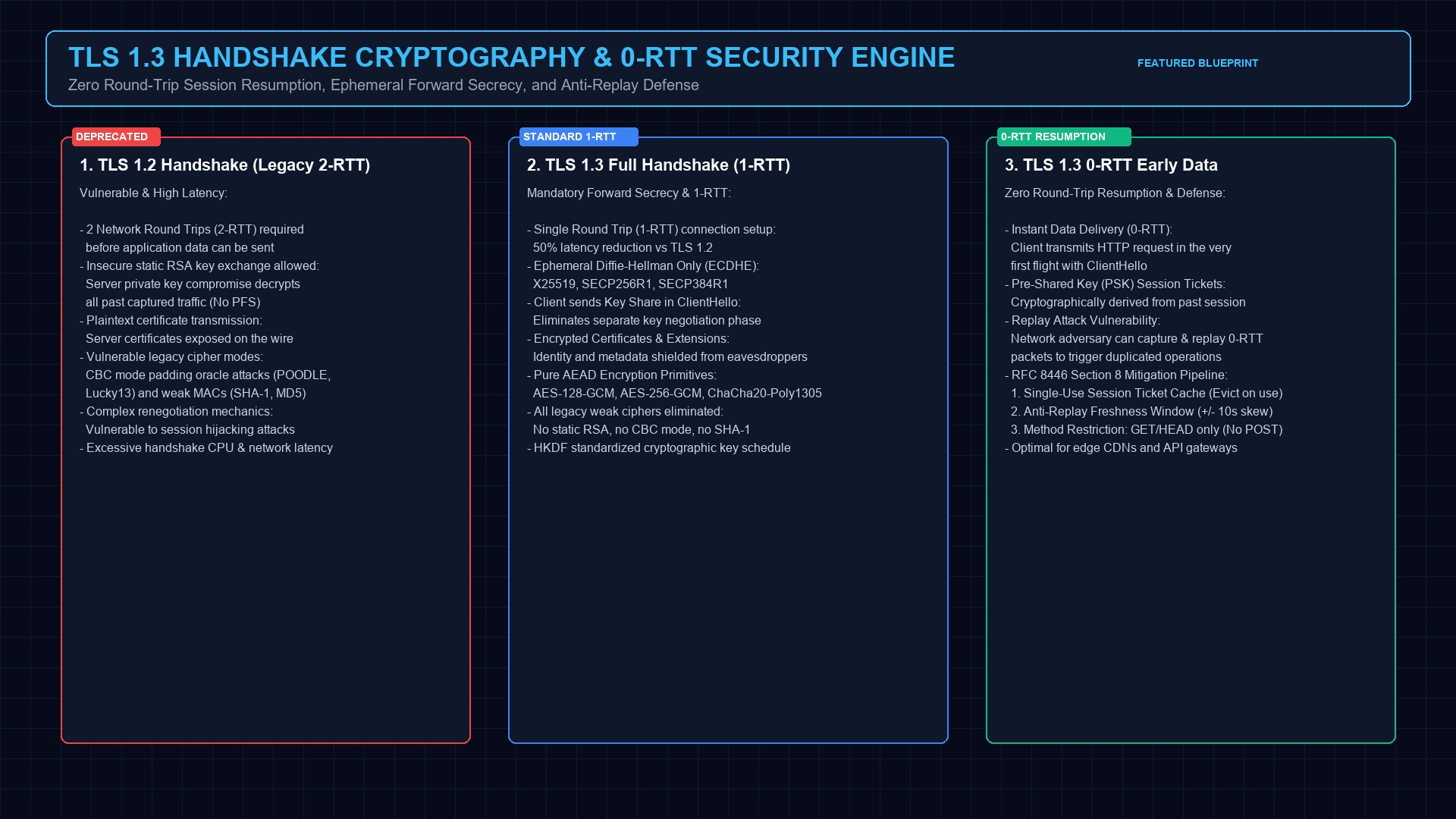
The Evolution of Transport Layer Security
Transport Layer Security is the foundation of trust on the public internet. Every credit card transaction, API call, and secure database connection relies on TLS to protect data in transit. For nearly a decade, TLS 1.2 served as the industry workhorse. It secured millions of web applications and protected enterprise infrastructure across the globe.
However, modern distributed systems operate under strict requirements that TLS 1.2 could no longer fulfill. First, modern microservices communicate across geographically distant data centers. High network latency degrades customer experience. TLS 1.2 required two full network round trips before transmitting application data. On mobile connections with 100 milliseconds of latency, the handshake alone delayed requests by 200 milliseconds.
Second, cryptographic attacks evolved rapidly over the last decade. Security researchers discovered dangerous flaws in legacy cryptographic primitives. Cipher Block Chaining mode suffered from padding oracle attacks. Static RSA key exchanges failed to provide forward secrecy. Insecure hash functions created collision vulnerabilities.
In response, the Internet Engineering Task Force published RFC 8446, standardizing TLS 1.3. TLS 1.3 is not merely an incremental update. It is a ground-up redesign of transport security. It halves handshake latency to a single round trip (1-RTT). It enables instant zero round-trip (0-RTT) session resumption. Most importantly, it completely removes insecure cryptographic legacy algorithms, ensuring ironclad security for cloud-native backends.
Why TLS 1.2 Became a Security Liability
To understand the genius of TLS 1.3, we must examine the architectural flaws that plagued TLS 1.2. In TLS 1.2, protocol flexibility created severe security risks. The specification allowed servers and clients to negotiate dozens of cipher suite combinations. Many of these suites contained obsolete cryptographic primitives.
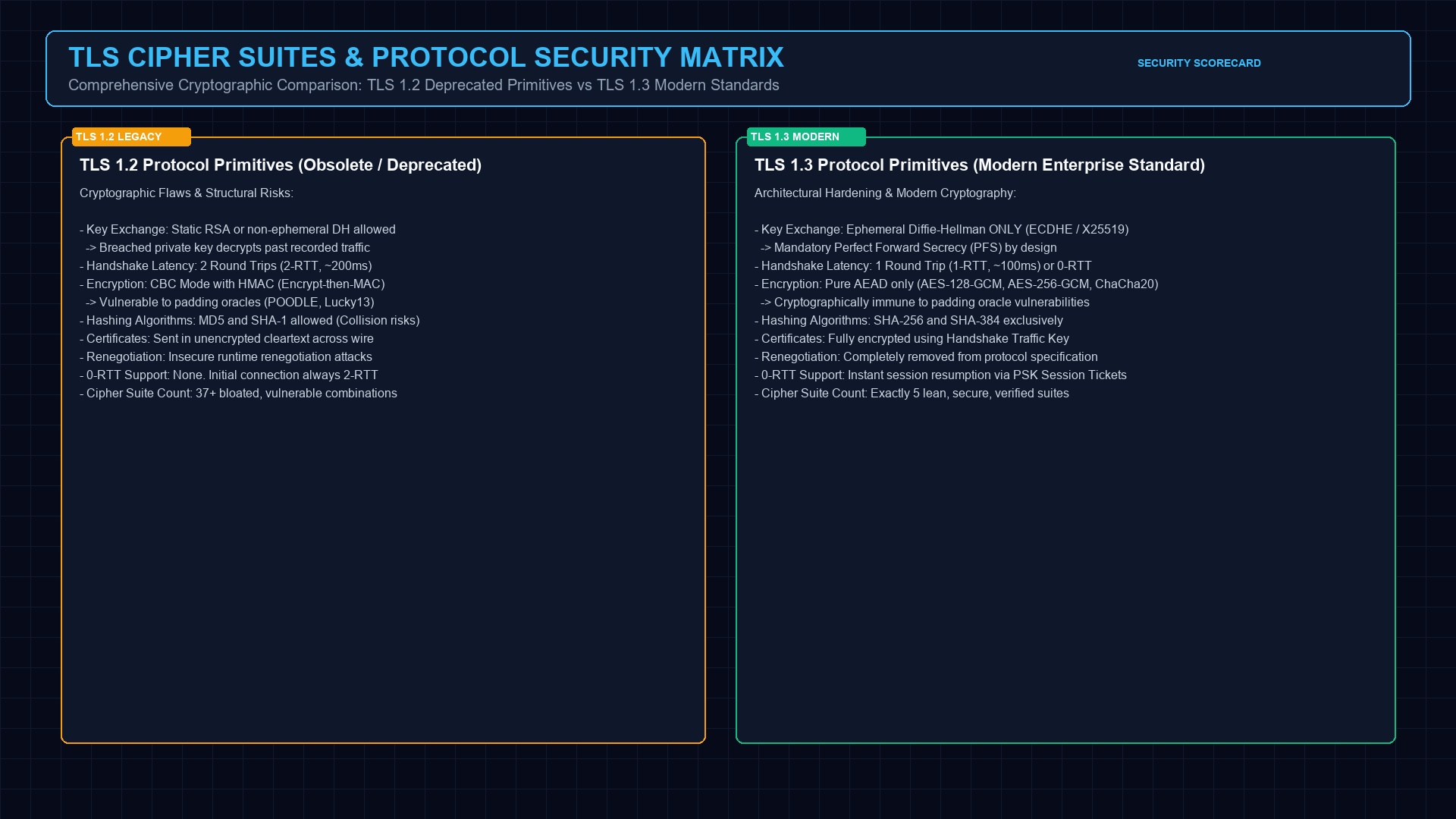
The most dangerous weakness was static RSA key exchange. In static RSA, the client generates a pre-master secret, encrypts it with the server’s public key, and sends it across the wire. If an adversary captures encrypted traffic today, and steals the server private key five years later, the adversary can decrypt every past session! This complete lack of Perfect Forward Secrecy made enterprise communications vulnerable to mass surveillance.
Furthermore, TLS 1.2 relied on Cipher Block Chaining (CBC) mode for symmetric encryption. CBC mode requires padding bytes to match cipher block sizes. Because decryption errors leaked timing discrepancies, attackers devised devastating padding oracle attacks, including POODLE and Lucky13. Implementing CBC mode securely in software proved almost impossible across different hardware architectures.
Additionally, TLS 1.2 transmitted server certificates in plain text across the network. Eavesdroppers on public Wi-Fi or transit networks could inspect certificate fields. They easily identified which domains users visited, compromising client privacy. TLS 1.3 addresses every single one of these vulnerabilities by making forward secrecy mandatory, adopting pure AEAD ciphers, and encrypting certificates on the wire.
The Anatomy of the TLS 1.3 1-RTT Handshake
The defining operational improvement in TLS 1.3 is the 1-RTT handshake. In TLS 1.2, negotiating cryptographic keys required two sequential round trips. The client first announced supported cipher algorithms. The server selected an algorithm and sent its public key. Only then could the client generate and transmit its matching key share.
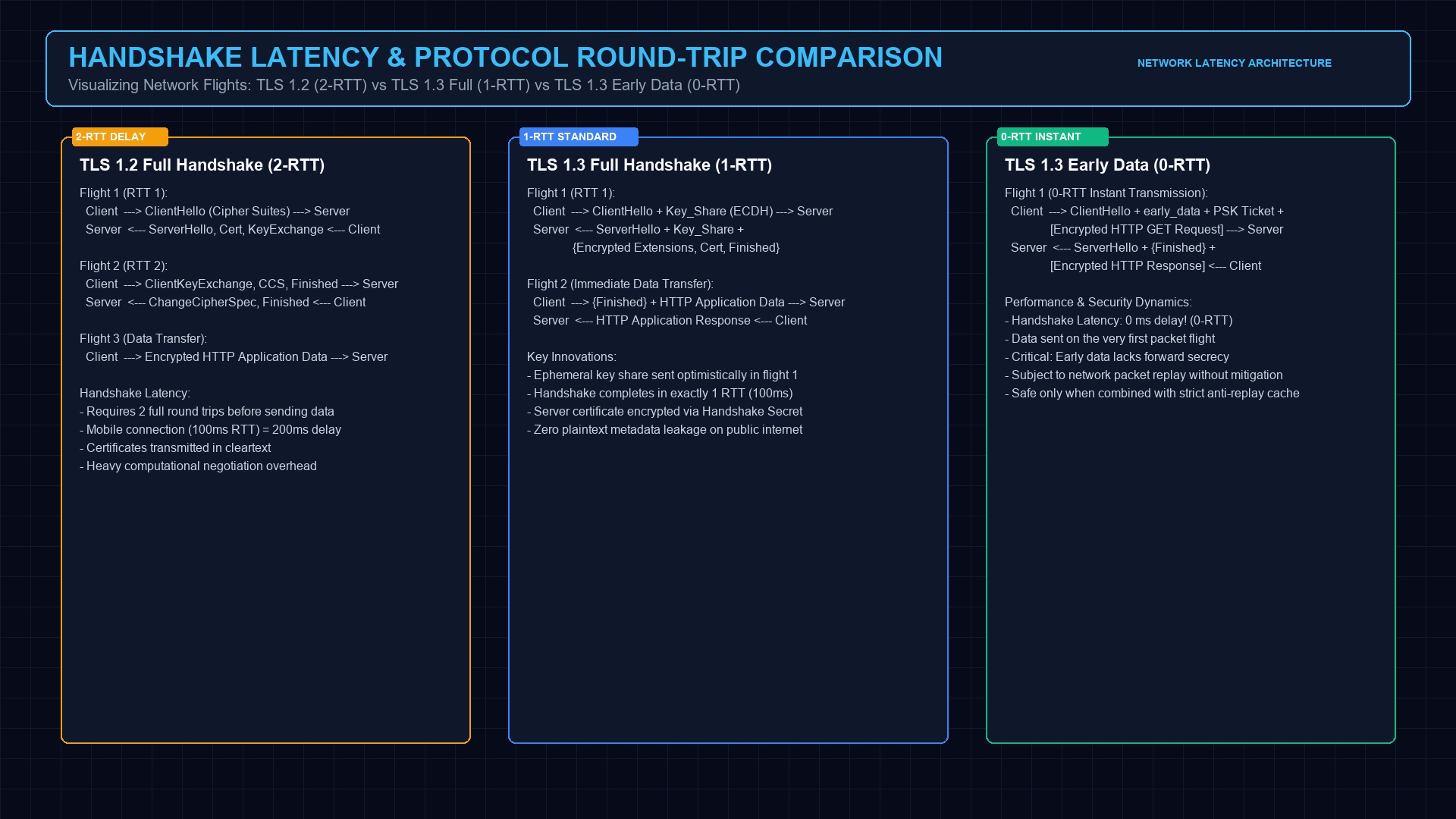
TLS 1.3 slashes this delay by 50% using an optimistic key exchange architecture:
- Flight 1 (ClientHello & Key Share): The client assumes the server supports modern elliptic curves (such as X25519 or SECP256R1). In its very first
ClientHellomessage, the client includes both the cipher suite list and an ephemeral public key share. - Flight 1 (ServerHello & Secrets): The server receives the client’s key share and generates its own ephemeral key pair. It computes the shared Diffie-Hellman secret immediately. The server replies with
ServerHelloand its key share. - Encrypted Extensions & Certificate: Because both peers now possess the shared secret, all subsequent handshake messages are encrypted! The server encrypts its extensions, digital certificate, and cryptographic handshake signature.
- Flight 2 (Client Finished & Application Data): The client verifies the certificate and server signature. It derives application traffic secrets and begins transmitting encrypted application payload immediately.
By collapsing negotiation into a single round trip, TLS 1.3 cuts connection latency in half. When combined with modern protocols like HTTP/3 and QUIC, connection setup becomes virtually instantaneous.
HKDF Cryptographic Key Schedule Derivation
In legacy protocols, deriving encryption keys relied on ad-hoc pseudo-random functions. TLS 1.3 replaces custom functions with the formally verified HMAC-based Extract-and-Expand Key Derivation Function (HKDF) defined in RFC 5869.
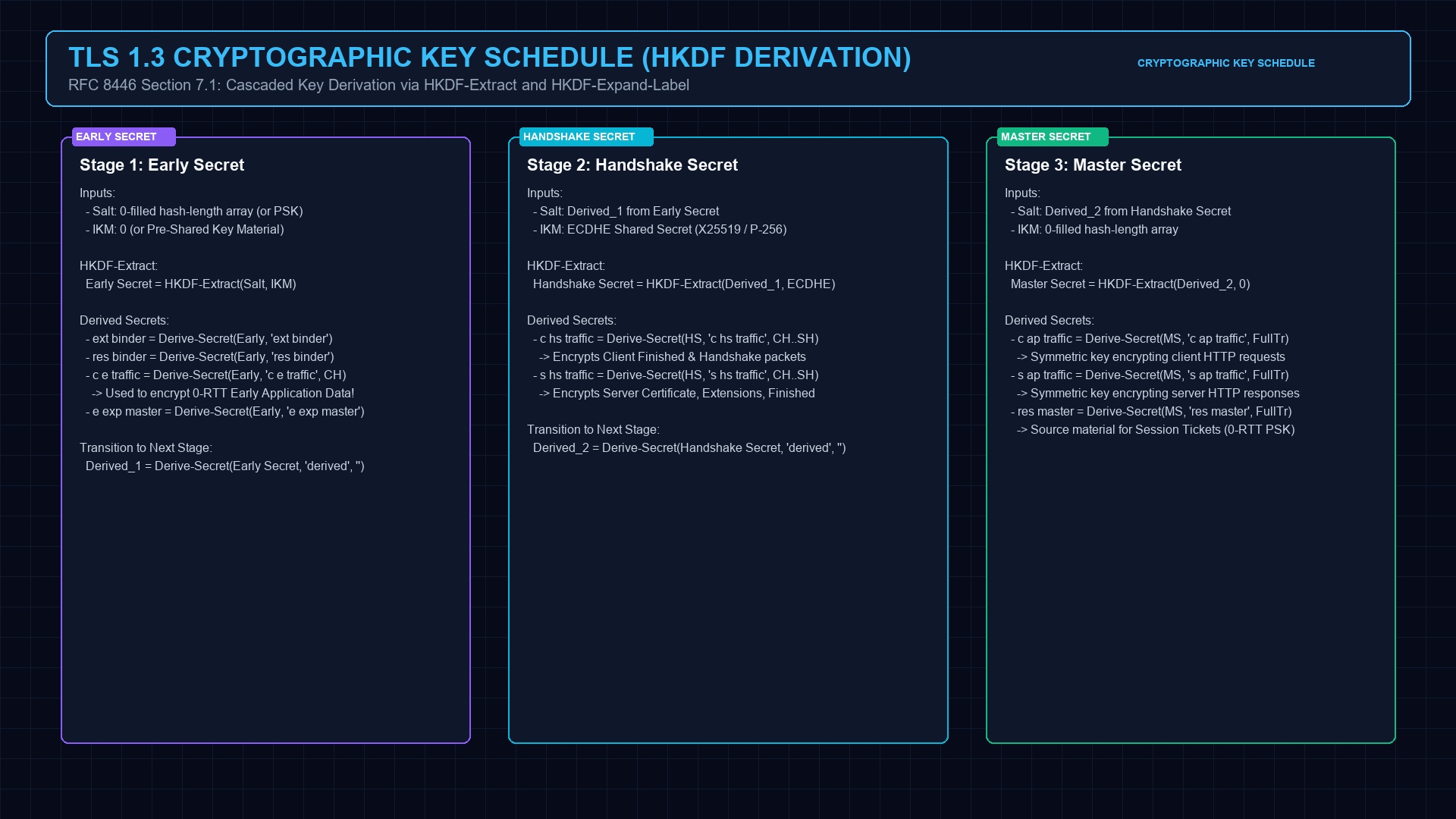
The TLS 1.3 key schedule operates through three distinct cryptographic phases. Each phase extracts input keying material (IKM) and expands it into dedicated traffic keys:
- Early Secret: Derived from pre-shared keys (PSKs) during session resumption. This secret derives the
client_early_traffic_secret, enabling 0-RTT early data encryption before the full handshake finishes. - Handshake Secret: Derived by mixing the output of the early secret stage with the ephemeral Diffie-Hellman shared secret (ECDHE). This secret derives
client_handshake_traffic_secretandserver_handshake_traffic_secret. These keys protect handshake certificates and parameter verification. - Master Secret: Derived by expanding the handshake secret. It produces the final symmetric application keys:
client_application_traffic_secret_0andserver_application_traffic_secret_0. It also derives theresumption_master_secretused to mint future session tickets.
This strict cryptographic separation guarantees complete isolation. If an attacker somehow compromises an application traffic key, they cannot reverse-engineer the handshake secret or compromise other client sessions.
Zero Round-Trip (0-RTT) Session Resumption Mechanics
While cutting handshake latency to 1-RTT is impressive, TLS 1.3 introduces an even more powerful optimization: 0-RTT Early Data resumption. When a client reconnects to a previously visited server, it can transmit encrypted application data on the very first network packet flight!
Here is how 0-RTT session resumption functions under the hood:
- Session Ticket Issuance: During an initial 1-RTT connection, the server sends a
NewSessionTicketmessage. This ticket contains a unique ticket identifier, a validity lifetime, and state encrypted with a secret ticket encryption key. The client stores this ticket locally. - Reconnection Flight: When the client reconnects, it retrieves the stored session ticket. It derives the early secret using the ticket’s pre-shared key.
- Instant Transmission: The client sends its
ClientHello, includes the session ticket in thepre_shared_keyextension, and appends encrypted HTTP request bytes immediately! - Immediate Processing: The server decrypts the session ticket, reconstructs the early secret, and decrypts the application payload without waiting for a handshake round trip!
For mobile users and high-frequency edge APIs, 0-RTT eliminates network connection lag completely. Users experience instantaneous page loads and immediate API responses.
The 0-RTT Replay Attack Vulnerability
Despite its extraordinary performance benefits, 0-RTT introduces a fundamental security dilemma: 0-RTT early data does not provide forward secrecy, and it is inherently vulnerable to network replay attacks!
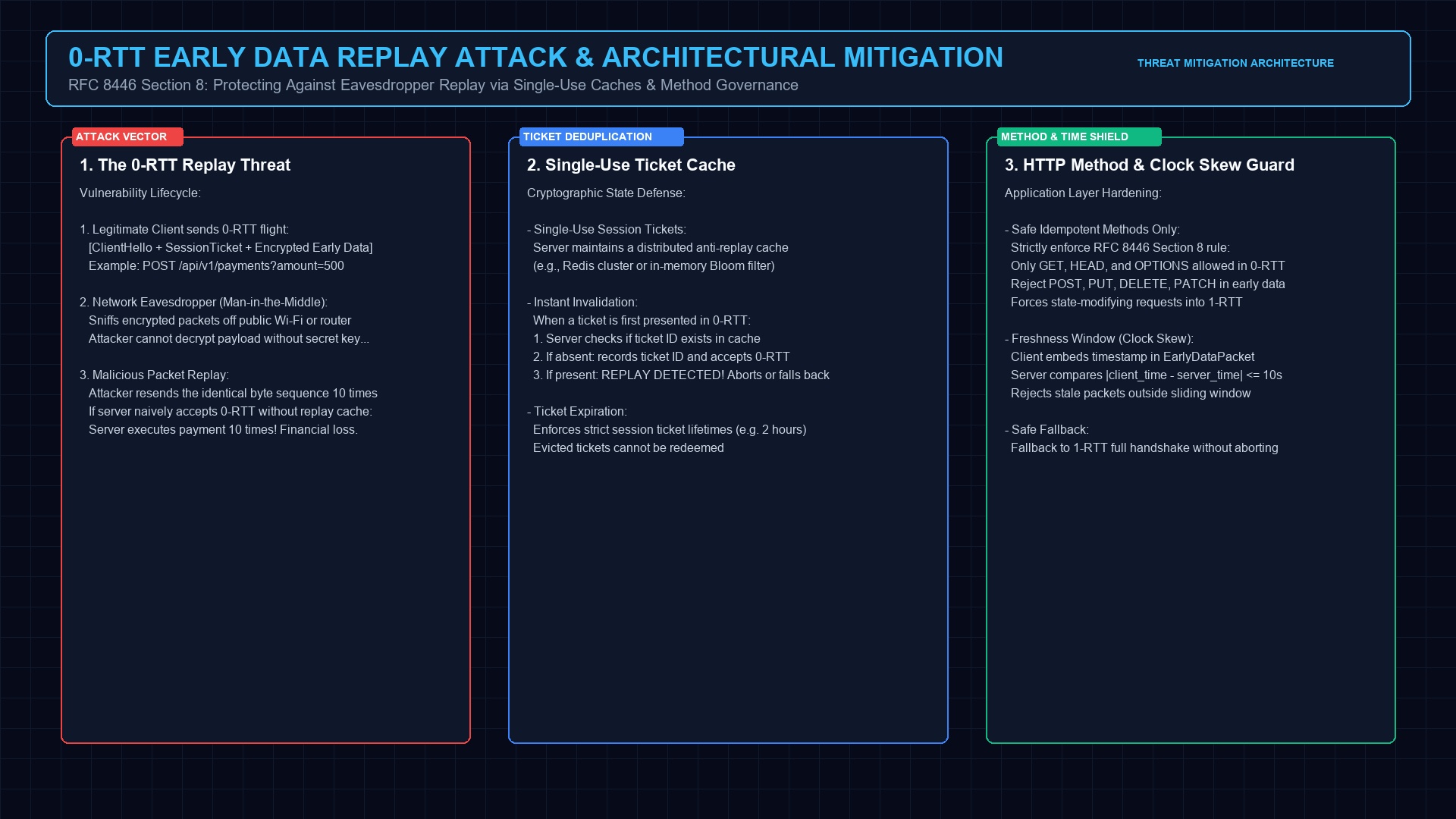
Consider an enterprise banking API where a client submits a fund transfer. If the client sends this payment inside a 0-RTT early data packet:
POST /api/v1/transfers HTTP/1.1
Host: bank.example.com
Authorization: Bearer session-token

{"toAccount": "987654", "amount": 1000.00}
An eavesdropper on the local network (such as a compromised public Wi-Fi hotspot) cannot decrypt the packet. The cryptographic payload is encrypted with modern AES-GCM. However, the attacker does not need to decrypt the packet to cause catastrophic harm! The attacker simply captures the raw binary bytes of the client flight and sends them to the server ten times.
Because the flight contains a valid session ticket, a naive server decrypts and processes all ten packets. The victim’s account is debited ten times instead of once! This is the classic 0-RTT replay attack. Without strict architectural mitigations, deploying 0-RTT creates unacceptable financial and security liabilities.
Architectural Anti-Replay Mitigations
To defend backend services against 0-RTT replay attacks, RFC 8446 Section 8 and RFC 8470 mandate rigorous defensive controls. Engineering teams must implement three coordinated defense layers:
1. Single-Use Session Ticket Cache
The most robust cryptographic mitigation is enforcing single-use session tickets. The server maintains an anti-replay cache (using distributed memory systems like Redis or in-memory Bloom filters). When a client presents a session ticket in early data, the server checks whether the ticket ID has already been redeemed. If the ticket is present, the server instantly flags a replay attack and rejects the early data flight. Once redeemed, the ticket is discarded, preventing attackers from re-submitting captured flights.
2. Freshness Windows and Clock Skew Validation
Every 0-RTT packet includes an obfuscated ticket age parameter. Servers establish a strict sliding freshness window (typically plus or minus 10 seconds). If a packet arrives with a timestamp that deviates significantly from the server’s authoritative clock, the server rejects the early data. This prevents attackers from storing captured flights and replaying them hours or days later.
3. Strict HTTP Method Governance
RFC 8470 explicitly forbids processing non-idempotent HTTP methods in 0-RTT early data. State-mutating operations (including POST, PUT, DELETE, and PATCH) must never execute within early data flights. API gateways and reverse proxies must enforce this rule strictly. Only safe, idempotent methods (such as GET, HEAD, and OPTIONS) may be processed in 0-RTT. If an incoming 0-RTT packet contains an unsafe method, the server delays processing until the full 1-RTT handshake completes, ensuring cryptographic replay immunity.
TLS 1.2 vs TLS 1.3 Cryptographic Comparison Matrix
The architectural differences between TLS 1.2 and TLS 1.3 represent a complete paradigm shift. The following matrix compares both protocols across essential architectural, performance, and security dimensions:
| Protocol Dimension | TLS 1.2 (Legacy RFC 5246) | TLS 1.3 (Modern RFC 8446) | Architectural Impact |
|---|---|---|---|
| Handshake Latency | 2 Round Trips (2-RTT, ~200ms) | 1 Round Trip (1-RTT, ~100ms) | 50% reduction in initial connection establishment latency. |
| Session Resumption | 1-RTT Session IDs or Session Tickets | 0-RTT Early Data Resumption | Instant transmission of application data on reconnect. |
| Key Exchange | Static RSA, DH, ECDH, DHE, ECDHE | ECDHE (X25519, P-256, P-384) ONLY | Static RSA eliminated; Perfect Forward Secrecy is mandatory. |
| Symmetric Encryption | CBC mode, stream ciphers (RC4), AEAD | Pure AEAD ONLY (AES-GCM, ChaCha20-Poly1305) | Completely eliminates padding oracle vulnerabilities (POODLE). |
| Certificate Encryption | Cleartext (Exposed on the wire) | Fully Encrypted via Handshake Secret | Shields server identity and domain metadata from eavesdroppers. |
| Cryptographic Key Schedule | Custom MD5/SHA-1 PRF expansion | Standardized HKDF (RFC 5869) | Formal mathematical separation of key derivation stages. |
| Replay Attack Vulnerability | Not applicable (No 0-RTT mode) | Vulnerable in 0-RTT without mitigation | Requires single-use ticket caches and HTTP method rules. |
| Renegotiation Vulnerability | Supported (Prone to DoS & hijacking) | Completely Removed | Eliminates complex renegotiation state machine attacks. |
Practical Java 25 TLS 1.3 and 0-RTT Implementation
Modern Java 25 provides comprehensive standard library support for TLS 1.3 and advanced cryptography through java.security and javax.crypto. Below is the complete implementation of the TLS 1.3 0-RTT anti-replay security manager from our companion workshop project:
package com.webcodein.workshop.tls.engine;

import com.webcodein.workshop.tls.model.CipherSuite;
import com.webcodein.workshop.tls.model.EarlyDataPacket;
import com.webcodein.workshop.tls.model.SessionTicket;

import java.time.Duration;
import java.time.Instant;
import java.util.Map;
import java.util.Set;
import java.util.UUID;
import java.util.concurrent.ConcurrentHashMap;

public class EarlyDataSecurityManager {

    public enum ValidationStatus {
        ACCEPTED,
        REJECTED_REPLAY_DETECTED,
        REJECTED_TICKET_EXPIRED,
        REJECTED_CLOCK_SKEW,
        REJECTED_NON_IDEMPOTENT_METHOD,
        REJECTED_TICKET_NOT_FOUND
    }

    public record ValidationResult(ValidationStatus status, String message, SessionTicket ticket) {
        public boolean isAccepted() {
            return status == ValidationStatus.ACCEPTED;
        }
    }

    private static final Duration MAX_ALLOWED_CLOCK_SKEW = Duration.ofSeconds(10);
    private final Map<String, SessionTicket> issuedTickets = new ConcurrentHashMap<>();
    private final Set<String> redeemedTickets = ConcurrentHashMap.newKeySet();

    public SessionTicket issueTicket(CipherSuite cipherSuite, byte[] resumptionMasterSecret, Duration lifetime) {
        String ticketId = "tkt_" + UUID.randomUUID();
        SessionTicket ticket = new SessionTicket(
                ticketId,
                resumptionMasterSecret,
                Instant.now(),
                lifetime,
                16384,
                cipherSuite
        );
        issuedTickets.put(ticketId, ticket);
        return ticket;
    }

    public ValidationResult validateEarlyData(EarlyDataPacket packet, Instant serverCurrentTime) {
        // 1. Anti-Replay Defense: Check single-use ticket cache
        if (redeemedTickets.contains(packet.ticketId())) {
            return new ValidationResult(
                    ValidationStatus.REJECTED_REPLAY_DETECTED,
                    "Replay attack detected: session ticket " + packet.ticketId() + " has already been redeemed",
                    null
            );
        }

        // 2. Existence verification
        SessionTicket ticket = issuedTickets.get(packet.ticketId());
        if (ticket == null) {
            return new ValidationResult(
                    ValidationStatus.REJECTED_TICKET_NOT_FOUND,
                    "Session ticket " + packet.ticketId() + " does not exist or was evicted",
                    null
            );
        }

        // 3. Expiration verification
        if (ticket.isExpired(serverCurrentTime)) {
            return new ValidationResult(
                    ValidationStatus.REJECTED_TICKET_EXPIRED,
                    "Session ticket " + packet.ticketId() + " has expired",
                    ticket
            );
        }

        // 4. Clock skew / freshness window verification
        Duration skew = Duration.between(packet.clientTimestamp(), serverCurrentTime).abs();
        if (skew.compareTo(MAX_ALLOWED_CLOCK_SKEW) > 0) {
            return new ValidationResult(
                    ValidationStatus.REJECTED_CLOCK_SKEW,
                    "Client timestamp deviates by " + skew.toMillis() + "ms (max allowed: 10000ms)",
                    ticket
            );
        }

        // 5. Method safety verification: Reject non-idempotent requests in 0-RTT
        if (!packet.isSafeIdempotentMethod()) {
            return new ValidationResult(
                    ValidationStatus.REJECTED_NON_IDEMPOTENT_METHOD,
                    "Unsafe HTTP method '" + packet.httpMethod() + "' rejected for 0-RTT early data",
                    ticket
            );
        }

        // Guarantee single-use: mark ticket as redeemed
        redeemedTickets.add(packet.ticketId());

        return new ValidationResult(
                ValidationStatus.ACCEPTED,
                "0-RTT early data session resumption validated successfully",
                ticket
        );
    }
}
This implementation guarantees that replayed packets are detected immediately. In parallel, our zero-trust service mesh uses these exact cryptographic validation principles to enforce mutual TLS across internal service boundaries.
Real-World Enterprise Case Studies
The transition from legacy TLS to TLS 1.3 with 0-RTT has delivered measurable competitive advantages across high-scale enterprise environments:
Case Study 1: Global E-Commerce Gateway Latency Reduction
A multinational e-commerce platform experienced elevated cart abandonment rates on mobile devices in Southeast Asia. Handshake analysis revealed that customers faced 250ms of network latency per connection. Under TLS 1.2, establishing a secure connection consumed over 500ms before rendering catalog items. The engineering team upgraded edge proxies to TLS 1.3 and activated 0-RTT for catalog GET requests. Connection setup latency dropped from 500ms to 0ms for returning shoppers. Mobile conversion rates increased by 11.4% within three weeks.
Case Study 2: Financial Brokerage Replay Prevention
A digital securities brokerage deployed 0-RTT resumption across its mobile trading APIs to accelerate market order placement. During a penetration test, security consultants successfully captured a 0-RTT order placement packet and replayed it across five proxy nodes, purchasing duplicate shares. The engineering team immediately restructured API ingress: they integrated our single-use ticket cache in Redis and restricted 0-RTT exclusively to market data queries. Trade executions were forced into 1-RTT with nonces, eliminating replay risks while preserving instant chart loading.
Case Study 3: Cloud-Native API Gateway Migration
A telecommunications provider operated an API gateway managing 45,000 requests per second across internal microservices. The gateway suffered from high CPU utilization due to legacy TLS 1.2 RSA handshakes. Migrating to TLS 1.3 with X25519 elliptic curve key exchange reduced cryptographic handshake CPU cycles by 42%. Server cluster capacity doubled without provisioning additional compute hardware.
Production Anti-Patterns and Pitfalls
When deploying TLS 1.3 and 0-RTT in enterprise production environments, avoid these critical architectural pitfalls:
Anti-Pattern 1: Permitting State-Modifying HTTP Methods in 0-RTT
Allowing HTTP POST, PUT, or DELETE operations in early data is a catastrophic vulnerability. Because network adversaries can replay 0-RTT packets without decrypting them, state-changing requests will execute repeatedly.
// WRONG: Processing 0-RTT requests indiscriminately
if (request.isEarlyData()) {
    orderService.processPayment(request.getPayload()); // DANGEROUS! Replay vulnerability!
}

// CORRECT: Enforcing strict RFC 8470 method restrictions
if (request.isEarlyData() && !request.isSafeIdempotentMethod()) {
    // Delay processing until 1-RTT handshake completes
    handshakeNegotiator.requireFullHandshake(request);
}
Anti-Pattern 2: Disabling Ticket Replay Protection Across Multi-Instance Clusters
In distributed microservice architectures, API gateways run across dozens of container instances behind a load balancer. If each gateway instance maintains an isolated in-memory replay cache, an attacker can replay a captured 0-RTT packet to a different instance! Distributed gateways must synchronize redeemed ticket state via centralized stores or utilize short-lived single-use ticket encryption keys.
Anti-Pattern 3: Maintaining Obsolete Cipher Suites for False Backward Compatibility
Organizations often enable legacy TLS 1.2 ciphers (such as TLS_RSA_WITH_AES_128_CBC_SHA) under the assumption that older legacy clients need them. In practice, this exposes modern clients to downgrade attacks. Attackers can tamper with the cipher negotiation to force vulnerable CBC modes. Eliminate all non-PFS and CBC cipher suites from production load balancer configurations.
Frequently Asked Questions
How does TLS 1.3 achieve a 1-RTT handshake?
TLS 1.3 achieves 1-RTT by including the client’s ephemeral public key share directly within the initial ClientHello message. Because the server replies immediately with its own key share, both peers compute the shared Diffie-Hellman secret in a single round trip, allowing application data to flow immediately thereafter.
What is the difference between 1-RTT and 0-RTT in TLS 1.3?
A 1-RTT handshake is a full connection setup requiring one network round trip before sending application data. A 0-RTT handshake allows returning clients with a pre-shared session ticket to send encrypted application data in the very first packet flight, eliminating handshake latency entirely.
Why does TLS 1.3 completely eliminate static RSA key exchange?
Static RSA key exchange does not provide Perfect Forward Secrecy. If an adversary captures encrypted traffic and subsequently acquires the server’s private key, all historical sessions can be decrypted. TLS 1.3 mandates ephemeral Diffie-Hellman (ECDHE) so that every session uses distinct, ephemeral keys.
How can backend engineers prevent 0-RTT replay attacks?
Engineers prevent 0-RTT replay attacks by enforcing single-use session ticket caches, validating client timestamps against a tight freshness window (+/- 10 seconds), and restricting 0-RTT early data strictly to safe, idempotent HTTP methods such as GET, HEAD, and OPTIONS.
Why are server certificates encrypted in TLS 1.3 but not in TLS 1.2?
In TLS 1.2, key exchange occurred after the server sent its certificate, forcing the certificate to travel in cleartext. In TLS 1.3, the ephemeral key exchange occurs immediately in the first flight, allowing the server to encrypt its certificate and extension metadata using the derived handshake secret.
Companion Workshop Code
The companion codebase for this deep dive is available in our public GitHub repository: https://github.com/salahtobok/learn.webcodein.workshop/tree/main/security/tls-1-3-handshake-cryptography-0rtt-security. It features complete Java 25 implementations of the RFC 8446 HKDF key schedule, ECDH key exchange over X25519 and SECP256R1, AEAD AES-GCM encryption, and the 0-RTT anti-replay security manager with ArchUnit governance tests.
For more architectural insights on modern cryptography and secure identity architectures, explore our in-depth guides on PASETO vs JWT Token Security, Content Security Policy (CSP) Level 3, and OWASP API Security Top 10 Mitigations.
Official References and Specifications
- RFC 8446: The Transport Layer Security (TLS) Protocol Version 1.3
- RFC 5869: HMAC-based Extract-and-Expand Key Derivation Function (HKDF)
- RFC 8470: Using Early Data in HTTP
- RFC 9001: Using TLS to Secure QUIC
- NIST SP 800-52 Rev. 2: Guidelines for the Selection, Configuration, and Use of TLS Implementations