The Need for Modern Real-Time Web Communication
Modern internet users expect web applications to update instantly. When you view a financial dashboard, stock prices must change in milliseconds without page refreshes. When you collaborate in an online document editor, cursor movements and keystrokes from your teammates must appear immediately. In multi-user chat applications, cloud gaming platforms, and artificial intelligence chat interfaces, data delivery cannot wait for slow user polling.
In the early days of the web, developers used periodic HTTP polling. Every few seconds, a client browser sent an HTTP request to ask if new server data existed. If no new data was available, the server returned an empty response. This approach wasted massive network bandwidth. Every request carried heavy HTTP headers, cookies, and TLS handshake handoffs. Server CPU cycles burned rapidly, and battery drain on mobile devices was catastrophic.
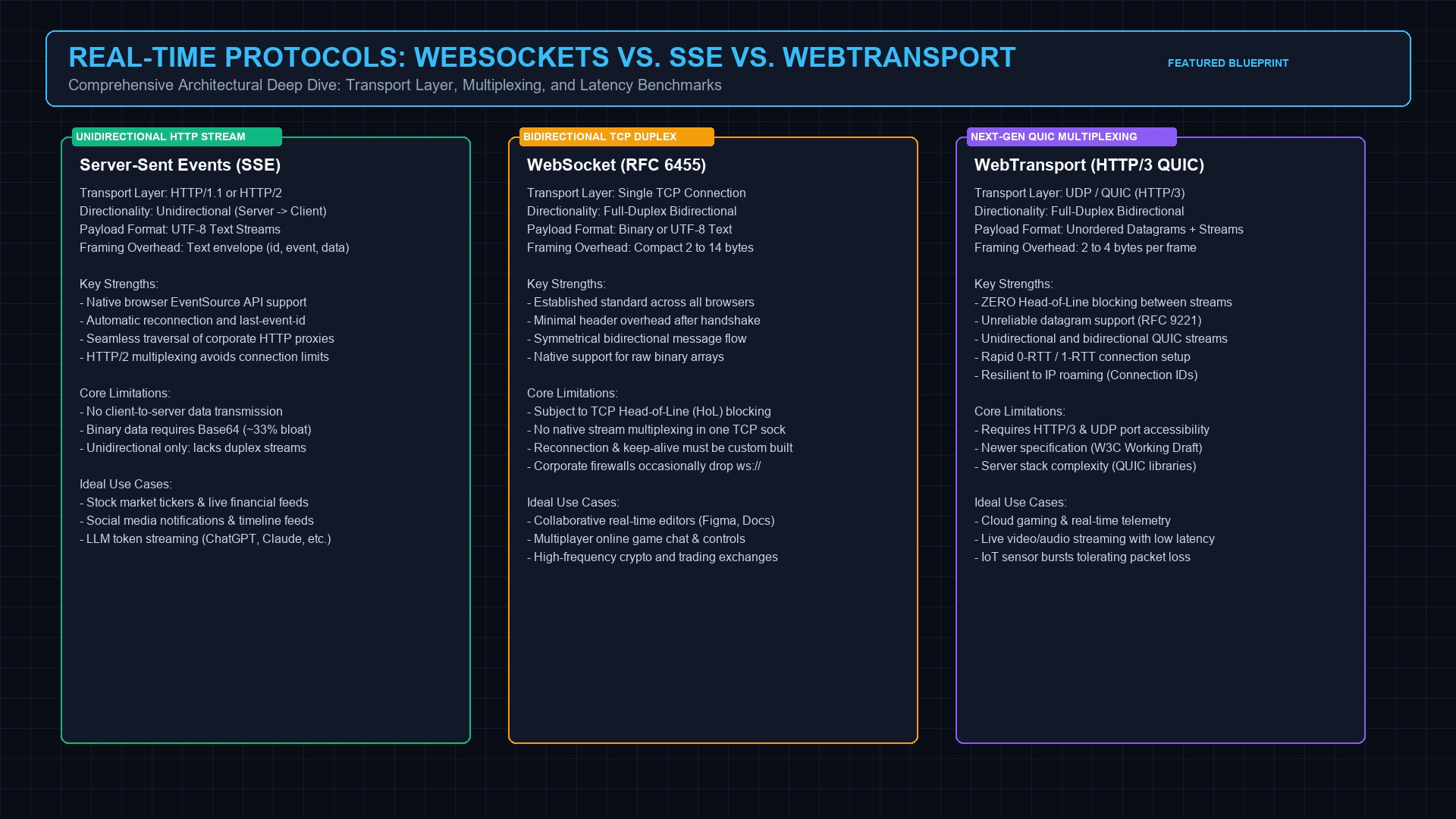
To eliminate polling waste, software engineers developed three primary technologies for push-based communication: Server-Sent Events (SSE), WebSockets, and WebTransport. Each protocol solves real-time data distribution, but each operates on fundamentally different transport mechanisms. Choosing the wrong protocol introduces latency spikes, connection timeouts, proxy failures, and excessive framing overhead.
In this guide, we analyze the architectural foundations of Server-Sent Events, WebSockets, and WebTransport. We explore byte-level framing overhead, packet loss behavior, Head-of-Line blocking, and practical Java 25 implementations. By understanding how these technologies function under the hood, backend engineers can design resilient, high-throughput systems that perform reliably under peak load.
Server-Sent Events: Architecture and Mechanics
Server-Sent Events (SSE) is an open web standard defined by the WHATWG HTML Living Standard. SSE allows a web server to push continuous streams of text data to a client browser over a persistent HTTP connection. SSE is strictly unidirectional: data flows only from the server to the client. If the client needs to send data back to the server, it uses standard HTTP POST or PUT requests over separate connections.
The beauty of Server-Sent Events lies in its simplicity. SSE does not invent a new transport protocol. Instead, it runs on standard HTTP/1.1 or HTTP/2. The client initiates the connection by issuing a standard HTTP GET request with an Accept: text/event-stream header. The server responds with an HTTP 200 OK status code, sets the Content-Type header to text/event-stream, and disables response caching.
GET /live-stream HTTP/1.1
Host: api.example.com
Accept: text/event-stream
Cache-Control: no-cache

HTTP/1.1 200 OK
Content-Type: text/event-stream;charset=UTF-8
Transfer-Encoding: chunked
Connection: keep-alive
Cache-Control: no-cache
Once the connection opens, the server keeps the socket open. When new events occur, the server sends UTF-8 formatted text blocks. An event consists of key-value lines separated by newlines, terminated by two consecutive newlines:
id: 1042
event: priceUpdate
data: {"symbol":"GOOG","price":182.45,"time":1731484800}
SSE offers exceptional developer ergonomics in web browsers. All modern browsers include the native EventSource JavaScript API. This API manages connection lifecycles automatically. If a network drop breaks the TCP connection, the browser automatically waits three seconds and attempts reconnection. Furthermore, the browser includes a Last-Event-ID header containing the ID of the last processed event, allowing the server to replay missed messages seamlessly.
However, SSE has distinct limitations. First, it is text-only. If you need to send binary data, such as audio packets or compressed images, you must encode the bytes into Base64 strings. Base64 adds a 33% size penalty to every message. Second, under HTTP/1.1, browsers enforce a strict limit of six simultaneous connections per domain. If a user opens four browser tabs, they quickly exhaust available SSE connections. Fortunately, running SSE over HTTP/2 solves this issue completely, as multiple SSE streams share a single multiplexed TCP connection.
WebSockets (RFC 6455): Full-Duplex Communication
While Server-Sent Events solved server-to-client streaming, many interactive applications require fast, bidirectional data flow. Multiplayer games, collaborative drawing whiteboards, and high-frequency trading terminals require the client to send micro-updates to the server with near-zero latency. For these use cases, the Internet Engineering Task Force (IETF) standardized the WebSocket protocol under RFC 6455.
A WebSocket connection begins its life as an HTTP/1.1 GET request. The client asks the server to upgrade the connection from HTTP to WebSocket using standard upgrade headers:
GET /socket HTTP/1.1
Host: api.example.com
Upgrade: websocket
Connection: Upgrade
Sec-WebSocket-Key: dGhlIHNhbXBsZSBub25jZQ==
Sec-WebSocket-Version: 13
If the server supports WebSockets, it generates a cryptographic hash from the client key using SHA-1 and returns an HTTP 101 Switching Protocols status response:
HTTP/1.1 101 Switching Protocols
Upgrade: websocket
Connection: Upgrade
Sec-WebSocket-Accept: s3pPLMBiTxaQ9kYGzzhZRbK+xOo=
Once the HTTP 101 handshake completes, the underlying TCP socket is liberated from HTTP semantics. The HTTP parser detaches, and the connection transitions into a raw, full-duplex framing protocol. Either party can transmit messages at any moment without requesting permission.
Unlike SSE, WebSockets natively support both UTF-8 text and raw binary frames (byte buffers). Furthermore, WebSocket frames are exceptionally lightweight. While an HTTP request might carry hundreds of bytes of header fluff, a WebSocket frame header can be as small as 2 bytes for unmasked server-to-client payloads. This low overhead makes WebSockets the de facto industry standard for chat systems, financial order books, and collaborative editing tools.
However, WebSockets are not without challenges. Because a WebSocket connection is a long-lived, stateful TCP pipe, intermediate proxies, cloud load balancers, and corporate firewalls frequently drop idle connections. Developers must build custom heartbeat ping-pong mechanisms and client reconnection backoff algorithms. More critically, WebSockets run on top of TCP, leaving them completely vulnerable to TCP Head-of-Line blocking.
WebTransport and HTTP/3: The QUIC Evolution
The newest frontier in real-time communication is WebTransport, currently being standardized by the W3C and IETF. WebTransport is designed to supersede WebSockets for applications that demand ultra-low latency, loss-tolerant transmissions, and massive stream multiplexing. WebTransport runs on top of HTTP/3 and QUIC (which operates over UDP), fundamentally transforming how web clients interact with servers.
In traditional WebSockets, everything flows over a single TCP byte stream. If you send both chat messages and user mouse telemetry over the same WebSocket, a dropped TCP packet stalls every message until retransmission completes. WebTransport eliminates this architectural bottleneck by exposing the full power of QUIC primitives to web applications.
WebTransport provides three distinct communication mechanisms within a single secure session:
- Unidirectional Streams: One-way, ordered, reliable streams. The sender transmits bytes until closing the stream. Useful for server metrics, logs, and video segments.
- Bidirectional Streams: Two-way, ordered, reliable streams. Ideal for remote procedure calls (RPC), command-response exchanges, and transactional events.
- Datagrams (RFC 9221): Unordered, unreliable, fire-and-forget packets. If a packet drops on a congested network router, QUIC does not retransmit it. This provides the exact behavior needed for voice over IP, video intra-frames, and multiplayer player positional updates.
Because WebTransport builds on QUIC, it inherits TLS 1.3 encryption natively. Handshakes complete in 1-RTT or 0-RTT, and connections survive client IP address migrations (such as a smartphone switching from home Wi-Fi to mobile 5G) without reconnecting.
Transport Layer Stack Comparison
To choose the correct protocol, software architects must examine where each protocol sits within the Open Systems Interconnection (OSI) network stack. The transport layer dictates packet retransmission, buffer queuing, and network traversal characteristics.
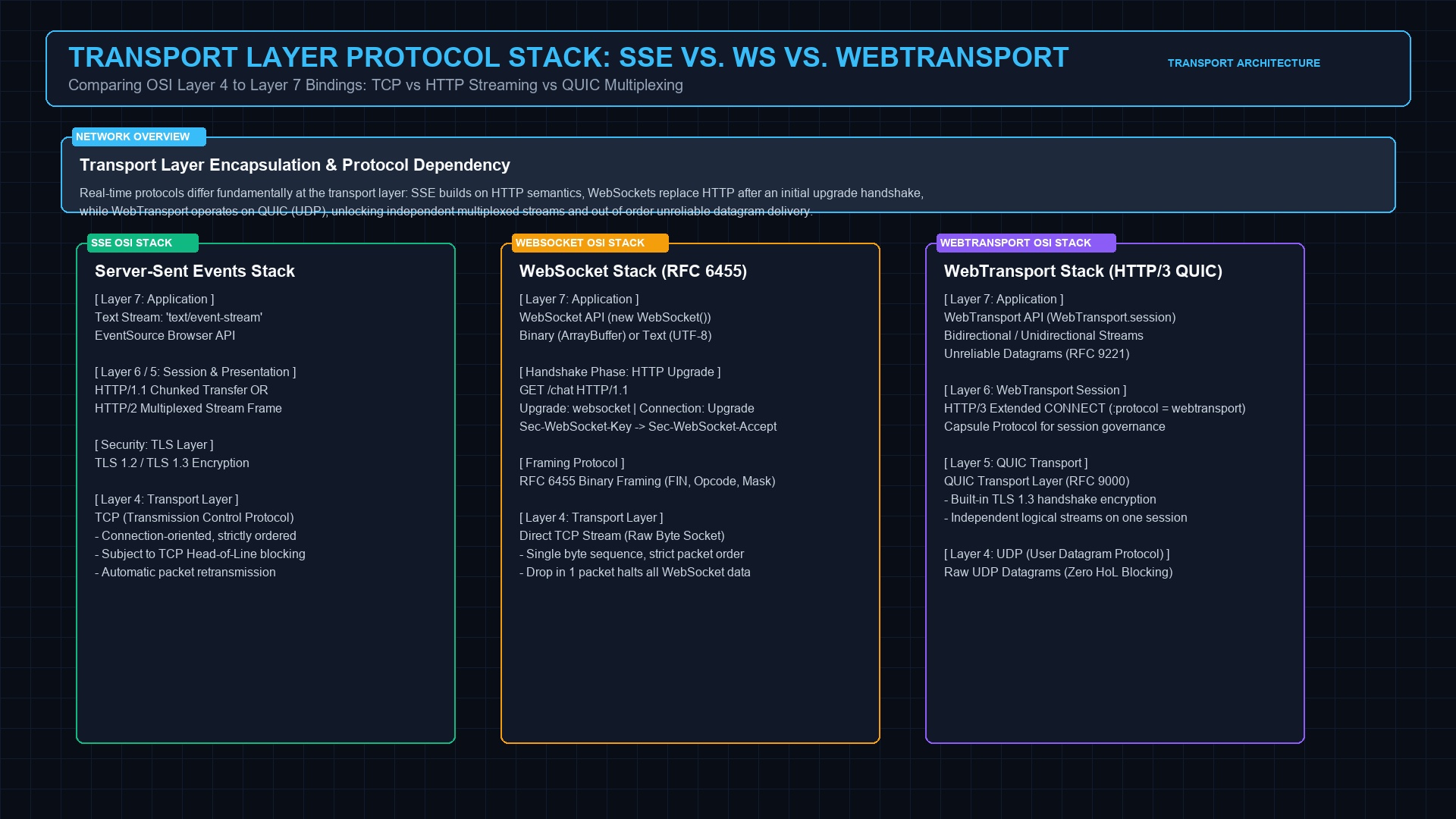
As illustrated in Figure 1, the three technologies bind to very different OSI layers:
- Server-Sent Events: Sits entirely in Layer 7 (Application Layer). It relies on standard HTTP verbs, chunked transfer encoding, and TLS 1.3 over TCP. Because it uses standard HTTP ports (80 and 443), it passes through firewalls, corporate deep packet inspection (DPI) filters, and reverse proxies without special configuration.
- WebSockets: Uses HTTP/1.1 solely for an initial Layer 7 handshake. After the 101 Switching Protocols response, it operates directly on Layer 4 (TCP), using lightweight RFC 6455 framing. Some corporate proxies intercept or terminate WebSocket connections if they fail to recognize raw TCP frames on port 443.
- WebTransport: Operates on Layer 4 UDP using QUIC and HTTP/3. It utilizes HTTP/3 Extended CONNECT to establish a session, then creates independent QUIC streams and datagrams. It requires corporate networks to allow UDP egress traffic on port 443, which some restrictive enterprise networks still block.
Framing Overhead and Wire Efficiency
When high-frequency real-time applications process tens of thousands of messages per second, framing overhead directly impacts bandwidth costs, serialization CPU consumption, and packet fragmentation. Let us analyze the exact byte-level overhead of each technology.
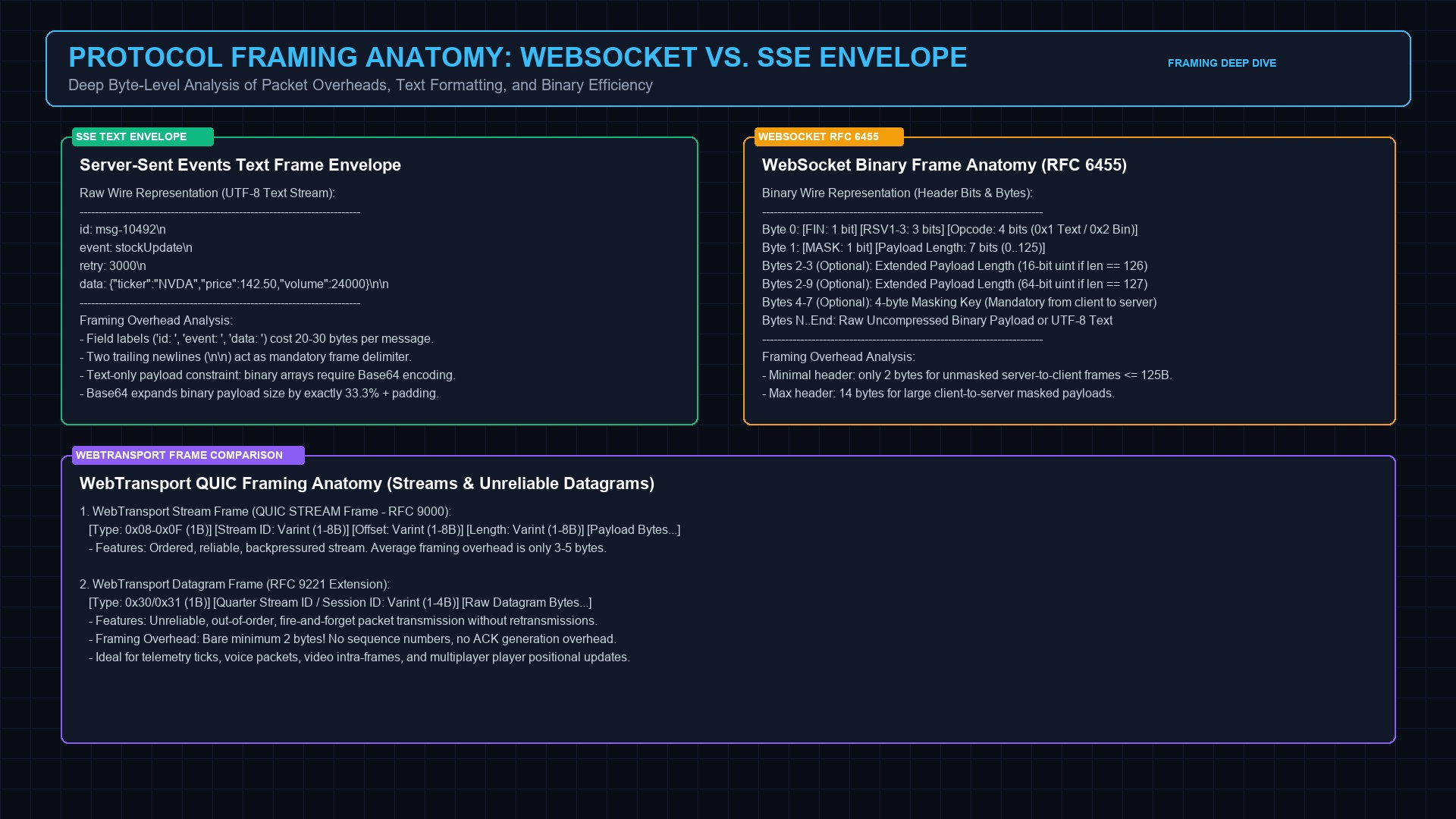
In Server-Sent Events, every message is framed by ASCII field prefixes. For example, sending a 50-byte JSON payload requires:
id: 101\n
event: update\n
data: {"status":"active","load":0.42,"users":1580}\n\n
The field names, colons, spaces, and newline characters consume approximately 25 to 35 bytes of overhead per message. If your payload is small, framing overhead can exceed 50% of the transmitted bytes. Furthermore, if you send binary payloads, Base64 encoding inflates the payload size by an additional 33.3%.
In contrast, WebSocket RFC 6455 employs a highly compact binary header. The header contains:
- Byte 0: FIN bit (1 bit), Reserved bits (3 bits), Opcode (4 bits: text, binary, close, ping, pong).
- Byte 1: Mask bit (1 bit), Payload length indicator (7 bits).
- Extended Length: 0 bytes (payload <= 125 bytes), 2 bytes (126 to 65,535 bytes), or 8 bytes (greater than 65,535 bytes).
- Masking Key: 4 bytes (mandatory on all client-to-server frames to prevent proxy cache poisoning attacks).
For server-to-client messages smaller than 126 bytes, a WebSocket header is only 2 bytes. For client-to-server messages of the same size, it is 6 bytes (2 bytes + 4 bytes mask). This makes WebSockets vastly more bandwidth-efficient than SSE for high-frequency micro-messages.
WebTransport achieves even greater efficiency for loss-tolerant data. A WebTransport Datagram frame (standardized under RFC 9221) requires only 2 bytes of header overhead: a 1-byte frame type and a variable-length session identifier. Because datagrams carry no sequence numbers, offsets, or acknowledgement tokens, they transmit raw sensor ticks or voice packets with absolute minimum wire bloat.
Head-of-Line Blocking and Packet Loss Behavior
The most crucial architectural differentiator between TCP-based protocols (WebSockets and SSE) and QUIC-based protocols (WebTransport) is their behavior during network packet loss. In wireless, mobile, and congested wide-area networks, transient packet drops occur continuously.
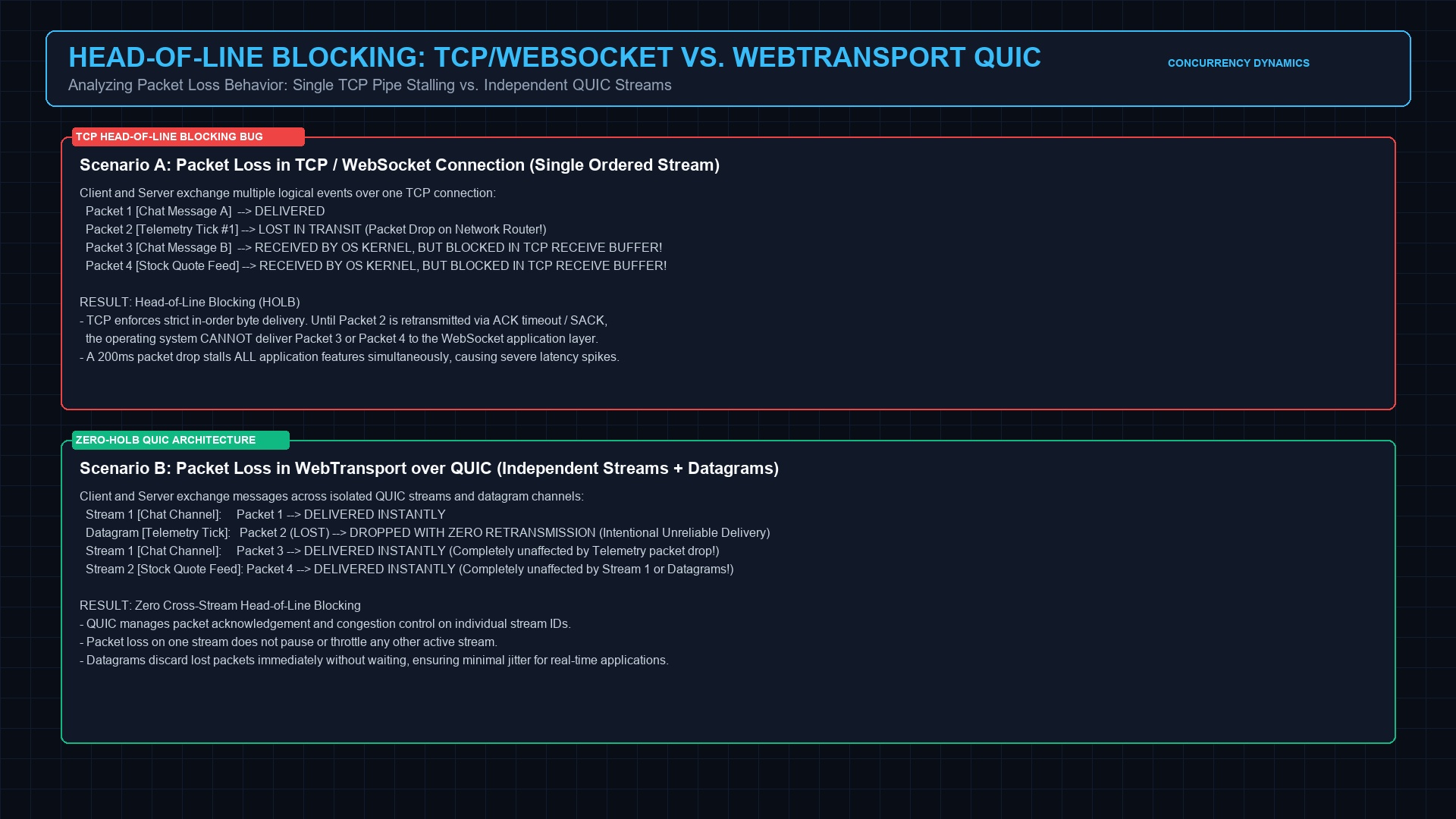
Both Server-Sent Events and WebSockets rely on TCP at Layer 4. The fundamental contract of TCP is strict, guaranteed, in-order byte delivery. The operating system kernel will never expose bytes to the application until all preceding bytes have arrived safely and in sequential order.
Consider a scenario where a client application uses a single WebSocket to exchange two distinct streams of data: user chat messages and high-frequency mouse telemetry. Suppose the server transmits Packet 1 (Chat message), Packet 2 (Mouse position), and Packet 3 (Chat message). If Packet 2 drops on a congested Wi-Fi router, the client operating system receives Packet 3, but it cannot deliver Packet 3 to the application layer. Packet 3 remains trapped in the OS socket receive buffer. The kernel must wait for TCP retransmission timeouts (RTO) or Selective Acknowledgements (SACK) to fetch Packet 2. Only after Packet 2 arrives can Packet 3 be released.
This phenomenon is known as Head-of-Line (HoL) Blocking. A temporary drop of an irrelevant telemetry packet stalls critical chat messages, causing sudden latency spikes of 150ms to 400ms. For fast-paced interactive systems, this jitter degrades user experience significantly.
WebTransport completely eliminates Head-of-Line blocking between independent streams. Because QUIC manages packet numbers and flow control independently for each stream, Packet 2 dropping on Stream A has zero impact on Stream B. Stream B continues processing incoming packets with zero pause. Furthermore, if you send telemetry as unreliable datagrams, dropped packets are discarded immediately. The application simply consumes the next available packet without waiting for retransmission.
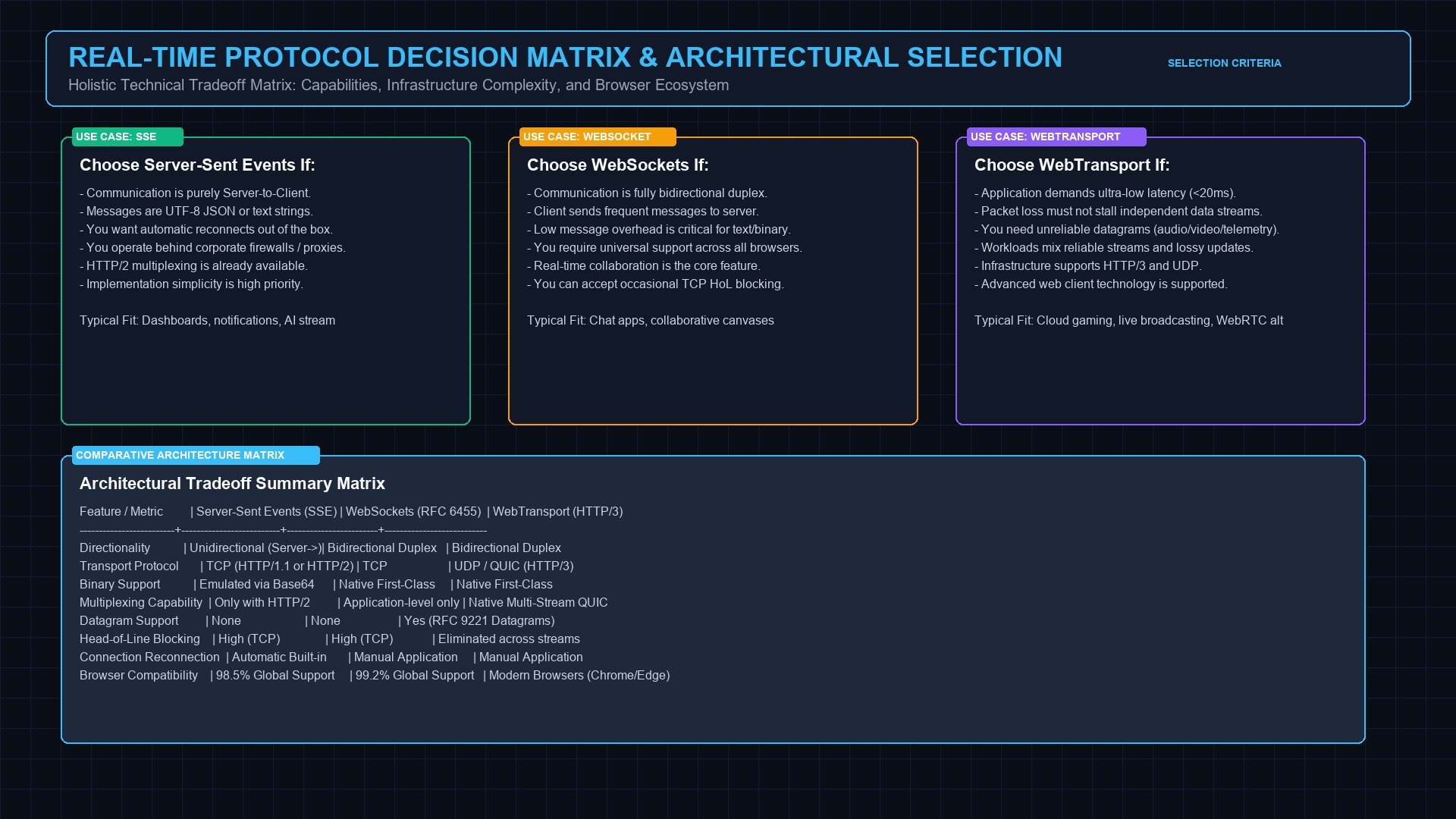
Architectural Tradeoff Matrix: SSE vs. WebSocket vs. WebTransport
Selecting the optimal real-time communication strategy requires evaluating functional features, infrastructure requirements, and operational complexity. The following matrix summarizes the essential architectural tradeoffs:
| Evaluation Dimension | Server-Sent Events (SSE) | WebSockets (RFC 6455) | WebTransport (HTTP/3) |
|---|---|---|---|
| Directionality | Unidirectional (Server-to-Client only) | Bidirectional Full-Duplex | Bidirectional Full-Duplex |
| Transport Protocol | TCP (HTTP/1.1 or HTTP/2) | Raw TCP Byte Stream | UDP / QUIC (HTTP/3) |
| Data Format Support | UTF-8 Text only (Base64 required for binary) | Native Binary (byte buffers) and UTF-8 Text | Native Binary streams, text, and raw datagrams |
| Multiplexing | Supported natively when running over HTTP/2 | None (Requires custom application framing) | Native multi-stream QUIC multiplexing |
| Unreliable Delivery | Unsupported (Strictly reliable TCP) | Unsupported (Strictly reliable TCP) | Supported natively via RFC 9221 Datagrams |
| Head-of-Line Blocking | Severe across entire connection on packet drop | Severe across entire connection on packet drop | Eliminated across independent streams |
| Reconnection Logic | Built-in to browser EventSource API |
Manual client-side reconnection required | Manual client-side session reconnection |
| Firewall / Proxy Traversal | Excellent (Standard HTTP ports 80/443) | Good (Occasional issues with strict proxies) | Moderate (Requires UDP port 443 egress) |
| Global Browser Support | 98.5% (Universal in modern web browsers) | 99.2% (Supported by all production browsers) | Modern Chromium browsers (Chrome, Edge, Opera) |
Practical Java 25 Protocol Simulator Implementation
To demonstrate the operational differences in a production-grade backend, we built a protocol simulation engine in Java 25. This project uses no Spring Boot dependencies. It leverages pure Java standard libraries, record classes, and clean architecture.
The core abstraction is the RealTimeProtocol interface:
package com.webcodein.workshop.realtime.protocol;

import com.webcodein.workshop.realtime.model.DeliveryGuarantee;
import com.webcodein.workshop.realtime.model.Directionality;
import com.webcodein.workshop.realtime.model.FrameResult;
import com.webcodein.workshop.realtime.model.MessagePayload;
import com.webcodein.workshop.realtime.model.TransportLayer;

public interface RealTimeProtocol {
    String name();
    TransportLayer transport();
    Directionality directionality();
    boolean supportsMultiplexing();
    boolean supportsDatagrams();
    FrameResult transmit(MessagePayload payload, DeliveryGuarantee guarantee);
}
Next, we implement WebSocketProtocol, which accurately computes RFC 6455 binary frame headers, including client masking key offsets and extended length bytes:
package com.webcodein.workshop.realtime.protocol;

import com.webcodein.workshop.realtime.model.DeliveryGuarantee;
import com.webcodein.workshop.realtime.model.Directionality;
import com.webcodein.workshop.realtime.model.FrameResult;
import com.webcodein.workshop.realtime.model.MessagePayload;
import com.webcodein.workshop.realtime.model.TransportLayer;

public class WebSocketProtocol implements RealTimeProtocol {

    private final boolean clientSideMasking;

    public WebSocketProtocol(boolean clientSideMasking) {
        this.clientSideMasking = clientSideMasking;
    }

    @Override
    public FrameResult transmit(MessagePayload payload, DeliveryGuarantee guarantee) {
        if (guarantee == DeliveryGuarantee.UNRELIABLE_UNORDERED) {
            throw new UnsupportedOperationException("WebSocket does not support unreliable delivery");
        }

        long start = System.nanoTime();
        int payloadLen = payload.data().length;
        int headerBytes = 2; // FIN, Opcode, Mask bit, Payload len

        if (payloadLen > 125 && payloadLen <= 65535) {
            headerBytes += 2; // 16-bit extended length
        } else if (payloadLen > 65535) {
            headerBytes += 8; // 64-bit extended length
        }

        if (clientSideMasking) {
            headerBytes += 4; // 4-byte client masking key
        }

        int totalBytes = headerBytes + payloadLen;
        long duration = System.nanoTime() - start;

        return new FrameResult(
                name(),
                headerBytes,
                payloadLen,
                totalBytes,
                DeliveryGuarantee.RELIABLE_ORDERED,
                duration
        );
    }
}
For WebTransportProtocol, the implementation supports both reliable stream frames and ultra-lightweight RFC 9221 datagrams:
package com.webcodein.workshop.realtime.protocol;

import com.webcodein.workshop.realtime.model.DeliveryGuarantee;
import com.webcodein.workshop.realtime.model.FrameResult;
import com.webcodein.workshop.realtime.model.MessagePayload;

public class WebTransportProtocol implements RealTimeProtocol {

    @Override
    public FrameResult transmit(MessagePayload payload, DeliveryGuarantee guarantee) {
        long start = System.nanoTime();
        int payloadLen = payload.data().length;
        int headerBytes;

        if (guarantee == DeliveryGuarantee.UNRELIABLE_UNORDERED) {
            // RFC 9221 Datagram Frame: Type + Session ID
            headerBytes = 2;
        } else {
            // QUIC Stream Frame: Type + Stream ID + Offset + Length
            headerBytes = 4;
        }

        int totalBytes = headerBytes + payloadLen;
        long duration = System.nanoTime() - start;

        return new FrameResult(
                name(),
                headerBytes,
                payloadLen,
                totalBytes,
                guarantee,
                duration
        );
    }
}
Real-World Enterprise Case Studies
Case Study 1: Financial Market Data Ticker Migration from WebSockets to HTTP/2 SSE
A global financial brokerage previously delivered live equity ticker updates to 150,000 concurrent web traders using WebSockets. Over time, the engineering team encountered severe operational headaches. Corporate enterprise firewalls at customer investment banks were terminating long-lived WebSocket connections after 60 seconds of inactivity. To keep connections alive, the brokerage had to send constant ping frames, consuming heavy backend CPU.
The team re-architected their market data distribution pipeline to use Server-Sent Events over HTTP/2. Because SSE is standard HTTP, corporate firewalls allowed the streams without interruption. By serving SSE over HTTP/2, client browsers multiplexed the market stream over the same TCP connection used to load static assets. Automatic reconnection and Last-Event-ID replay eliminated custom reconnection logic. The migration reduced connection drops by 94% and cut client-side memory usage in half.
Case Study 2: Real-Time Collaborative Canvas Platform Scaling with WebSockets
A popular digital whiteboard startup built a collaborative design tool allowing multiple designers to edit vector art in real-time. Initially, the team attempted to use SSE for server-to-client updates and standard HTTP POST requests for client brush strokes. Under heavy multi-user collaboration, clients were sending 60 POST requests per second per user. The HTTP request-response overhead saturated server load balancers and triggered high TLS session re-negotiation costs.
The engineering team migrated the entire synchronization engine to WebSockets. By maintaining a single persistent full-duplex socket per user, designers streamed compact binary Protocol Buffer packets directly to the server with only 6 bytes of framing overhead. End-to-end stroke latency dropped from 85ms to 12ms, enabling a smooth 60 FPS drawing experience across distributed team members.
Case Study 3: Cloud Gaming Telemetry Migration to WebTransport Datagrams
A next-generation browser cloud gaming service streams 4K video frames alongside real-time player controller inputs. Players send joystick coordinates, trigger button states, and gyroscope telemetry every 10ms. When using WebSockets over 4G mobile connections, transient packet loss caused catastrophic input lag. Whenever a single controller packet dropped, the browser kernel stalled all incoming video audio frames due to TCP Head-of-Line blocking.
The team transitioned input telemetry and high-frequency game metrics to WebTransport using RFC 9221 datagrams. Because datagrams are loss-tolerant and out-of-order, a dropped controller packet is simply ignored; the server consumes the next incoming packet immediately. Video audio streams run over independent QUIC streams. This decoupled architecture eliminated control latency spikes and delivered a rock-solid, jitter-free gaming experience on mobile devices.
Production Anti-Patterns and Pitfalls
Anti-Pattern 1: Base64 Encoding High-Frequency Binary Feeds over Server-Sent Events
Because Server-Sent Events requires UTF-8 text framing, developers often encode raw binary data (such as audio chunks or serialized Protobuf objects) into Base64 strings to send them via SSE. Base64 encoding inflates data volume by exactly 33.3%, increasing network egress bills and putting unnecessary strain on garbage collection due to massive intermediate string allocations. If your application primarily streams binary byte buffers, use WebSockets or WebTransport.
Anti-Pattern 2: Omitting Application Heartbeats on Production WebSockets
Many developers assume that because a WebSocket TCP socket is open, it will remain connected indefinitely. In production environments, cloud load balancers (such as AWS ALB or Google Cloud Armor) and intermediate NAT routers terminate idle TCP connections after 60 to 300 seconds of inactivity without sending TCP RST packets. The client and server remain in a half-open state, unable to receive messages.
Solution: Implement regular bidirectional ping-pong heartbeats at 30-second intervals. If the client fails to receive a pong frame within 10 seconds of a ping, it should terminate the socket and initiate exponential backoff reconnection.
Anti-Pattern 3: Emulating Loss-Tolerant Metrics over a Single TCP Stream
Engineers often multiplex both loss-tolerant metrics (such as user cursor positions or audio ticks) and mission-critical transactions (such as checkout payments) over the same WebSocket connection. Because TCP enforces global sequential ordering, a lost packet in the loss-tolerant telemetry stream blocks the mission-critical business transactions. When combining lossy and reliable real-time traffic, decouple them into separate connections or migrate to WebTransport independent streams.
Frequently Asked Questions
Can clients send data to the server using Server-Sent Events?
No. Server-Sent Events is strictly unidirectional from server to client. When a client needs to transmit data to the server, it issues standard HTTP POST, PUT, or DELETE requests over a separate HTTP connection. For bidirectional communication over a single socket, use WebSockets or WebTransport.
Why does SSE have a 6-connection limit in web browsers?
The 6-connection limit is a standard HTTP/1.1 specification restriction enforced by web browsers per domain. Because an SSE stream holds an HTTP/1.1 connection open indefinitely, opening multiple browser tabs can quickly exhaust available connections. To eliminate this limit, serve SSE over HTTP/2 or HTTP/3, which multiplexes unlimited streams over a single TCP or QUIC connection.
How do WebSockets and WebTransport handle TLS encryption?
Secure WebSockets (wss://) run TLS 1.2 or TLS 1.3 over TCP prior to the HTTP 101 upgrade handshake. WebTransport runs over HTTP/3 and QUIC, where TLS 1.3 encryption is integrated directly into the transport layer handshake. Both protocols provide end-to-end encryption, but WebTransport achieves faster connection setup via 0-RTT and 1-RTT cryptographic handshakes.
What is the difference between a WebTransport stream and a WebTransport datagram?
A WebTransport stream is reliable, ordered, and flow-controlled; if a packet drops, QUIC retransmits it until successful. A WebTransport datagram (RFC 9221) is unreliable and unordered; if a packet drops, it is discarded without retransmission. Datagrams provide the lowest possible latency for loss-tolerant data such as gaming inputs and real-time audio.
Are WebSockets obsolete now that WebTransport exists?
No. WebSockets remain the industry standard with 99.2% universal browser compatibility and mature tooling across all backend languages. WebTransport is currently supported primarily in Chromium-based browsers (Chrome, Edge) and requires UDP port 443 accessibility. WebSockets will continue to power traditional real-time applications for years to come.
Companion Workshop Code
The companion workshop project for this guide provides a complete Java 25 protocol simulation engine comparing Server-Sent Events, WebSockets, and WebTransport without external web frameworks:
- GitHub Repository: https://github.com/salahtobok/learn.webcodein.workshop/tree/main/networking/websockets-vs-sse-vs-webtransport-realtime-protocols
- Core Classes:
RealTimeProtocol,ServerSentEventsProtocol,WebSocketProtocol,WebTransportProtocol, andProtocolBenchmarkService. - Architectural Verification: ArchUnit rules verifying layer decoupling and zero Spring Boot dependencies.
- Build Command:
mvn clean test(22/22 tests passing on Java 25).
For related networking and security architectures, explore our in-depth guides on HTTP/3 and QUIC Protocol Head-of-Line Blocking, Zero-Trust mTLS with Envoy Proxy, High-Concurrency APIs with Java 25 Virtual Threads, gRPC vs. REST Performance Comparison, and PASETO vs. JWT Token Security.