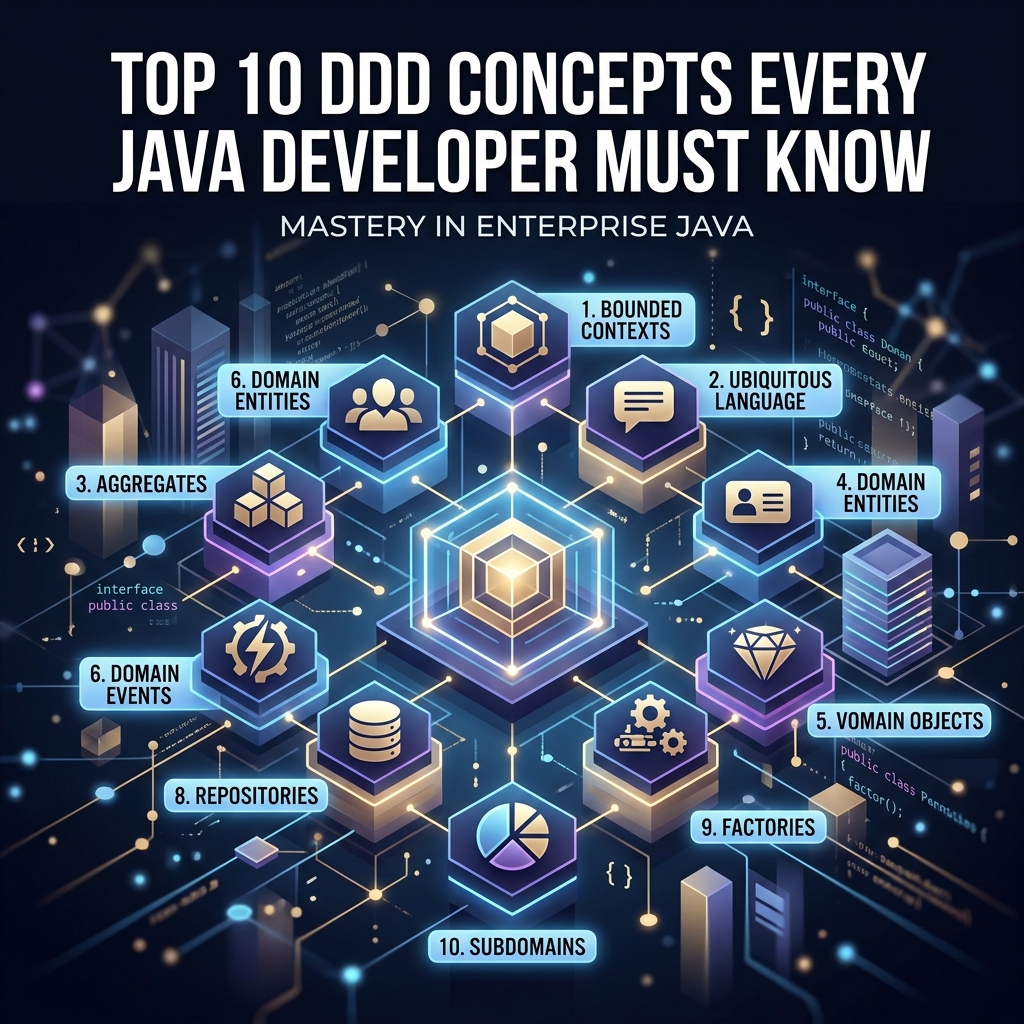
Introduction: Domain-Driven Design in the Real World
Domain-Driven Design (DDD) is a proven way to design complex software. Many software teams start with database tables first. They design relational schemas, write simple CRUD controllers, and place business rules inside database triggers or bloated service classes. Over time, this habit creates an unmaintainable system often called a “Big Ball of Mud.”
Domain-Driven Design changes this habit completely. It places the business domain and its business logic at the very center of the architecture. Instead of letting database tables dictate code structure, DDD shapes code around real business processes. It encourages developers and business experts to speak the exact same vocabulary. This shared understanding reduces miscommunication, prevents bugs, and keeps software flexible when requirements change.
In this comprehensive guide, we examine 10 essential DDD concepts every Java engineer must know. We illustrate each pattern using modern Java 25 and Spring Boot 4.0.0 through an enterprise Bookstore application.
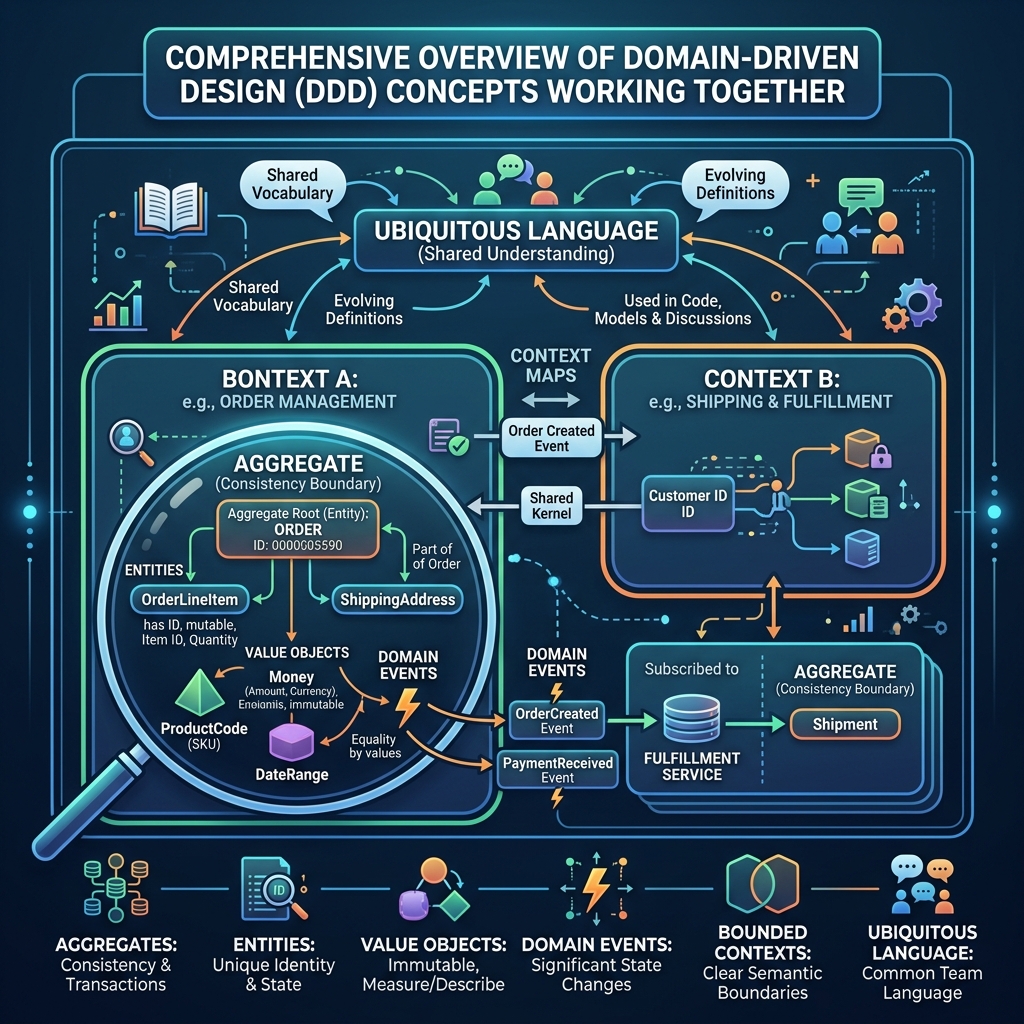
Quick Index: 10 Essential DDD Concepts
- 1. Ubiquitous Language: Speak the Business Language
- 2. Bounded Context: Explicit Model Boundaries
- 3. Entity: Identity Over Mutable State
- 4. Value Object: Immutable Descriptors with Structural Equality
- 5. Aggregate and Aggregate Root: Consistency Boundaries
- 6. Repository: In-Memory Collection Abstraction
- 7. Domain Event: Decoupling Business Occurrences
- 8. Domain Service: Stateless Cross-Aggregate Logic
- 9. Anti-Corruption Layer: Protecting the Core Domain
- 10. Specification Pattern: Composable Business Rules
- 11. Comparative Architecture Matrix
- 12. Real-World Enterprise Production Case Studies
- 13. Common Production Anti-Patterns and Engineering Fixes
- 14. Automated Architectural Governance with ArchUnit
- 15. Frequently Asked Questions (FAQ)
- 16. Conclusion and Companion Code
1. Ubiquitous Language: Speak the Business Language
Ubiquitous Language is the foundational practice of Domain-Driven Design. It requires developers, domain experts, product managers, and testers to use the exact same terminology. Words must carry identical meanings in casual conversations, formal documentation, user stories, Java classes, unit tests, and database tables.
In standard development teams, developers frequently translate business terms into generic technical jargon. Business experts talk about “Members placing Orders.” Developers often create classes named UserAccountRecord or CartTransactionService. This mental translation layer wastes time and introduces subtle software bugs.
When an incident report states that “A VIP member’s order failed to receive the seasonal discount,” an engineer should immediately locate BookstoreMember, Order, and PricingService in the Java codebase. No mental translation is needed.
// Bad: Technical naming that business experts cannot recognize
public class UserAccountEntity {
    public void executeCartTransaction(ShoppingCart cart) {
        // Obscure technical logic
    }
}

// Good: Ubiquitous Language reflecting exact business domain concepts
public class BookstoreMember {
    private final MemberId memberId;
    private final boolean vip;

    public BookstoreMember(MemberId memberId, boolean vip) {
        this.memberId = Objects.requireNonNull(memberId);
        this.vip = vip;
    }

    public boolean isVip() {
        return this.vip;
    }

    public void placeOrder(Order order) {
        if (!order.isReadyForCheckout()) {
            throw new IllegalStateException("Order is not ready for checkout");
        }
        // Domain operation executes cleanly
    }
}
2. Bounded Context: Explicit Model Boundaries
As enterprise systems grow, building a single unified data model for the entire company becomes impossible. A concept like “Book” means entirely different things to different departments. Trying to force all departments into one mega-class results in bloated God classes with hundreds of irrelevant fields.
A Bounded Context defines a strict linguistic and logical boundary. Inside this boundary, a particular domain model applies consistently. Outside the boundary, the same word can carry a completely different meaning and structure.
In our Bookstore application, the Sales department cares about book retail prices, discounts, and inventory availability. Meanwhile, the Shipping department cares about physical weight, metric dimensions, and fragile package labeling. In Domain-Driven Design, we create two distinct models inside their respective packages.
// --- Sales Bounded Context ---
package com.bookstore.sales.domain;

import java.math.BigDecimal;

public record Book(
    String isbn,
    BigDecimal price,
    boolean inStock
) {
    public boolean canBeSold() {
        return inStock && price.compareTo(BigDecimal.ZERO) > 0;
    }
}

// --- Shipping Bounded Context ---
package com.bookstore.shipping.domain;

public record Book(
    String isbn,
    double weightKg,
    Dimensions dimensions
) {
    public boolean requiresOversizePackaging() {
        return weightKg > 5.0 || dimensions.isOversized();
    }
}
Both models share the same real-world ISBN, yet each record contains only the fields required for its explicit business responsibilities. Neither context pollutes the other.
3. Entity: Identity Over Mutable State
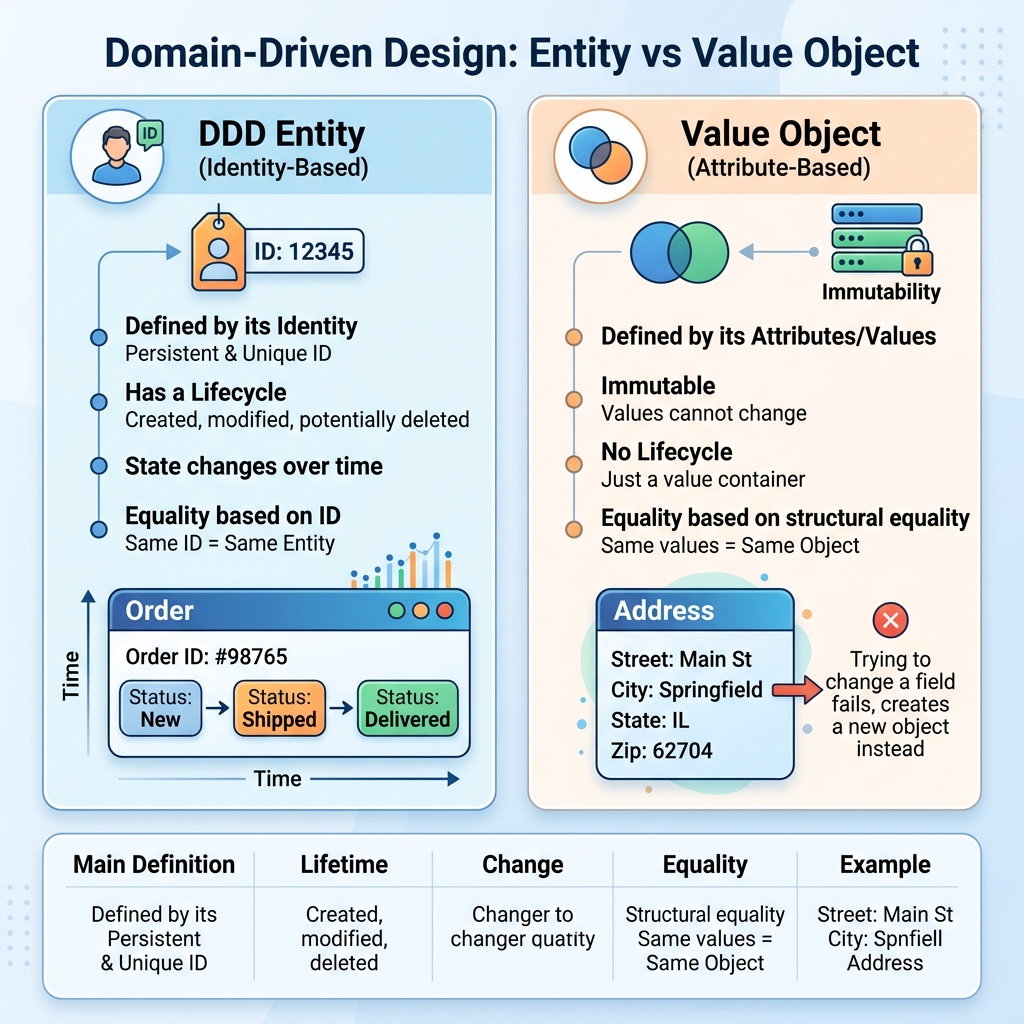
An Entity is a domain object defined primarily by its unique, continuous identity rather than its attributes. An Entity’s properties can change repeatedly throughout its lifecycle, yet it remains the exact same business object.
Examples of Entities include an Order, a Bank Account, or a Customer. If an Order changes its delivery address, adds an item, or changes its status from PENDING to COMPLETED, it is still the exact same Order. Therefore, Java equality (equals() and hashCode()) on an Entity must depend strictly on its unique identifier (such as a UUID), never on mutable fields.
package com.bookstore.domain;

import jakarta.persistence.Entity;
import jakarta.persistence.Id;
import jakarta.persistence.Table;
import java.util.Objects;
import java.util.UUID;

@Entity
@Table(name = "orders")
public class Order {

    @Id
    private UUID orderId; // Unique identity that never changes
    private String status;
    private String shippingAddress;

    protected Order() {} // Default constructor required for JPA reflection

    public Order(UUID orderId) {
        this.orderId = Objects.requireNonNull(orderId, "OrderId must not be null");
        this.status = "PENDING";
    }

    public void complete() {
        this.status = "COMPLETED";
    }

    public boolean isReadyForCheckout() {
        return "PENDING".equals(this.status);
    }

    @Override
    public boolean equals(Object o) {
        if (this == o) return true;
        if (!(o instanceof Order other)) return false;
        return Objects.equals(this.orderId, other.orderId);
    }

    @Override
    public int hashCode() {
        return Objects.hash(orderId);
    }
}
4. Value Object: Immutable Descriptors with Structural Equality
Unlike Entities, a Value Object has no identity. It measures, quantifies, or describes a characteristic of the domain. Two Value Objects with identical attributes are considered completely interchangeable.
Value Objects must always be immutable. If you need to change a Value Object, you create a new instance with the new values. Modern Java records provide the perfect mechanism for Value Objects because they guarantee immutability, structural equality, and clean compact validation out of the box.
Encapsulating attributes into Value Objects eliminates the “Primitive Obsession” anti-pattern. Instead of passing loose BigDecimal numbers or raw strings, we use strongly typed objects like Money or MemberId.
package com.bookstore.domain;

import java.math.BigDecimal;
import java.util.Objects;

// Java Record provides immutability and structural equality
public record Money(BigDecimal amount, String currency) {

    // Compact constructor enforces domain invariants on creation
    public Money {
        if (amount == null || amount.compareTo(BigDecimal.ZERO) < 0) {
            throw new IllegalArgumentException("Amount cannot be negative");
        }
        Objects.requireNonNull(currency, "Currency is required");
    }

    public Money add(Money other) {
        if (!this.currency.equals(other.currency)) {
            throw new IllegalArgumentException("Currency mismatch: cannot add " + other.currency + " to " + this.currency);
        }
        return new Money(this.amount.add(other.amount), this.currency);
    }

    public Money multiply(double multiplier) {
        return new Money(this.amount.multiply(BigDecimal.valueOf(multiplier)), this.currency);
    }

    public Money subtract(Money other) {
        if (!this.currency.equals(other.currency)) {
            throw new IllegalArgumentException("Currency mismatch");
        }
        if (this.amount.compareTo(other.amount) < 0) {
            throw new IllegalArgumentException("Result cannot be negative");
        }
        return new Money(this.amount.subtract(other.amount), this.currency);
    }
}
5. Aggregate and Aggregate Root: Consistency Boundaries
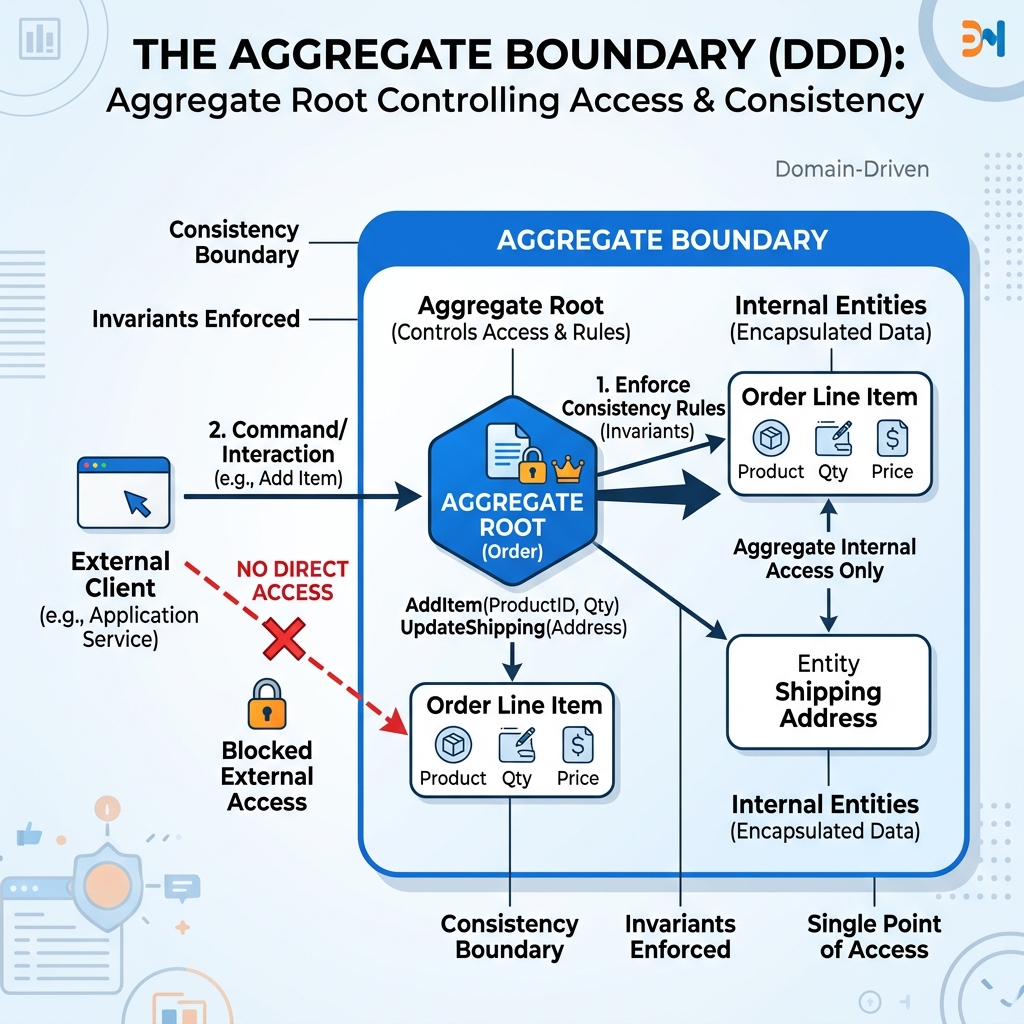
An Aggregate is a cluster of related Entities and Value Objects treated as a single transactional unit for data changes. Every Aggregate has a single entry point called the Aggregate Root.
External code can only hold references to the Aggregate Root. Outside callers are strictly forbidden from directly modifying internal entities. The Aggregate Root guarantees that all business invariants remain valid before, during, and after every state modification.
package com.bookstore.domain;

import java.util.ArrayList;
import java.util.List;
import java.util.UUID;

// Aggregate Root guarding its internal Chapter entities
public class BookAggregate {
    private final UUID id;
    private String title;
    private Money price;
    private boolean clearance;
    private int salesCount;
    private int stock;

    // Internal entities protected inside the boundary
    private final List<Chapter> chapters = new ArrayList<>();

    public BookAggregate(UUID id, String title, Money price) {
        this(id, title, price, false, 0, 0);
    }

    public BookAggregate(UUID id, String title, Money price, boolean clearance, int salesCount, int stock) {
        this.id = id;
        this.title = title;
        this.price = price;
        this.clearance = clearance;
        this.salesCount = salesCount;
        this.stock = stock;
    }

    // Invariant rule enforced by the Root
    public void addChapter(String chapterTitle) {
        if (chapterTitle == null || chapterTitle.isBlank()) {
            throw new IllegalArgumentException("Chapter title is required");
        }
        this.chapters.add(new Chapter(UUID.randomUUID(), chapterTitle));
    }

    // Returns an unmodifiable view to prevent external tampering
    public List<String> getChapterTitles() {
        return chapters.stream().map(Chapter::getTitle).toList();
    }

    public void applyDiscount() {
        this.price = this.price.multiply(0.9);
    }

    public UUID getId() { return id; }
    public Money getPrice() { return price; }
    public boolean isClearance() { return clearance; }
    public int getSalesCount() { return salesCount; }
    public int getStock() { return stock; }
}

// Package-private internal Entity: outside packages cannot instantiate or mutate directly
class Chapter {
    private final UUID id;
    private final String title;

    Chapter(UUID id, String title) {
        this.id = id;
        this.title = title;
    }

    public String getTitle() { return title; }
}
6. Repository: In-Memory Collection Abstraction
A Repository provides the illusion of an in-memory collection of Aggregate Roots. Application services query and save full Aggregates through the Repository interface without knowing whether data is stored in PostgreSQL, MongoDB, or an in-memory map.
A fundamental rule of Domain-Driven Design is that there must be only one Repository per Aggregate Root. You must never create repositories for child entities like ChapterRepository. Child entities are loaded and saved exclusively through their parent Aggregate Root.
package com.bookstore.domain;

import java.util.Optional;
import java.util.UUID;

// Repository interface lives inside the pure domain layer
public interface BookRepository {
    Optional<BookAggregate> findById(UUID id);
    void save(BookAggregate book);
    void delete(BookAggregate book);
}

// Application service orchestrates domain operations through the repository
package com.bookstore.application;

import com.bookstore.domain.BookAggregate;
import com.bookstore.domain.BookRepository;
import org.springframework.stereotype.Service;
import org.springframework.transaction.annotation.Transactional;
import java.util.UUID;

@Service
@Transactional
public class BookApplicationService {
    private final BookRepository repository;

    public BookApplicationService(BookRepository repository) {
        this.repository = repository;
    }

    public void addChapterToBook(UUID bookId, String title) {
        BookAggregate book = repository.findById(bookId)
            .orElseThrow(() -> new IllegalArgumentException("Book not found for ID: " + bookId));

        book.addChapter(title);
        repository.save(book); // Persists the aggregate root and its chapters atomically
    }
}
7. Domain Event: Decoupling Business Occurrences
A Domain Event represents a significant business occurrence that has already taken place in the domain. Domain Events are named in the past tense (such as BookPublishedEvent, OrderPlacedEvent, or PaymentReceivedEvent).
Domain Events allow subsystems to react asynchronously without direct coupling. Instead of having an order service call email services, inventory services, and loyalty points services directly, the order service simply emits an event. Independent listeners handle their own tasks without blocking the checkout flow.
package com.bookstore.domain;

import java.time.Instant;
import java.util.UUID;

// Immutable Domain Event record
public record BookPublishedEvent(
    UUID bookId,
    String title,
    Instant occurredOn
) {}

// Event listener in application or infrastructure layer
package com.bookstore.application;

import com.bookstore.domain.BookPublishedEvent;
import org.springframework.context.event.EventListener;
import org.springframework.stereotype.Component;

@Component
public class NotificationHandler {

    @EventListener
    public void onBookPublished(BookPublishedEvent event) {
        // Dispatches email newsletters, refreshes search caches, or notifies catalog
        System.out.println("Dispatching notification for published book: " + event.title());
    }
}
8. Domain Service: Stateless Cross-Aggregate Logic
Sometimes a business calculation does not belong naturally inside any single Entity or Value Object. If an operation coordinates multiple distinct Aggregates or enforces rules across several entities, forcing that logic into one entity feels awkward and causes high coupling.
A Domain Service encapsulates this stateless business logic. Do not confuse Domain Services with Application Services. An Application Service handles infrastructure tasks like database transactions, security, and DTO conversion. A Domain Service contains pure business rules and zero infrastructure code.
package com.bookstore.domain;

import org.springframework.stereotype.Service;
import java.math.BigDecimal;

@Service // Pure domain service coordinating member status and book pricing
public class PricingService {

    public Money calculateFinalPrice(BookstoreMember member, BookAggregate book) {
        Money basePrice = book.getPrice();

        // Rule 1: VIP members receive a 20% discount across all catalog items
        if (member.isVip()) {
            return basePrice.multiply(0.8);
        }

        // Rule 2: Clearance items receive a flat $5 deduction
        if (book.isClearance()) {
            return basePrice.subtract(new Money(new BigDecimal("5.00"), basePrice.currency()));
        }

        return basePrice;
    }
}
9. Anti-Corruption Layer: Protecting the Core Domain
Modern applications frequently integrate with legacy systems, external vendor APIs, or third-party web services. These outside systems often use poorly named fields, strange data types, or legacy XML formats.
An Anti-Corruption Layer (ACL) translates foreign models into the clean Ubiquitous Language of your Bounded Context. The ACL acts as a defensive shield. It ensures that bad external designs do not leak into your core business domain.
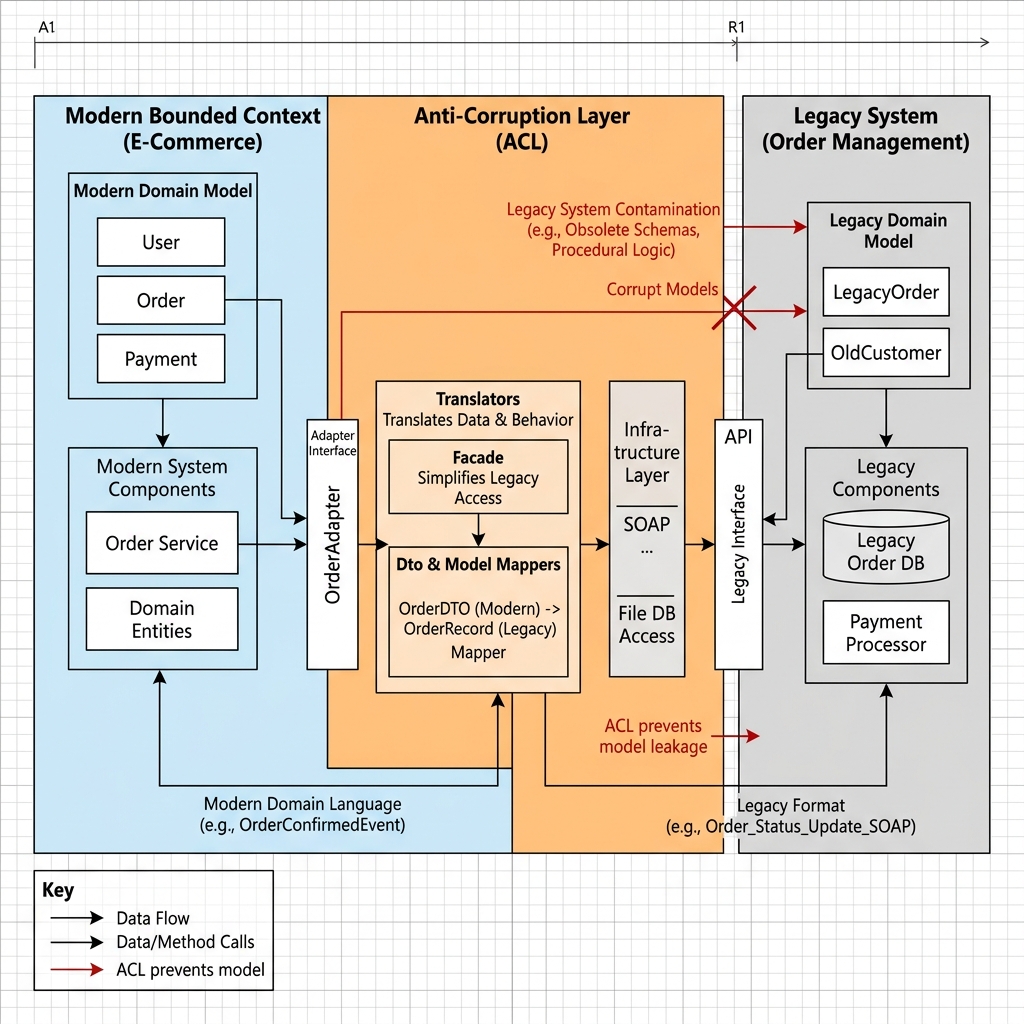
package com.bookstore.infrastructure;

import com.bookstore.domain.ShippingDetails;
import org.springframework.stereotype.Component;

@Component
public class LegacyShippingAcl {
    private final LegacySoapShippingClient legacyClient;

    public LegacyShippingAcl(LegacySoapShippingClient legacyClient) {
        this.legacyClient = legacyClient;
    }

    // Translates legacy SOAP payload into pristine domain Value Object
    public ShippingDetails getShippingInfo(String isbn) {
        LegacyShippingResponse raw = legacyClient.fetch(isbn);

        // Defensive parsing and normalization
        double weight = Double.parseDouble(raw.getWgt());
        boolean requiresSignature = "Y".equalsIgnoreCase(raw.getSigReq());

        return new ShippingDetails(weight, requiresSignature);
    }
}
10. Specification Pattern: Composable Business Rules
The Specification Pattern encapsulates a specific business rule into an independent, reusable class. Instead of spreading complex boolean checks across services and database queries, each rule becomes a standalone object that implements a clear predicate.
Specifications can be chained together dynamically using logical operators (and, or, not). This allows developers to combine complex business rules without writing deeply nested if-else ladders.
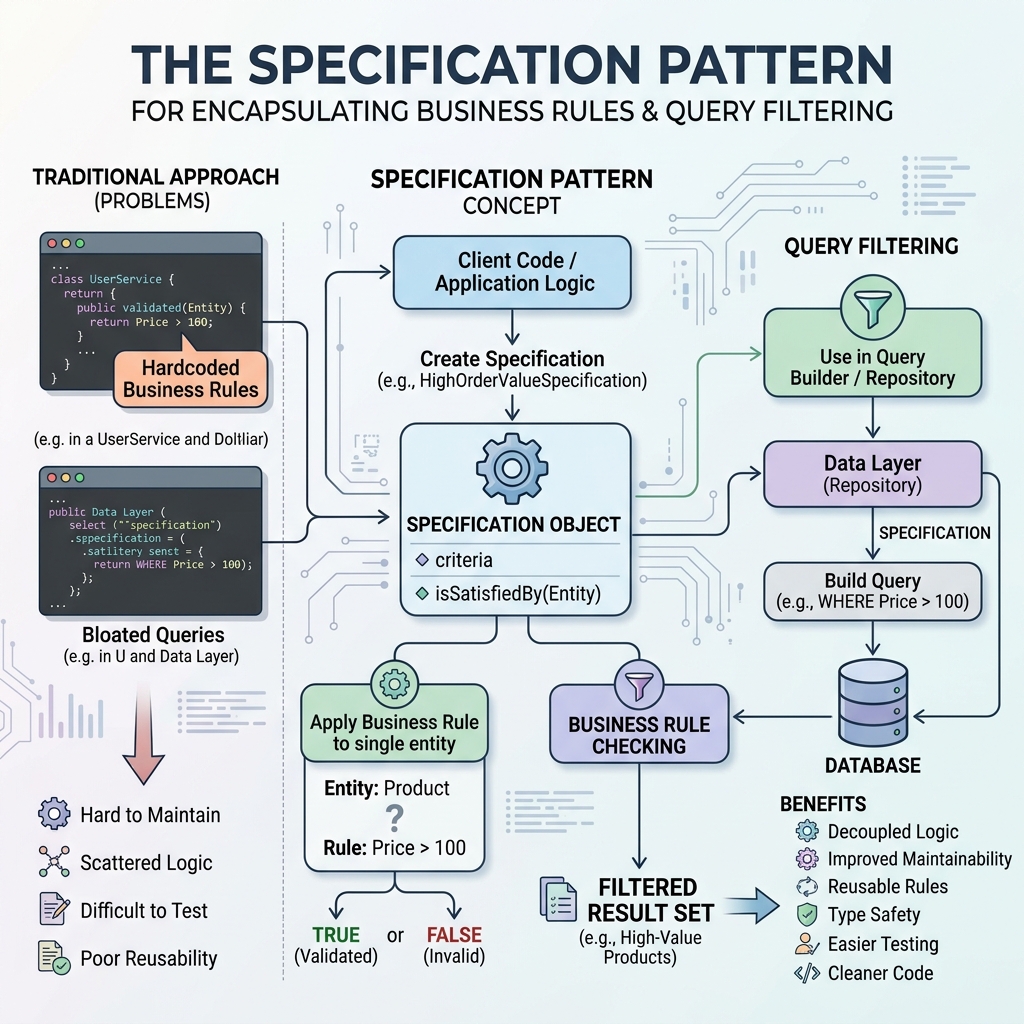
package com.bookstore.domain;

// Composable specification interface
public interface Specification<T> {
    boolean isSatisfiedBy(T item);

    default Specification<T> and(Specification<T> other) {
        return item -> this.isSatisfiedBy(item) && other.isSatisfiedBy(item);
    }
}

// Concrete rule 1: Must be a bestseller
public class IsBestsellerSpec implements Specification<BookAggregate> {
    @Override
    public boolean isSatisfiedBy(BookAggregate book) {
        return book.getSalesCount() > 10000;
    }
}

// Concrete rule 2: Must have available inventory stock
public class IsInStockSpec implements Specification<BookAggregate> {
    @Override
    public boolean isSatisfiedBy(BookAggregate book) {
        return book.getStock() > 0;
    }
}

// Dynamic rule composition in a promotion service
@Service
public class PromotionService {
    public void applyPromotion(BookAggregate book) {
        Specification<BookAggregate> promotable = new IsBestsellerSpec().and(new IsInStockSpec());

        if (promotable.isSatisfiedBy(book)) {
            book.applyDiscount();
        }
    }
}
Comparative Architecture Matrix: 10 DDD Patterns
The following table summarizes the structural traits, lifecycles, and Spring Boot 4 implementation constructs across all 10 core concepts:
| DDD Pattern | Core Architectural Role | Mutability | Identity Strategy | Boundary Scope | Spring Boot 4 Construct | Common Anti-Pattern |
|---|---|---|---|---|---|---|
| Ubiquitous Language | Unified vocabulary shared by business and code | Evolving | Domain Terminology | Bounded Context | Package & Class Naming | Technical translation jargon |
| Bounded Context | Linguistic boundary isolating sub-models | Static | Context Boundary | Subsystem / Module | Gradle/Maven Multi-Module or Modulith | Global Monolithic God Class |
| Entity | Object tracked across state mutations | Mutable | Immutable UUID / ID | Aggregate Internal | Jakarta @Entity with UUID |
Equals based on mutable fields |
| Value Object | Descriptive or measurable quantity | Immutable | Structural Equality | Entity Attribute | Java record / @Embeddable |
Primitive Obsession |
| Aggregate Root | Consistency gate enforcing invariants | Controlled | Unique Aggregate ID | Transactional Unit | Root Class managing private children | Direct child entity exposure |
| Repository | Collection illusion for persistence | Stateless | N/A (Gateway) | 1 per Aggregate Root | Spring Data JPA / Interface Adapter | DAO per database table |
| Domain Event | Past-tense business notification | Immutable | Event ID / Timestamp | System-wide Decoupling | Java record + @EventListener |
Using events for CRUD mutations |
| Domain Service | Stateless multi-aggregate logic | Stateless | N/A | Domain Core | Spring @Service (Pure Logic) |
Anemic entities with bloated services |
| Anti-Corruption Layer | Defensive adapter shielding domain | Stateless | Translation Map | Integration Boundary | Spring @Component Adapter |
Direct foreign entity reuse |
| Specification | Encapsulated, composable predicate | Stateless | Rule Definition | Domain Query / Guard | Functional Interface / Predicate | Hardcoded mega SQL queries |
Real-World Enterprise Production Case Studies
To understand how these 10 concepts operate in production systems, let us review three real-world architectural scenarios:
Case Study 1: High-Throughput E-Commerce Flash Sale
A global retailer conducts flash sales where thousands of customers purchase limited stock simultaneously. Under traditional CRUD designs, multiple threads update database rows concurrently, resulting in lost updates, race conditions, and negative inventory.
By enforcing an Aggregate boundary around InventoryAggregate, the Aggregate Root manages reservations. The root validates that remaining stock exceeds the requested amount before deducting. Combined with optimistic locking, the Aggregate ensures consistency without locking whole database tables. Once completed, the root emits an InventoryReservedEvent to trigger asynchronous billing.
Case Study 2: FinTech Multi-Currency Double-Entry Ledger
A payment provider processes international transfers across 40 countries. In a naive design using raw double fields, rounding errors and accidental currency mismatches result in financial discrepancies.
By using the Money Value Object, arithmetic operations strictly forbid adding USD to EUR without explicit currency conversion. Furthermore, the double-entry ledger represents each transfer as an immutable JournalEntry aggregate that emits FundsTransferredEvent. This creates an unchangeable audit log required for financial compliance.
Case Study 3: Healthcare EHR Clinical Integration
A modern hospital management platform integrates with legacy laboratory hardware that outputs messy HL7 flat files and legacy SOAP services. Direct database mapping would contaminate the core medical model with obsolete XML fields.
The platform deploys an Anti-Corruption Layer (ACL). The ACL ingests legacy lab packets, validates the checksums, and translates the raw values into clean, strongly typed LabReport and PatientObservation Value Objects. The internal medical core remains completely decoupled from legacy hardware formats.
Common Production Anti-Patterns and Engineering Fixes
When adopting Domain-Driven Design, software teams frequently fall into common architectural traps. Here are three critical anti-patterns and their engineering fixes:
Anti-Pattern 1: Leaking Internal Entities from the Aggregate Root
The Problem: The Aggregate Root exposes a public getter returning a mutable collection of child entities (e.g., public List<Chapter> getChapters()). External controllers or services add or remove chapters directly, bypassing the Aggregate Root's validation rules.
The Fix: Return unmodifiable collections or immutable views (such as Collections.unmodifiableList() or stream mappings). Provide explicit business methods on the Aggregate Root to modify children.
// WRONG: Leaking mutable internal list
public List<Chapter> getChapters() {
    return this.chapters; // Outside callers can execute chapters.clear()!
}

// CORRECT: Encapsulating internal state completely
public List<String> getChapterTitles() {
    return chapters.stream().map(Chapter::getTitle).toList();
}

public void addChapter(String title) {
    if (title == null || title.isBlank()) {
        throw new IllegalArgumentException("Chapter title cannot be blank");
    }
    this.chapters.add(new Chapter(UUID.randomUUID(), title));
}
Anti-Pattern 2: The Anemic Domain Model
The Problem: Entities are reduced to dumb data structures containing only private fields, getters, and public setters. All business logic is extracted into bloated procedural service classes. The entity cannot protect its own invariants.
The Fix: Move business logic into the entity itself. Remove public setters and replace them with meaningful business methods reflecting the Ubiquitous Language.
// WRONG: Anemic Entity with public setters
order.setStatus("CANCELLED");
order.setCancelledAt(Instant.now());

// CORRECT: Rich Domain Entity enforcing invariants
order.cancel("Customer requested cancellation");
Anti-Pattern 3: Bypassing the Anti-Corruption Layer
The Problem: Developers import third-party API DTOs or legacy database entities directly into core domain services. When the third-party API changes, the entire core application breaks.
The Fix: Always route external calls through an Anti-Corruption Layer adapter that converts external models into internal domain Value Objects before passing them inward.
Automated Architectural Governance with ArchUnit
Architectural rules are easily forgotten under deadline pressure. To ensure the 10 DDD concepts are respected continuously, we write automated ArchUnit tests that run during every mvn test build:
package com.bookstore;

import com.tngtech.archunit.core.importer.ImportOption;
import com.tngtech.archunit.junit.AnalyzeClasses;
import com.tngtech.archunit.junit.ArchTest;
import com.tngtech.archunit.lang.ArchRule;

import static com.tngtech.archunit.lang.syntax.ArchRuleDefinition.classes;
import static com.tngtech.archunit.lang.syntax.ArchRuleDefinition.noClasses;

@AnalyzeClasses(packages = "com.bookstore", importOptions = ImportOption.DoNotIncludeTests.class)
public class DddArchitectureTest {

    // Rule 1: The domain layer must NEVER depend on application or infrastructure
    @ArchTest
    public static final ArchRule domain_should_not_depend_on_application_or_infrastructure =
            noClasses().that().resideInAPackage("..domain..")
                    .should().dependOnClassesThat().resideInAnyPackage("..application..", "..infrastructure..");

    // Rule 2: Services in the domain package must be annotated with @Service
    @ArchTest
    public static final ArchRule services_in_domain_should_be_domain_services =
            classes().that().resideInAPackage("..domain..")
                    .and().haveSimpleNameEndingWith("Service")
                    .should().beAnnotatedWith(org.springframework.stereotype.Service.class);

    // Rule 3: Repositories in the domain layer must always be interfaces
    @ArchTest
    public static final ArchRule repositories_in_domain_should_be_interfaces =
            classes().that().resideInAPackage("..domain..")
                    .and().haveSimpleNameEndingWith("Repository")
                    .should().beInterfaces();
}
Frequently Asked Questions (FAQ)
1. Is Domain-Driven Design suitable for all Java projects?
No. DDD is intended for complex domains with rich business rules and frequent requirement evolution. For simple CRUD applications, marketing sites, or basic proxy APIs, full DDD adds unnecessary complexity and overhead.
2. What is the fundamental difference between an Entity and a Value Object?
An Entity has a persistent unique identity that remains unchanged across its lifecycle (such as an Order ID). A Value Object has no identity and is defined entirely by its attributes (such as Money or Dimensions). Value Objects must always be immutable.
3. Can Java Records be used effectively in Domain-Driven Design?
Yes. Java records are ideal for implementing Value Objects and Domain Events. They provide built-in immutability, compact constructor validation, and value-based structural equality out of the box.
4. Should every database table have a corresponding Repository?
No. In DDD, repositories exist only for Aggregate Roots. Internal entities and child records are loaded and persisted exclusively through their parent Aggregate Root to ensure consistency.
5. What distinguishes a Domain Service from an Application Service?
A Domain Service contains pure business rules that coordinate multiple aggregates. An Application Service coordinates infrastructure concerns such as starting database transactions, enforcing security, and mapping DTOs.
Conclusion and Companion Code
Domain-Driven Design provides a structured, disciplined methodology for managing software complexity. By establishing a Ubiquitous Language, respecting Bounded Contexts, encapsulating invariants within Aggregate Roots, and protecting your core model with an Anti-Corruption Layer, you build systems that remain resilient and adaptable for years.
Explore our related in-depth architecture guides for deeper insights:
- Domain-Driven Design (DDD) Masterclass: The Ultimate Java Developer Guide
- DDD vs CRUD: Visual Guide for Java Developers
- Domain-Driven Design Explained Simply: A Beginner's Complete Guide
- Bounded Context in DDD Explained: The Most Important Concept for Beginners
- Build Your First DDD Application with Spring Boot 4: Step-by-Step Tutorial
- DDD Layers Explained: Where Does Each Piece of Code Go?
- Hexagonal Architecture vs Clean Architecture vs Onion Architecture
Get the complete, compilable companion project on GitHub: View on GitHub (learn.webcodein.workshop)