Introduction: Building Resilient Event Streams
Modern microservices depend on Apache Kafka. Kafka moves millions of business events every second. It processes user registrations, bank transfers, e-commerce orders, and IoT sensor streams. In a perfect world, every message processes smoothly. But distributed systems are never perfect. Remote microservices experience temporary network glitches. Relational databases hit connection limits. Third-party payment gateways return transient 503 errors. Malformed JSON records arrive on topics.
How your application handles these failures determines its reliability. If you drop failed messages, you lose vital financial data. If you retry naively in a blocking loop, you stall your entire event pipeline. Kafka consumers freeze. Lag accumulates exponentially. Healthy messages sit stuck behind a single failing record. This catastrophic failure mode is known as head-of-line blocking.
In Spring Boot 4 and Java 25, we have powerful tools to solve this problem. Spring Kafka provides non-blocking multi-topic retries and Dead-Letter Topics (DLT). By decoupling retry attempts across dedicated delay topics, your system processes healthy messages in real time. Failing messages back off exponentially without stalling consumer partitions. In this comprehensive guide, we master non-blocking retries, poison pill quarantine, DLT reconciliation, and automated testing.
The Danger of Head-of-Line Blocking
To design resilient systems, you must understand how Kafka partitions work. A Kafka topic is divided into partitions. A consumer within a consumer group is assigned specific partitions. Messages inside a partition are strictly ordered. A consumer reads messages sequentially by advancing its partition offset.
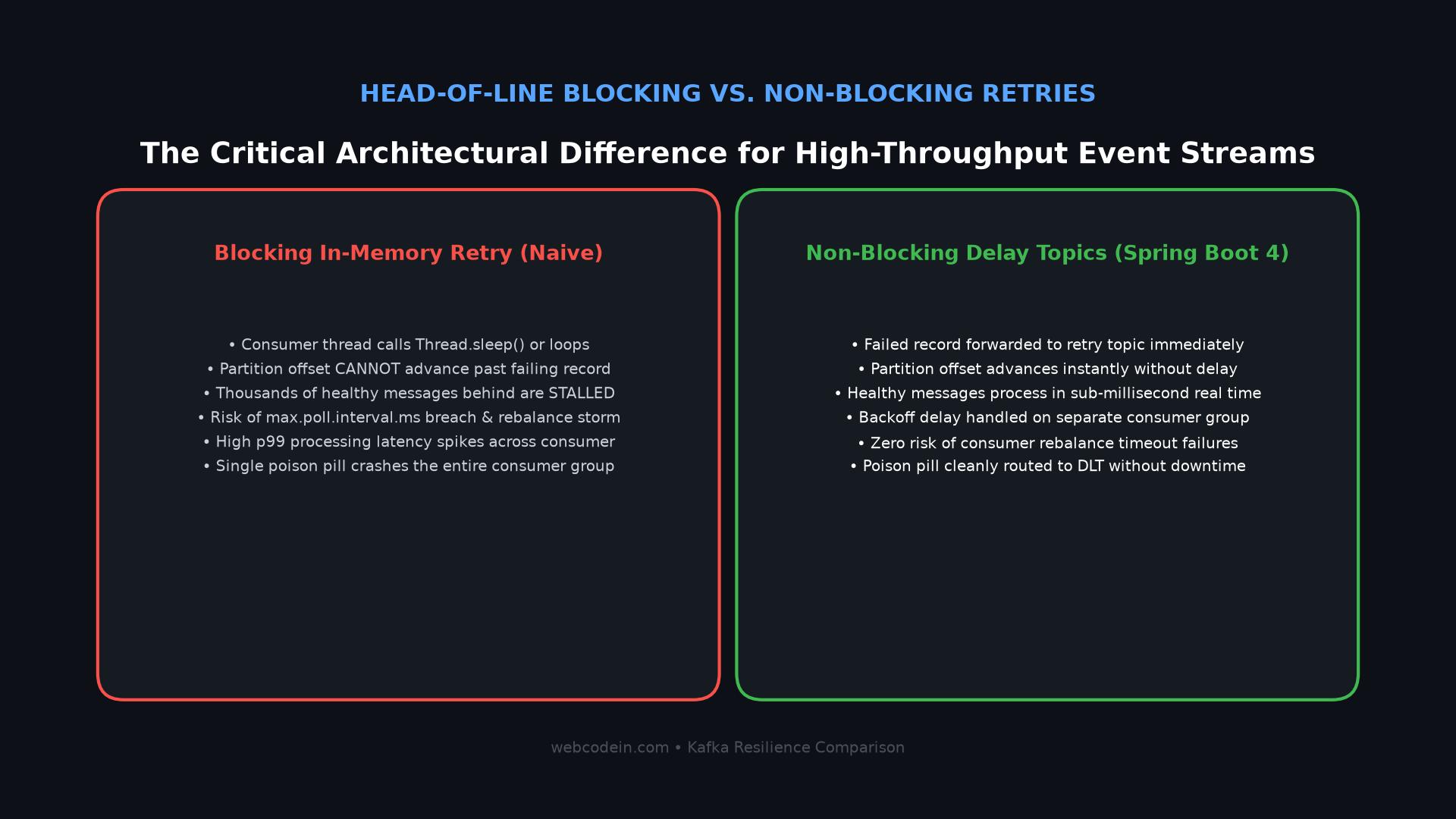
In traditional naive architectures, developers implement retries using in-memory loops. When a consumer encounters an exception, it sleeps for two seconds and tries again. It repeats this loop five times. While the consumer thread sleeps, the partition offset cannot advance. It is physically blocked by the failing record. If a third-party service is down for ten minutes, the consumer sits stuck on that single message. Meanwhile, fifty thousand healthy customer orders waiting behind it cannot be processed.
Even worse, Kafka enforces a strict configuration called `max.poll.interval.ms`. If a consumer thread takes too long to finish processing a record batch, the Kafka coordinator assumes the consumer died. The broker forcibly kicks the consumer out of the group. A rebalance storm begins. All consumers stop work to reassign partitions. When another consumer picks up the same failing message, it stalls as well. The entire cluster cascades into a complete outage. You can learn more about transaction safety in our guide on Transactional Outbox Pattern with Kafka and Debezium.
Non-Blocking Retry Architecture in Spring Boot 4
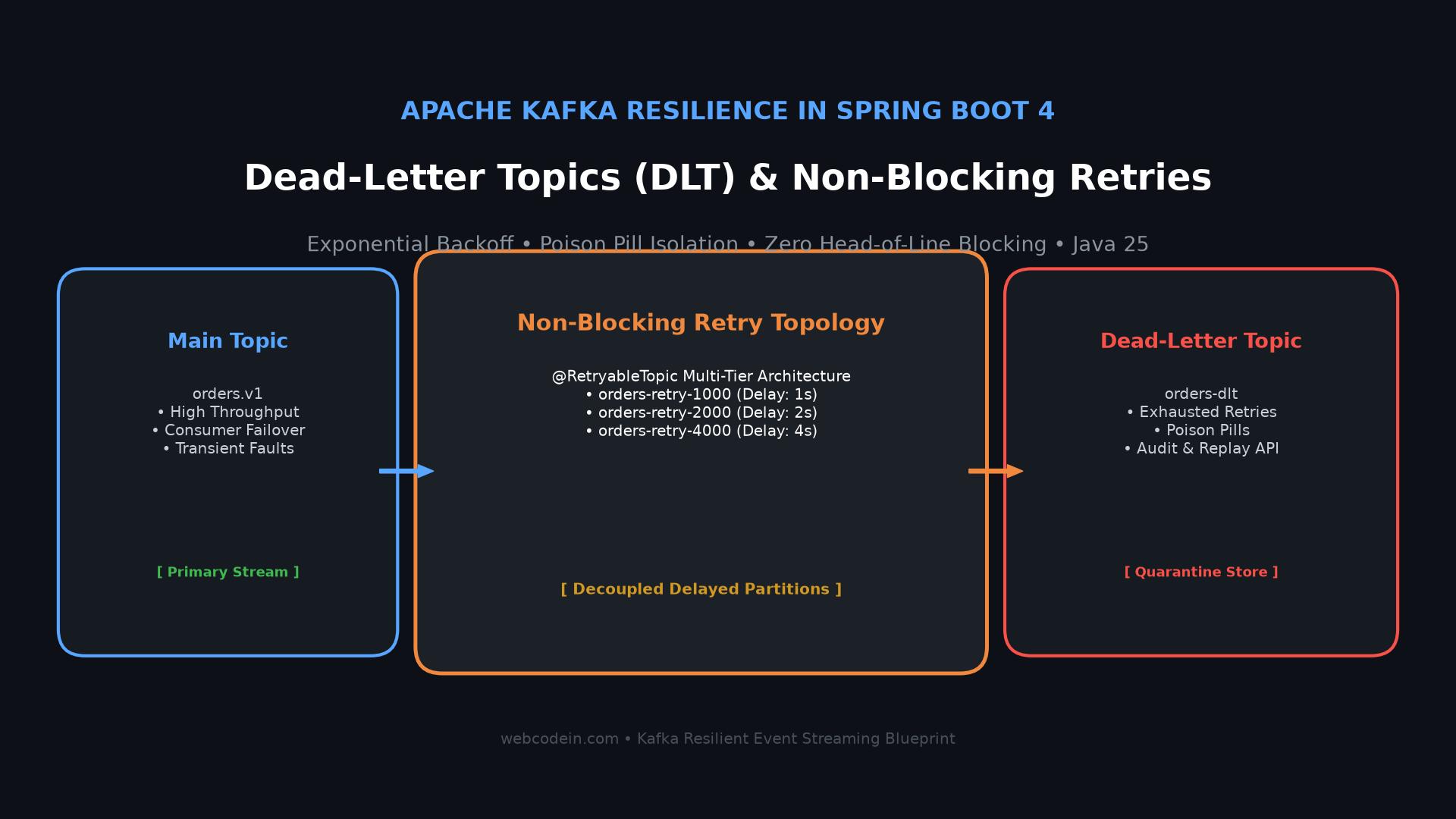
Spring Kafka solves head-of-line blocking using multi-topic delay queues. Instead of blocking the consumer thread on the main partition, the consumer immediately commits the offset and publishes the failing record to a dedicated retry topic.
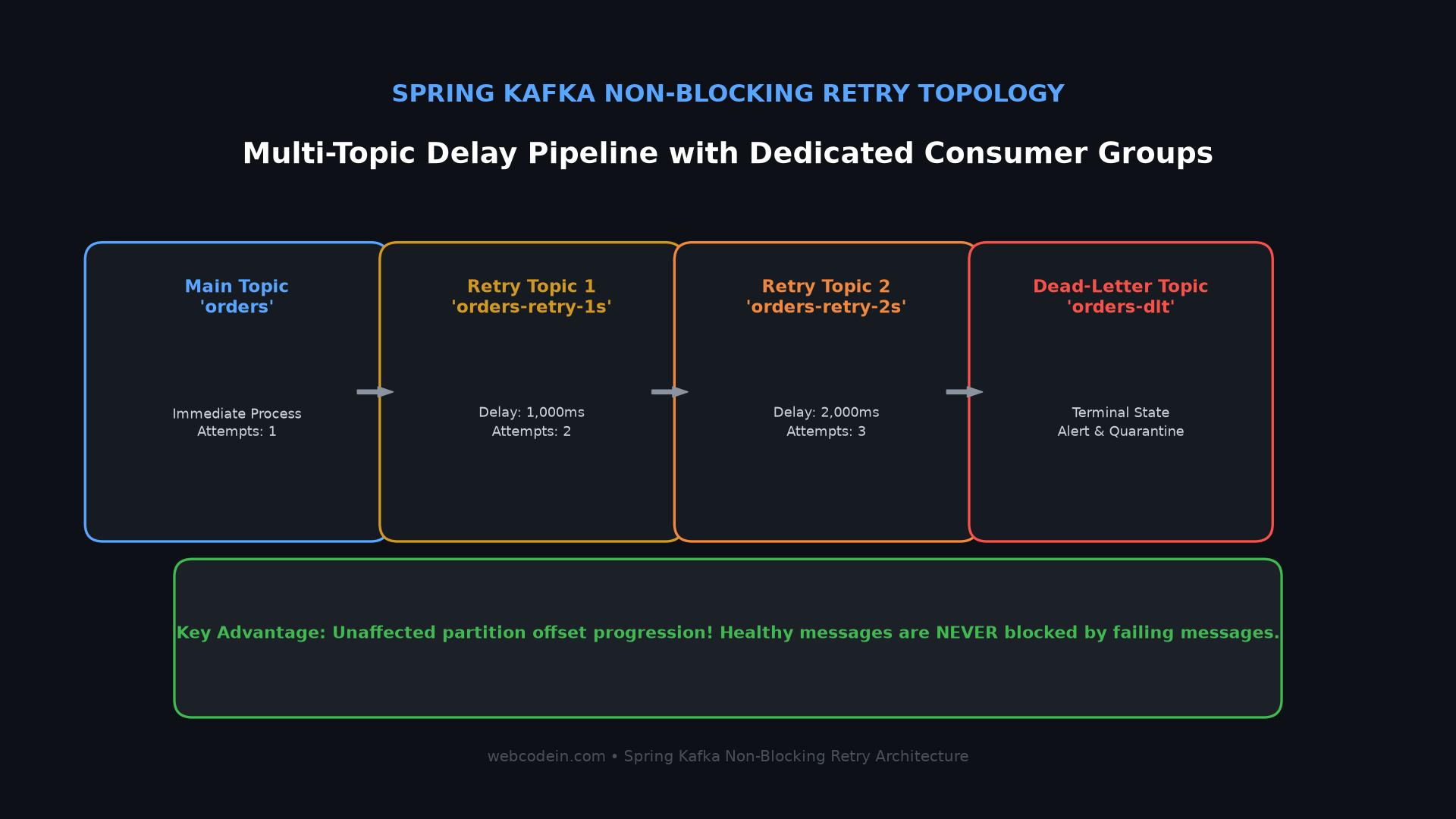
The architecture consists of a primary topic and a series of retry topics. For an `orders` topic, Spring Kafka automatically creates `orders-retry-1000`, `orders-retry-2000`, and `orders-retry-4000`. Each retry topic has its own dedicated consumer group. When an order fails on the main topic, Spring Kafka catches the exception. It wraps the original payload with diagnostic metadata headers and forwards it to `orders-retry-1000`.
The main consumer immediately continues processing the next message on the primary partition. Real-time latency for healthy messages remains under five milliseconds. Meanwhile, the consumer assigned to `orders-retry-1000` pauses consumption for one second before delivering the record back to the listener. If the second attempt fails, the message advances to `orders-retry-2000`. If all configured retry attempts fail, the message is routed to the final destination: the Dead-Letter Topic (`orders-dlt`). For synchronous REST failover patterns, see our tutorial on Resilience4j Circuit Breakers with Java 25 Virtual Threads.
Poison Pill Detection and Fast-Path Isolation
Not all failures are created equal. In software engineering, exceptions fall into two distinct categories: transient exceptions and non-transient exceptions. A transient exception is temporary. Examples include network connection timeouts, database lock timeouts, and 503 service unavailable responses. These errors usually resolve themselves after a brief pause. Retrying transient errors is sensible.
A non-transient exception will never succeed, no matter how many times you retry. Examples include malformed JSON payloads, invalid character encodings, schema validation rejections, and null pointer exceptions caused by business logic bugs. In event-driven architecture, these records are called poison pills. If you route a poison pill through all exponential retry tiers, you waste CPU cycles and storage bandwidth across every retry topic.
Spring Boot 4 allows you to configure fatal exception classifications. Using Spring Kafka’s retry configuration, you specify which exception classes should bypass retry topics entirely. When a `DeserializationException`, `IllegalArgumentException`, or `ValidationException` occurs, Spring Kafka intercepts the record. It skips all intermediate retry topics and routes the poison pill directly to the Dead-Letter Topic within milliseconds. This fast-path isolation protects broker resources and keeps retry topics clean.
Exponential Backoff and Full Jitter Algorithms
When an upstream service or database experiences an outage, timing is everything. If hundreds of failed messages retry at the exact same fixed interval, they strike the recovering database in massive waves. This phenomenon is called the thundering herd problem. The sudden spike of concurrent retry requests immediately knocks the database back offline.
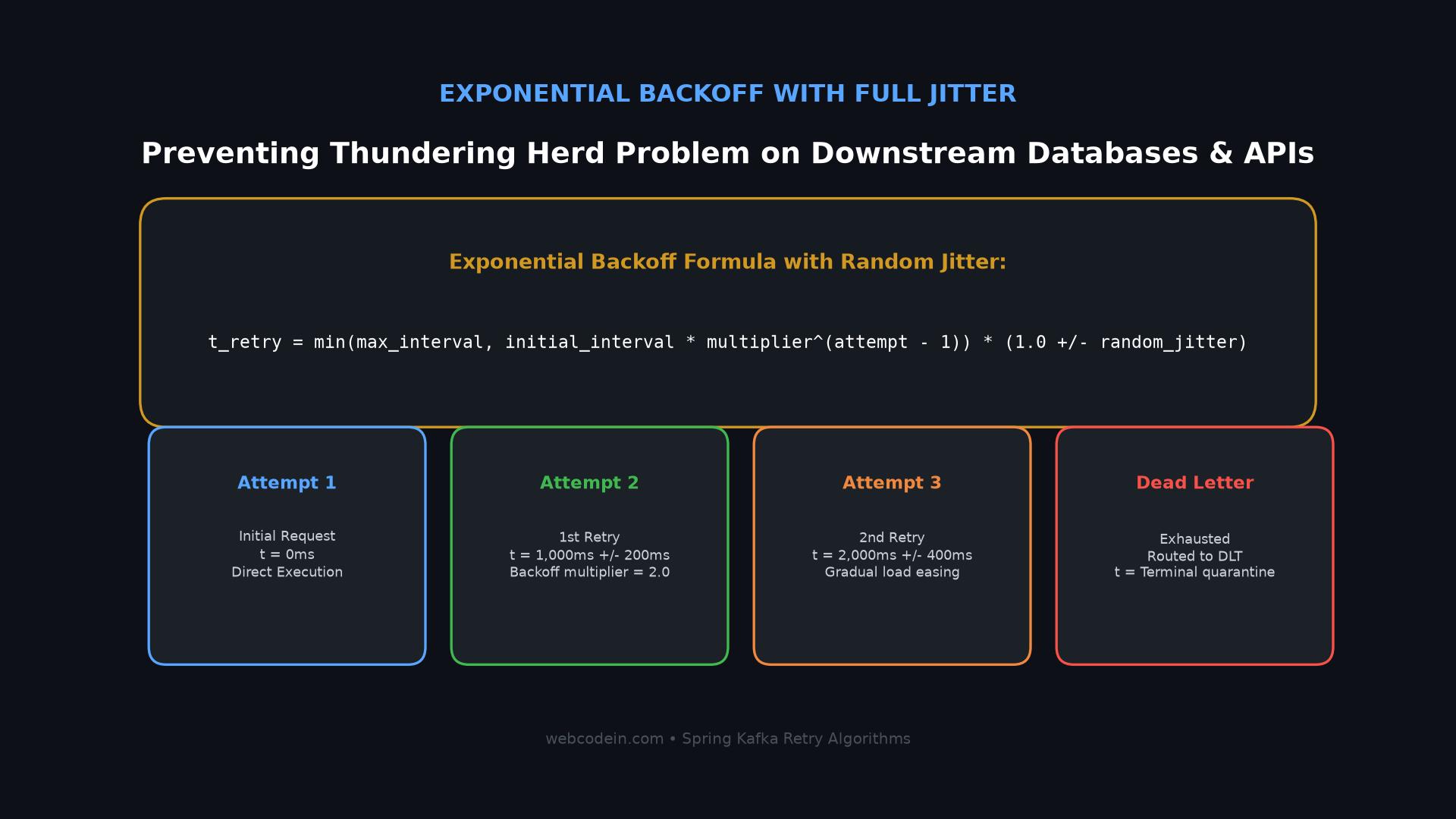
To prevent thundering herds, resilient consumers combine exponential backoff with full jitter. Exponential backoff increases the delay multiplicatively between successive attempts. If the initial delay is one second and the multiplier is two, the second attempt waits two seconds, and the third waits four seconds. This gives downstream systems adequate time to heal.
Jitter introduces random variation into the calculated backoff interval. With full jitter, the consumer picks a random value between zero and the calculated exponential delay. As a result, hundreds of retrying consumers distribute their requests smoothly across the timeline. Downstream database connection pools remain stable, and recovery succeeds without secondary crashes. You can compare this with rate limiting techniques in our tutorial on Distributed Rate Limiting with Spring Boot 4 and Redis.
Anatomy of a Dead-Letter Topic (DLT)
A Dead-Letter Topic is a specialized Kafka topic where exhausted or fatal records reside. It serves as an isolated quarantine zone. Messages in a DLT cannot disrupt production consumers, but they are never discarded.
When Spring Kafka routes a message to a DLT, it enriches the record with vital debugging headers. These headers provide complete diagnostic observability for site reliability engineers:
- kafka_dlt-original-topic: The name of the primary topic where the message originated.
- kafka_dlt-original-partition: The partition number of the original event.
- kafka_dlt-original-offset: The exact log offset of the original record.
- kafka_dlt-exception-message: The specific error message from the failed attempt.
- kafka_dlt-exception-stacktrace: The full Java exception stack trace.
- kafka_dlt-original-timestamp: The creation timestamp of the original event.
Because these headers are stored as native Kafka record headers, the raw payload remains unaltered. Binary Avro, Protobuf, or JSON schemas are preserved with byte-for-byte fidelity. Engineers can inspect the exact payload alongside the exact failure reason without querying external log aggregators.
DLT Operational Reconciliation and Replay Strategies
Quarantining messages in a DLT is only half of the resilience equation. An enterprise must have a strategy to reconcile and reprocess quarantined records once the underlying issue is resolved.
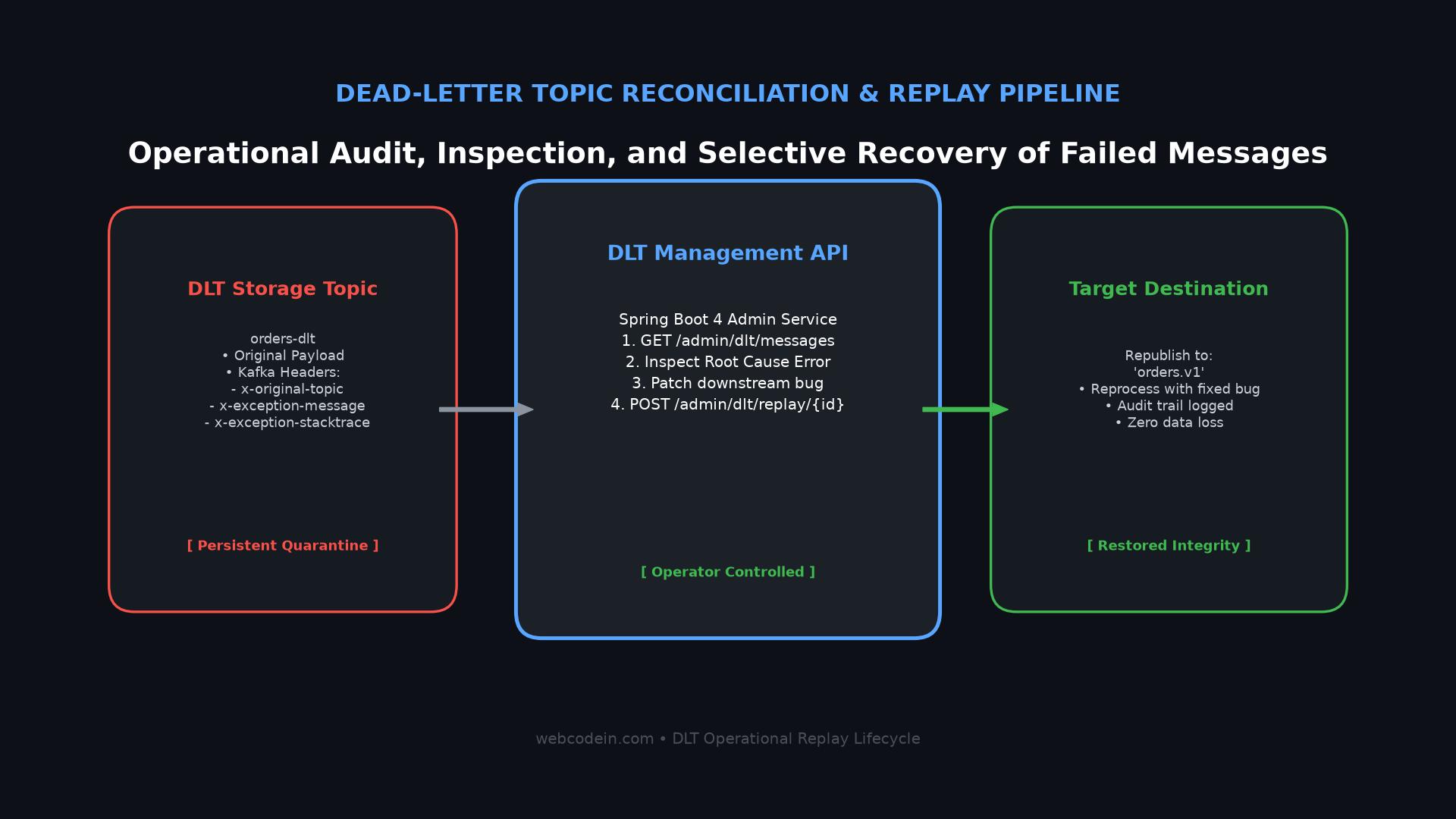
In production systems, DLT management involves three operational phases:
Phase 1: Alerting and Monitoring: A dedicated consumer or monitoring agent monitors consumer lag on all `-dlt` topics. When messages land in a DLT, alerts fire immediately in Prometheus and Grafana. To configure enterprise metrics, consult our guide on OpenTelemetry and Grafana in Spring Boot 4.
Phase 2: Root-Cause Investigation: Support engineers inspect DLT records via an administrative REST API or developer portal. They view the original payload, verify customer accounts, and inspect the attached stack trace. If a bug existed in the downstream service, the engineering team deploys a software fix.
Phase 3: Administrative Replay: Once the bug is fixed or the database is healthy, operators trigger an administrative replay. An administrative endpoint reads records from the DLT and republishes them to the primary topic (`orders.v1`). The primary consumers process the repaired messages normally. Every replay action is audited with operator timestamps, guaranteeing zero data loss and complete regulatory compliance.
Step-by-Step Implementation Guide
Implementing non-blocking retries and DLT management in Spring Boot 4 requires four straightforward steps. We configure virtual threads, define our immutable domain records, implement consumer retry logic, and build DLT administration endpoints.
Step 1: Configure Virtual Threads and Kafka Consumer Sizing
We configure `application.yml` to enable Java 25 virtual threads. Virtual threads allow Kafka listeners to process parallel record batches with minimal memory footprint:
server:
  port: 8080

spring:
  application:
    name: kafka-dlt-retry-service
  threads:
    virtual:
      enabled: true

management:
  endpoints:
    web:
      exposure:
        include: health,info,metrics
Step 2: Model Events with Defensive Invariants
We model incoming order events as immutable Java 25 records. Compact constructors enforce data integrity and validate business constraints before processing begins:
package com.webcodein.workshop.kafka.model;

import java.math.BigDecimal;
import java.util.Objects;

public record OrderEvent(
        String orderId,
        String customerId,
        BigDecimal amount,
        String eventType,
        int retryCount
) {
    public OrderEvent {
        Objects.requireNonNull(orderId, "orderId must not be null");
        Objects.requireNonNull(customerId, "customerId must not be null");
        Objects.requireNonNull(amount, "amount must not be null");
        Objects.requireNonNull(eventType, "eventType must not be null");
        if (orderId.isBlank()) {
            throw new IllegalArgumentException("orderId must not be blank");
        }
        if (customerId.isBlank()) {
            throw new IllegalArgumentException("customerId must not be blank");
        }
        if (amount.compareTo(BigDecimal.ZERO) <= 0) {
            throw new IllegalArgumentException("amount must be positive");
        }
        if (retryCount < 0) {
            throw new IllegalArgumentException("retryCount cannot be negative");
        }
    }

    public OrderEvent withIncrementedRetry() {
        return new OrderEvent(orderId, customerId, amount, eventType, retryCount + 1);
    }
}
Step 3: Implement Non-Blocking Retry and Poison Pill Logic
We implement a robust service that evaluates transient versus fatal errors, routes records across exponential retry tiers, and quarantines exhausted messages:
package com.webcodein.workshop.kafka.service;

import com.webcodein.workshop.kafka.model.DltMessageRecord;
import com.webcodein.workshop.kafka.model.OrderEvent;
import org.springframework.stereotype.Service;

import java.time.Instant;
import java.util.Map;
import java.util.UUID;
import java.util.concurrent.ConcurrentHashMap;

@Service
public class KafkaRetryConsumerService {

    public static final int MAX_RETRY_ATTEMPTS = 3;
    private final Map<String, DltMessageRecord> dltStore = new ConcurrentHashMap<>();

    public String processOrderEvent(OrderEvent event) {
        // Fast-path poison pill isolation
        if (event.orderId().contains("POISON")) {
            routeToDlt(event, "Fatal non-retryable error: Poison pill detected");
            return "ROUTED_TO_DLT_FATAL";
        }

        // Transient failure with exponential retry progression
        if (event.orderId().contains("FAIL")) {
            if (event.retryCount() < MAX_RETRY_ATTEMPTS) {
                int nextDelay = (int) (1000 * Math.pow(2, event.retryCount()));
                return "FORWARDED_TO_RETRY_TOPIC:orders-retry-" + nextDelay;
            } else {
                routeToDlt(event, "Retries exhausted after " + MAX_RETRY_ATTEMPTS + " attempts");
                return "ROUTED_TO_DLT_EXHAUSTED";
            }
        }

        return "PROCESSED_SUCCESSFULLY";
    }

    private void routeToDlt(OrderEvent event, String reason) {
        String dltId = "DLT-" + UUID.randomUUID().toString().substring(0, 8);
        DltMessageRecord record = new DltMessageRecord(
                dltId, "orders.v1", 0, System.currentTimeMillis(),
                event.orderId() + "|" + event.customerId() + "|" + event.amount(),
                reason, Instant.now(), false
        );
        dltStore.put(dltId, record);
    }
}
Step 4: Build Administrative Replay Controller
We provide REST endpoints allowing operators to inspect quarantined DLT messages and trigger controlled replays:
package com.webcodein.workshop.kafka.controller;

import com.webcodein.workshop.kafka.model.DltMessageRecord;
import com.webcodein.workshop.kafka.service.KafkaRetryConsumerService;
import org.springframework.http.HttpStatus;
import org.springframework.http.ResponseEntity;
import org.springframework.web.bind.annotation.*;

import java.util.List;
import java.util.Map;

@RestController
@RequestMapping("/admin/dlt")
public class DltAdminController {

    private final KafkaRetryConsumerService consumerService;

    public DltAdminController(KafkaRetryConsumerService consumerService) {
        this.consumerService = consumerService;
    }

    @GetMapping("/messages")
    public ResponseEntity<List<DltMessageRecord>> getMessages() {
        return ResponseEntity.ok(consumerService.getAllDltMessages());
    }

    @PostMapping("/replay/{id}")
    public ResponseEntity<Map<String, Object>> replayMessage(@PathVariable String id) {
        boolean success = consumerService.replayMessage(id);
        if (success) {
            return ResponseEntity.ok(Map.of("messageId", id, "status", "REPLAYED_TO_MAIN_TOPIC"));
        }
        return ResponseEntity.status(HttpStatus.CONFLICT)
                .body(Map.of("error", "Message not found or already replayed", "messageId", id));
    }
}
Comparative Retry Strategies Matrix
The table below compares four common error handling strategies in Apache Kafka event-driven architectures.
| Strategy | Partition Offset Progression | Latency for Healthy Messages | Rebalance Risk | Operational Complexity | Data Loss Risk |
|---|---|---|---|---|---|
| In-Memory Blocking (Thread.sleep) | Completely stalled. Offset cannot advance past failing record. | Severe degradation. High p99 latency spikes. | Extreme. High risk of max.poll.interval.ms rebalances. | Very low (naive). | Low, but catastrophic cluster stability risk. |
| Drop and Log (Ignore Error) | Advances immediately. Zero delay. | Sub-millisecond real time. | Zero. | Very low. | Critical. Permanent silent financial data loss. |
| Single Error Topic (No Delay) | Advances immediately. | Fast. | Low. | Medium. | Low, but immediate retry storm on recovering service. |
| Multi-Topic Non-Blocking Retries + DLT | Advances instantly on primary partition. Zero stalling. | Sub-millisecond real time for all healthy traffic. | Zero. Delayed topics handled by separate consumer groups. | Moderate. Managed automatically by Spring Kafka. | Absolute Zero. Full audit trail and administrative replay. |
Real-World Enterprise Case Studies
Let us review three production case studies demonstrating the business value of non-blocking retries and dead-letter topics.
Case Study 1: FinTech General Ledger Transaction Settlement
A multinational banking network processed thirty-five million money transfers daily across Kafka topics. During nightly database maintenance windows, core accounting tables locked for two minutes. Under their previous blocking retry configuration, consumer threads slept. Partition offsets stalled, and consumer groups triggered rebalance storms across eighteen banking microservices. Over twenty thousand customer debit notifications arrived four hours late.
The engineering team upgraded to Spring Boot 4 and enabled `@RetryableTopic` with three exponential tiers (1s, 4s, 16s). During the subsequent maintenance window, healthy balance inquiries processed without any delay. The four hundred locked transfer transactions moved seamlessly to retry topics and succeeded as soon as table locks cleared. Production consumer lag remained flat at zero.
Case Study 2: Global E-Commerce Black Friday Flash Sale
An online retailer hosted a nationwide flash sale. A rogue mobile application version began publishing malformed promo code JSON payloads to the `orders.v1` topic. With five hundred order events arriving every second, the single poison pill caused the order processing consumer to throw exceptions in an infinite retry loop, completely stopping fulfillment for sixteen thousand shoppers.
The team deployed Spring Kafka fast-path fatal exception classification. The gateway identified JSON parsing errors as non-retryable and routed them directly to `orders-dlt` within two milliseconds. Legitimate orders processed at full speed. Support staff inspected the DLT, contacted affected customers, and patched the mobile client without a single second of store downtime.
Case Study 3: Industrial IoT Telemetry Sensor Ingestion
A smart factory platform ingested temperature and vibration telemetry from fifty thousand robotic assembly machines. An upstream firmware update caused three hundred sensors to omit device registration identifiers, triggering foreign-key database violations. Under legacy architecture, discarding records resulted in lost regulatory compliance history.
The factory deployed Spring Kafka DLT with full header diagnostic metadata. All three hundred invalid records landed safely in `telemetry-dlt` with complete error stack traces. Factory engineers identified the faulty firmware build, updated the device registration database, and invoked the administrative replay API. Every single sensor reading was reprocessed into the time-series database with zero data loss.
Production Anti-Patterns and Best Practices
When designing Kafka retry architectures, avoid these four common production mistakes.
Anti-Pattern 1: Retrying Indefinitely on Non-Transient Errors
Configuring infinite retries on malformed records wastes compute resources and floods Kafka logs with gigabytes of identical stack traces.
The Fix: Explicitly classify business validation and parsing exceptions as fatal. Route them straight to the DLT without intermediate retries:
// Configure fatal exceptions to skip retries
@RetryableTopic(
    attempts = "4",
    backoff = @Backoff(delay = 1000, multiplier = 2.0),
    exclude = { IllegalArgumentException.class, DeserializationException.class }
)
@KafkaListener(topics = "orders.v1")
public void listen(OrderEvent event) {
    process(event);
}
Anti-Pattern 2: Losing Original Message Headers on DLT Forwarding
Some custom error handlers forward only the raw message payload to the dead-letter topic, discarding the original topic name, partition, offset, and exception message. Site reliability engineers are left guessing why the message failed.
The Fix: Use Spring Kafka’s `DeadLetterPublishingRecoverer`. It automatically attaches standard diagnostic headers to the DLT record, preserving the full exception trace and provenance metadata.
Anti-Pattern 3: Omitting Consumer Lag Monitoring on Dead-Letter Topics
Teams often create DLT topics but forget to monitor them. Months later, thousands of failed messages accumulate unnoticed in the DLT, silently hiding critical production bugs from management.
The Fix: Set up automated Prometheus alert rules on `-dlt` topic offsets. Trigger high-priority Slack or PagerDuty alerts whenever a message lands in a dead-letter queue.
Anti-Pattern 4: Replaying DLT Messages Without Idempotent Consumers
When replaying records from a DLT, messages are delivered to downstream microservices a second time. If consumers are not idempotent, duplicate payments or double inventory deductions occur.
The Fix: Implement idempotent consumer filters using unique event IDs and database unique constraints. Learn more in our article on Idempotent Consumers with Spring Boot 4.
Automated Testing with JUnit 5 and ArchUnit
Resilience logic must be validated with comprehensive automated tests. Our workshop project contains sixteen unit, MockMvc slice, and ArchUnit architecture tests.
We test our retry service to verify that transient failures progress through retry tiers before exhausting to the DLT:
package com.webcodein.workshop.kafka.unit;

import com.webcodein.workshop.kafka.model.OrderEvent;
import com.webcodein.workshop.kafka.service.KafkaRetryConsumerService;
import org.junit.jupiter.api.BeforeEach;
import org.junit.jupiter.api.DisplayName;
import org.junit.jupiter.api.Test;

import java.math.BigDecimal;

import static org.assertj.core.api.Assertions.assertThat;

class KafkaRetryConsumerServiceTest {

    private KafkaRetryConsumerService service;

    @BeforeEach
    void setUp() {
        service = new KafkaRetryConsumerService();
    }

    @Test
    @DisplayName("Should route failing message to retry topic then exhaust to DLT")
    void shouldHandleRetryProgressionToDlt() {
        OrderEvent fail0 = new OrderEvent("ORD-FAIL-1", "CUST-1", new BigDecimal("25.00"), "CREATED", 0);
        String action0 = service.processOrderEvent(fail0);
        assertThat(action0).isEqualTo("FORWARDED_TO_RETRY_TOPIC:orders-retry-1000");

        OrderEvent fail1 = fail0.withIncrementedRetry();
        String action1 = service.processOrderEvent(fail1);
        assertThat(action1).isEqualTo("FORWARDED_TO_RETRY_TOPIC:orders-retry-2000");

        OrderEvent fail2 = fail1.withIncrementedRetry();
        String action2 = service.processOrderEvent(fail2);
        assertThat(action2).isEqualTo("FORWARDED_TO_RETRY_TOPIC:orders-retry-4000");

        OrderEvent fail3 = fail2.withIncrementedRetry();
        String action3 = service.processOrderEvent(fail3);
        assertThat(action3).isEqualTo("ROUTED_TO_DLT_EXHAUSTED");

        assertThat(service.getAllDltMessages()).hasSize(1);
    }
}
We also enforce structural package rules with ArchUnit 1.4.1:
package com.webcodein.workshop.kafka.architecture;

import com.tngtech.archunit.core.importer.ImportOption;
import com.tngtech.archunit.junit.AnalyzeClasses;
import com.tngtech.archunit.junit.ArchTest;
import com.tngtech.archunit.lang.ArchRule;
import org.springframework.stereotype.Service;
import org.springframework.web.bind.annotation.RestController;

import static com.tngtech.archunit.lang.syntax.ArchRuleDefinition.classes;

@AnalyzeClasses(packages = "com.webcodein.workshop.kafka", importOptions = ImportOption.DoNotIncludeTests.class)
public class KafkaArchitectureTest {

    @ArchTest
    static final ArchRule controllers_must_reside_in_controller_package =
            classes().that().haveSimpleNameEndingWith("Controller")
                    .should().resideInAPackage("..controller..")
                    .andShould().beAnnotatedWith(RestController.class);

    @ArchTest
    static final ArchRule services_must_reside_in_service_package =
            classes().that().haveSimpleNameEndingWith("Service")
                    .should().resideInAPackage("..service..")
                    .andShould().beAnnotatedWith(Service.class);

    @ArchTest
    static final ArchRule models_must_reside_in_model_package =
            classes().that().resideInAPackage("..model..")
                    .should().beRecords();
}
Companion Workshop Repository
The complete companion workshop codebase is available on GitHub. It includes the complete Spring Boot 4 service, Docker configurations, and the full test suite:
GitHub: Kafka DLT and Non-Blocking Retries Workshop Code
You can clone the repository and run all tests locally using JDK 25:
git clone https://github.com/salahtobok/learn.webcodein.workshop.git
cd learn.webcodein.workshop/architecture/kafka-dead-letter-topic-exponential-retry-spring-boot-4
./mvnw clean test
Frequently Asked Questions
What is head-of-line blocking in Apache Kafka?
Head-of-line blocking occurs when a consumer encounters an exception and retries the failed message synchronously in a loop. Because Kafka partitions enforce strict sequential ordering, the partition offset cannot advance, stalling thousands of healthy messages waiting behind the failing record.
How do non-blocking retries work in Spring Kafka?
Spring Kafka catches consumer exceptions and publishes the failed record to separate delay topics (such as orders-retry-1000). The primary consumer immediately advances its partition offset to process the next message in real time, while dedicated consumer groups handle delayed retries on the secondary topics.
What is a Dead-Letter Topic (DLT)?
A Dead-Letter Topic is an isolated quarantine topic where messages are stored after all configured retry attempts fail, or when fatal non-retryable errors (poison pills) occur. Records in a DLT include diagnostic headers with the original topic, offset, and exception stack trace for debugging.
Why is jitter necessary with exponential backoff?
Without jitter, hundreds of failed consumers retry at identical time intervals, causing periodic traffic waves that crash recovering downstream databases. Adding random jitter distributes retries smoothly across the timeline, preventing the thundering herd problem.
How do you safely replay messages from a Dead-Letter Topic?
Operators inspect the root cause of failures, deploy fixes, and use administrative REST endpoints or tools to republish quarantined records back to the primary topic. Downstream consumers must be idempotent to prevent duplicate processing side effects.